Back to Articles Image Of The Day

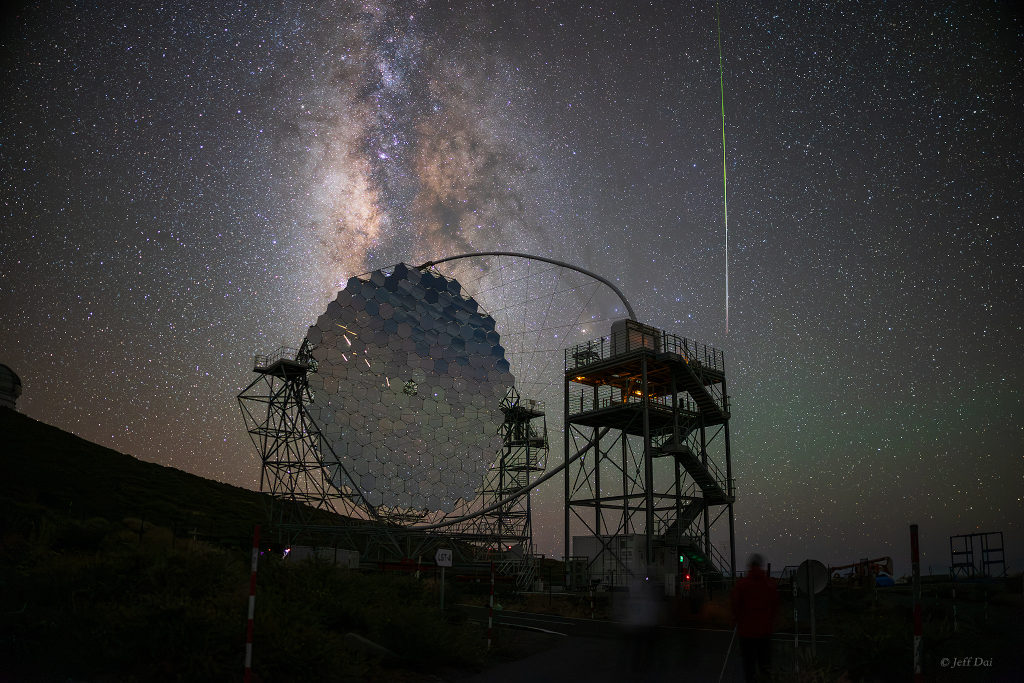
Giant Mirror Catches Meteor's Flash Beside the Milky Way

📖 3 min read 📊 beginner 🏷️ NASA APOD

In Brief

A breathtaking image from the Canary Islands captures a Perseid meteor streaking past the glowing Milky Way, with a massive new telescope mirror reflecting the cosmic flash. This picture not only showcases the beauty of our night sky but also highlights a powerful instrument designed to uncover the universe's most energetic secrets.
Giant Mirror Catches Meteor's Flash Beside the Milky Way

The Full Story

On a clear August night over the Observatorio del Roque de los Muchachos in Spain's Canary Islands, a spectacular celestial event unfolded. A bright Perseid meteor, part of an annual shower, sliced through the dark sky, its colorful trail perfectly framed against the luminous band of our own Milky Way galaxy. The core of our galaxy, with its majestic dust clouds and countless stars, seemed to reach up from the horizon, creating a truly mesmerizing scene. But this wasn't just any night sky photo. In the foreground of this cosmic drama stood a technological marvel: the 23-meter diameter mirror of the prototype Large-Sized Telescope (LST-1). This massive structure, made up of 198 hexagonal mirror segments, isn't your typical stargazing scope. LST-1 is the first of its kind to be built at the northern hemisphere site of the innovative Cherenkov Telescope Array Observatory (CTAO), an international project aiming to build the world's most powerful observatory for very high-energy gamma-ray astronomy. So, what exactly does LST-1 do? It's designed to detect something incredibly subtle and fleeting: extremely brief flashes of visible light in Earth's atmosphere. These flashes, lasting less than a billionth of a second, are triggered by powerful, energetic particles called gamma-rays. Gamma-rays are the highest-energy form of light in the universe, and they come from some of the most violent cosmic events imaginable – think supermassive black holes devouring matter in distant galaxies or massive stars exploding in what are called gamma-ray bursts. When a gamma-ray from a far-off galaxy smashes into Earth's atmosphere, it creates a cascade of other particles, which then emit a faint, blue glow called Cherenkov light. This atmospheric light show is incredibly quick and dim, but LST-1's vast, high-efficiency mirror and super-fast camera are precisely engineered to catch these elusive flickers. The irony of the moment captured in the photo is that some of LST-1's individual mirror segments also perfectly reflected the much brighter, yet equally atmospheric, flash of the passing Perseid meteor, showcasing its incredible light-gathering capability. The LST-1 is a crucial component of the much larger Cherenkov Telescope Array Observatory. When completed, CTAO will consist of dozens of these specialized telescopes spread across two sites (one in the northern hemisphere, one in the south). Together, they will form a network capable of mapping the high-energy universe with unprecedented detail. By studying gamma-rays, scientists can investigate fundamental questions about the origins of cosmic rays, the nature of dark matter, and the extreme physics happening near black holes. This image reminds us that while telescopes like LST-1 are designed for profound scientific discovery, they are also silent witnesses to the everyday beauty of our universe. As LST-1 begins its full operations, it promises to open a new window into the high-energy cosmos, bringing us closer to understanding the most powerful and mysterious phenomena beyond our world.

Key Takeaways

  • 1 A stunning photo captured a Perseid meteor streaking past the Milky Way, with a cutting-edge telescope's mirror reflecting the meteor's flash.
  • 2 The 23-meter LST-1 telescope is designed to detect ultra-brief flashes of light in Earth's atmosphere, triggered by powerful cosmic gamma-rays.
  • 3 This technology helps scientists study the universe's most extreme events, such as exploding stars and active black holes in distant galaxies.
  • 4 LST-1 is a prototype for the Cherenkov Telescope Array Observatory, which aims to create the most detailed map of the high-energy universe.

💡 Think of it this way:

Imagine trying to spot a firefly's fleeting flash from a hundred miles away – that's how brief and distant the light LST-1 is designed to detect can be, revealing events from across the cosmos!

How We Know This

The Large-Sized Telescope (LST-1) is a specialized observatory. It uses a colossal 23-meter diameter mirror, made from 198 individual hexagonal segments, to capture incredibly faint and fast flashes of visible light in the Earth's atmosphere. These flashes, known as Cherenkov light, are produced when high-energy gamma-rays from deep space collide with air molecules, creating a brief cascade of particles that glow for mere billionths of a second. LST-1's advanced camera then records these fleeting light signals, acting as a high-speed cosmic motion detector.

What This Means

The successful operation of LST-1 is a significant step towards the completion of the Cherenkov Telescope Array Observatory (CTAO), which will be the world's most advanced facility for gamma-ray astronomy. By mapping the high-energy universe in unprecedented detail, LST-1 and the full CTAO network will unlock secrets about the most powerful cosmic accelerators, the origins of cosmic rays, and potentially even shed light on the elusive nature of dark matter. This technology promises to revolutionize our understanding of black holes, supernovae, and the fundamental laws of physics under extreme conditions, pushing the boundaries of astrophysics.

Why It Matters

This stunning snapshot helps us appreciate both the beauty of our night sky and the incredible technology scientists are building to understand the most extreme phenomena in the universe, like black holes and exploding stars. It's a peek into how we're pushing the boundaries of discovery.

Related Topics

#Astronomy #Meteor #Milky Way #Gamma-rays #Telescope #CTAO