Omega Centauri: A Mysterious Star Cluster with a Galactic Secret
In Brief
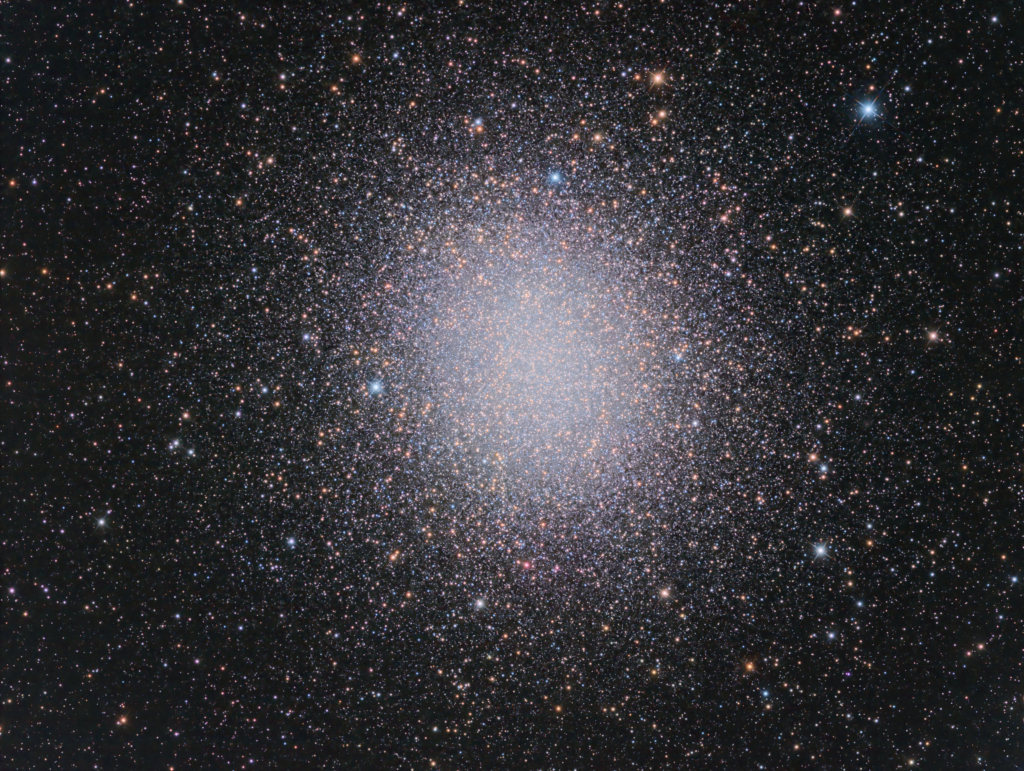
Imagine a bustling city of 10 million ancient stars, all packed together – that's Omega Centauri! This giant star cluster is a cosmic enigma, behaving less like a typical star cluster and more like the leftover heart of another galaxy swallowed by our own. Scientists have also found a massive black hole hiding at its core, adding to its mysterious past.
The Full Story
Key Takeaways
- 1 Omega Centauri is the Milky Way's largest and brightest globular cluster, containing 10 million ancient stars.
- 2 Unlike typical star clusters, it features stars of different ages and chemical compositions, making it a cosmic enigma.
- 3 Scientists believe Omega Centauri is actually the remnant core of a small dwarf galaxy that was absorbed by the Milky Way.
- 4 Evidence from the Hubble Space Telescope points to a massive black hole hidden at its center, supporting the dwarf galaxy hypothesis.
- 5 Studying Omega Centauri provides crucial insights into galaxy mergers, black hole growth, and the evolution of the universe.
💡 Think of it this way:
Think of it like finding an enormous, ancient village that actually turns out to be the downtown core of a much older, lost city, complete with a hidden, powerful artifact at its center.
How We Know This
Astronomers studied Omega Centauri primarily through powerful ground-based telescopes and, critically, the Hubble Space Telescope over two decades. By meticulously observing the light emitted from individual stars within the cluster, they were able to analyze their spectroscopic 'fingerprints.' These fingerprints reveal the stars' ages, chemical makeup, and how they move. The detection of distinct stellar populations with varying ages and compositions was key to understanding its unusual nature. The long-term, high-resolution observations from Hubble also allowed scientists to precisely track the motions of stars near the cluster's center, revealing the tell-tale gravitational influence of a massive, unseen object – the black hole.
What This Means
The ongoing study of Omega Centauri is incredibly significant. It offers a unique natural laboratory to understand how galaxies grow by consuming smaller ones, a process believed to be fundamental to the universe's evolution. This research helps refine our models of galaxy formation, the role of black holes in these mergers, and how our own Milky Way galaxy has evolved over billions of years. It could also guide future searches for similar 'relic' cores of other dwarf galaxies within our galactic halo, piecing together an even more complete picture of the Milky Way's ancient and violent past.
Why It Matters
Understanding Omega Centauri helps us unlock profound secrets about how galaxies merge, how black holes grow, and even how our own Milky Way galaxy came to be the vast home it is today. It's a living fossil that offers a direct window into the violent, transformative history of the universe.