Webb Telescope Uncovers a Stellar 'Treasure Chest' of Young Stars
In Brief
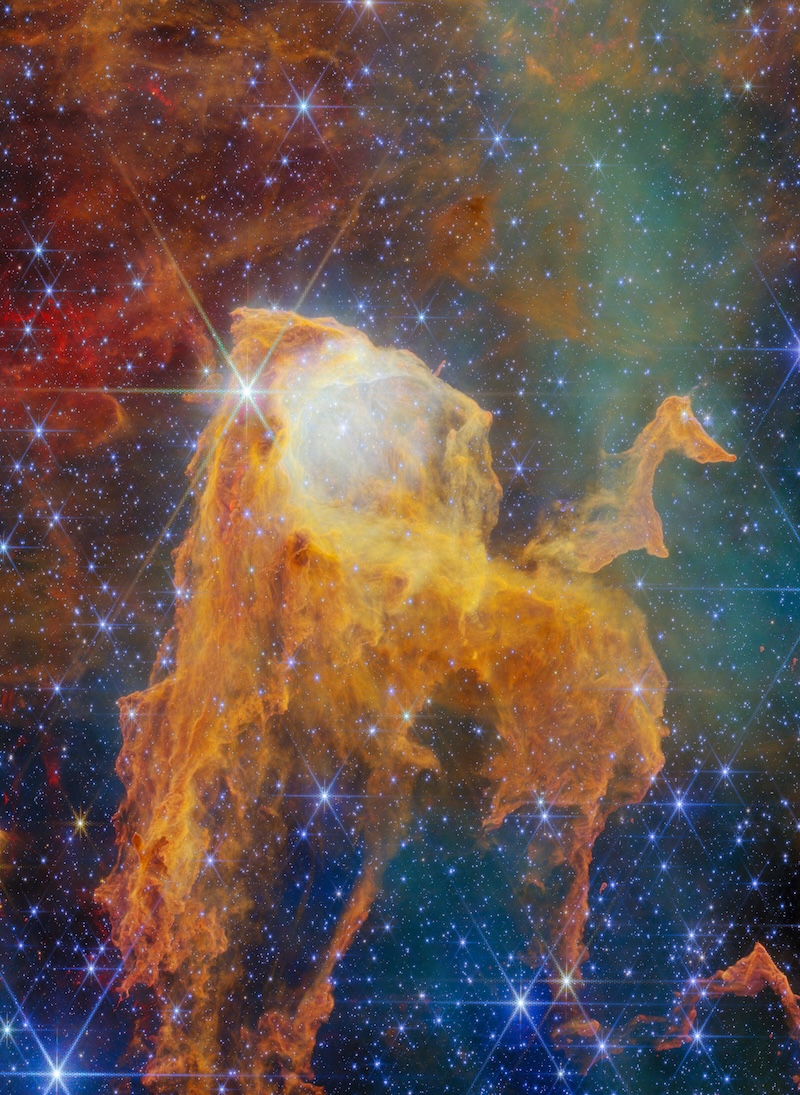
NASA's James Webb Space Telescope has captured a stunning image of a cosmic "treasure chest" in the distant Carina Nebula. This dusty pillar, sculpted by powerful stellar winds, is brimming with a cluster of around 70 newborn stars, some of them incredibly massive and brilliant.
The Full Story
Key Takeaways
- 1 The James Webb Space Telescope imaged a 'treasure chest' of young stars in the Carina Nebula.
- 2 A dusty pillar houses about 70 newborn stars, estimated to be only 1.3 million years old.
- 3 The cluster includes a massive star approximately 19 times the size of our Sun.
- 4 Powerful stellar winds and radiation sculpt these star-forming regions and trigger new star formation.
- 5 This discovery provides crucial insights into how stars are born and evolve in early stellar clusters.
💡 Think of it this way:
Imagine a colossal cloud of cosmic dust and gas, carved into a majestic pillar by powerful winds, that then "cracks open" to reveal a dazzling cluster of freshly formed diamonds and gems—these are the newborn stars, the shimmering jewels in a cosmic treasure chest.
How We Know This
The discovery was made using NASA's James Webb Space Telescope (JWST). Webb is uniquely equipped to make these observations because it primarily sees in infrared light. Young stars are often shrouded by thick clouds of gas and dust that block visible light, making them invisible to optical telescopes. Webb's advanced infrared instruments can pierce through this cosmic dust, revealing the hidden nurseries and the brand-new stars forming within them with unparalleled clarity and detail.
What This Means
Understanding the early life of stars and how they form in clusters is fundamental to all of astronomy. This discovery provides a vivid 'snapshot' of a very young cluster, offering vital clues about the precise conditions necessary for star formation, how massive stars influence their cosmic neighborhood, and the initial environments where planetary systems might eventually begin to form around these nascent stars. Future observations with Webb will likely continue to monitor these dynamic, young clusters, giving astronomers a dynamic, real-time view of star birth and evolution over cosmic timescales.
Why It Matters
This discovery gives us a vivid peek into how stars are born and evolve in bustling cosmic nurseries, helping us understand our own Sun's origins and the incredible diversity of stars across the universe. It's like witnessing the earliest moments of star formation in a truly spectacular way, offering insights into the building blocks of galaxies.