Back to Articles Image Of The Day

Webb Unmasks Hidden Stars and Galactic Collisions in the Black Eye Galaxy

📖 3 min read 📊 beginner 🏷️ NASA APOD

In Brief

The James Webb Space Telescope has peered through the dark dust lane of the famous Black Eye Galaxy (M64), revealing a vibrant hidden nursery of newborn stars. Unlike the Hubble Space Telescope, Webb's infrared vision penetrates the dust, showing us new evidence of a dramatic galactic collision that shaped this unique spiral galaxy.
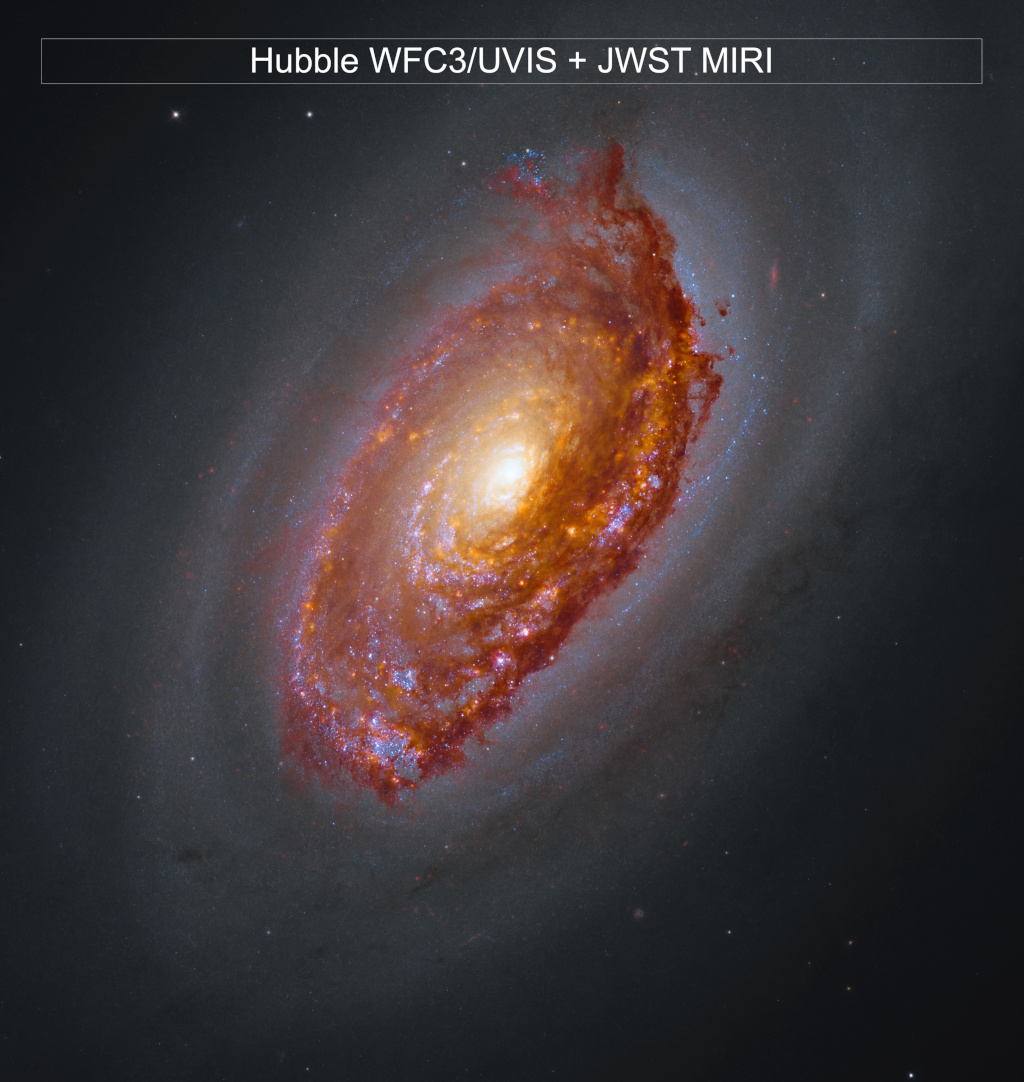
Webb Unmasks Hidden Stars and Galactic Collisions in the Black Eye Galaxy

The Full Story

Messier 64, famously known as the 'Black Eye Galaxy' due to the dramatic dark band of dust obscuring its bright core, has always been a captivating sight for astronomers. While the Hubble Space Telescope gave us stunning visible-light images, that dark dust band remained a mystery, hiding what lay within. Now, the James Webb Space Telescope (JWST) has turned its powerful infrared eyes on M64, offering a brand new perspective. Webb's Mid-InfraRed Instrument (MIRI) acts like a cosmic heat detector. Unlike visible light, which gets blocked by thick clouds of dust, infrared light can pass right through, allowing Webb to see what's hidden. In M64, this means seeing the dust itself in a new light – literally. Webb observes this dust glowing red as it absorbs light from countless surrounding newborn stars and re-emits it as heat. These young stars, which were previously invisible behind the dust, are embedded in dynamic pink star-forming regions, now clearly revealed through Webb's infrared gaze. But M64 isn't just about pretty new stars; it holds a secret about galactic history. Astronomers have long known that the inner and outer regions of M64's gas rotate in opposite directions. This bizarre counter-rotation creates regions of intense pressure where the two 'currents' of gas collide and compress, igniting bursts of star formation. Think of it like two rivers flowing into each other, creating turbulence and rapids. What could cause such a strange phenomenon? The most likely culprit is a past collision or 'merger' between M64 and a smaller galaxy. This dramatic cosmic fender-bender jostled M64, leaving its outer gas swirling in the opposite direction. For a long time, spiral galaxies like M64 (and our own Milky Way) were thought to have relatively calm and uneventful histories. However, M64 was a key piece of evidence that proved spiral galaxies can and do experience violent mergers, fundamentally altering their structure and evolution. Webb's new, detailed view of M64 will provide astronomers with invaluable information about the galaxy's dust – its precise structure, how it moves, and what it's made of. This will add crucial context to M64's merger history and offer deeper insights into how such dramatic events influence a galaxy's overall evolution. It's a reminder that the universe is a dynamic place, full of cosmic drama that shapes the very galaxies we call home.

Key Takeaways

  • 1 Webb's infrared vision pierces through M64's dark dust lane, revealing hidden nurseries of newborn stars.
  • 2 The Black Eye Galaxy has gas regions rotating in opposite directions, sparking intense star formation where they meet.
  • 3 This unusual counter-rotation is strong evidence of a past collision between M64 and a smaller galaxy, changing our understanding of how spiral galaxies evolve.

💡 Think of it this way:

Imagine a beautifully wrapped gift box where the wrapping paper is opaque and dark. The Hubble Space Telescope could admire the wrapping, but couldn't see what was inside. Webb, with its infrared vision, is like an X-ray scanner that can 'see through' the paper, revealing the exciting new toy (newborn stars) and even clues about how the gift was put together (a past galactic collision)!

How We Know This

The discovery was made using the James Webb Space Telescope's Mid-InfraRed Instrument (MIRI). Unlike telescopes that see visible light (like the human eye), MIRI detects infrared light. Infrared light has longer wavelengths, allowing it to pass through dense cosmic dust clouds that would block visible light. By 'seeing' the heat emitted by the dust that has absorbed energy from young stars, MIRI effectively makes the previously hidden regions visible.

What This Means

This detailed view of M64 will significantly enhance our understanding of how galaxies evolve, particularly the role of galactic mergers in triggering star formation and shaping galactic structure. It provides a deeper look into the life cycle of dust and stars within a merging galaxy, offering clues about the Milky Way's own past and future interactions. Ultimately, it helps astronomers build a more complete picture of the universe's dynamic history.

Why It Matters

This discovery helps us understand the dynamic and sometimes violent lives of galaxies, including our own Milky Way. It shows that even seemingly 'peaceful' spiral galaxies can undergo massive collisions, profoundly influencing how stars are born and how galaxies evolve over billions of years.

Related Topics

#Black Eye Galaxy #Webb Telescope #Galaxy Merger #Star Formation #Infrared Astronomy