A Celestial Game of Peek-a-Boo: Moon Hides Venus in Daytime Sky
In Brief
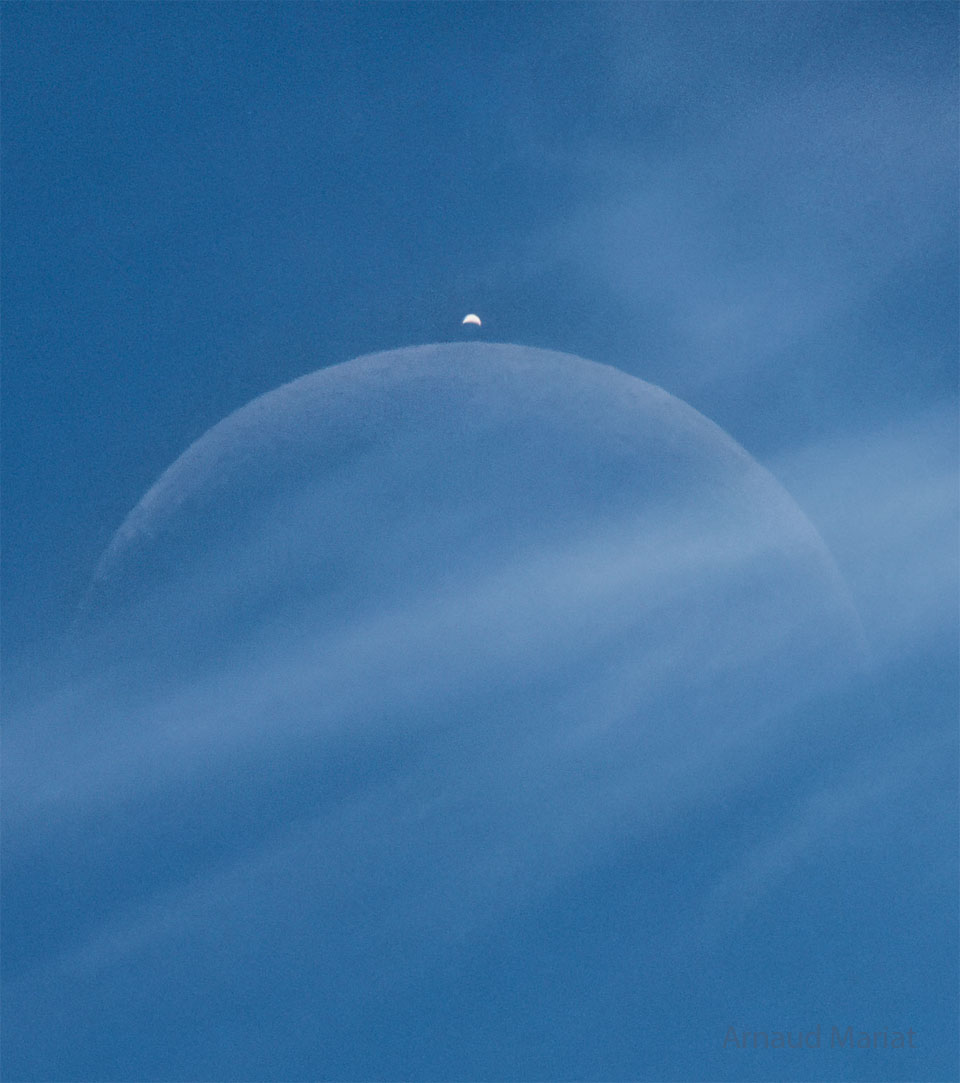
In a rare and captivating event, our Moon performed a celestial 'peek-a-boo' with the planet Venus. During daylight hours, the Moon passed directly in front of Venus, temporarily hiding it from view for observers in a small part of the world. Both celestial bodies appeared as beautiful crescents in the sky.
The Full Story
Key Takeaways
- 1 The Moon passed directly in front of Venus, a celestial event called an occultation.
- 2 Both the Moon and Venus were observed displaying crescent phases.
- 3 Venus appeared brighter than the Moon due to its reflective clouds and closer orbit to the Sun.
- 4 This was a rare daytime event, visible only from a small portion of Earth.
💡 Think of it this way:
Imagine a friend walking across a room, briefly passing in front of a clock on the far wall. For a moment, the clock is hidden. That's essentially what happened in space, but with our Moon 'walking' in front of the much more distant planet Venus.
How We Know This
This incredible event was captured through careful observation and photography. Even with the challenge of daytime visibility and clouds, dedicated sky-watchers and astrophotographers used telescopes and cameras to zoom in and record the Moon's subtle passage in front of the brilliant planet Venus, revealing details like their crescent phases.
What This Means
Observing and documenting rare celestial alignments like this helps astronomers refine our understanding of orbital mechanics and the precise movements of objects in our solar system. More importantly, these events captivate the public, sparking curiosity about astronomy and encouraging more people to look up and appreciate the wonders of the night (and day!) sky. It reminds us that our universe is always putting on a show, if we only take the time to notice.
Why It Matters
This unique spectacle reminds us that our solar system is a dynamic playground, full of surprising and beautiful events, even during the day. It's a fantastic reminder to look up and appreciate the intricate dance of planets and moons above us, sparking wonder and curiosity about the cosmos.