Saturn's South Pole Reveals a Stunning 10-Sided Cloud!
In Brief
NASA's Hubble Space Telescope has spotted a never-before-seen decagonal (10-sided) cloud pattern swirling around Saturn's South Pole. This new geometric wonder joins the famous hexagon at the planet's North Pole, offering a fresh puzzle for scientists studying gas giant atmospheres.
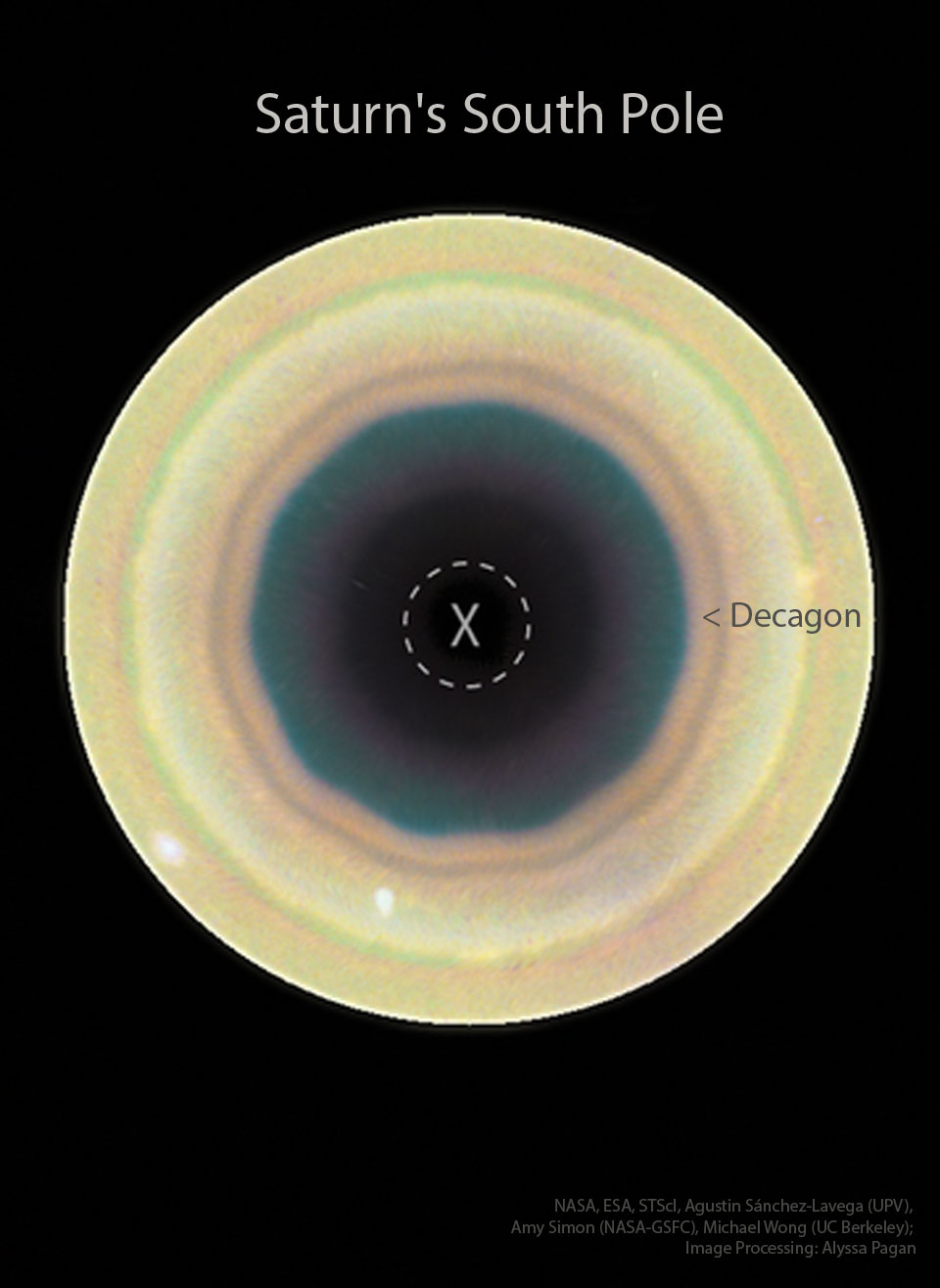
The Full Story
Key Takeaways
- 1 Hubble Space Telescope discovered a 10-sided cloud pattern (decagon) at Saturn's South Pole.
- 2 This new decagon is similar to the long-known 6-sided hexagon at Saturn's North Pole.
- 3 These geometric shapes are likely caused by waves formed where fast and slow atmospheric gases interact.
- 4 The stability of this new decagon will be a key area for future research.
💡 Think of it this way:
Imagine the perfect ripples created by currents in a vast ocean, but instead of being round, these powerful currents in Saturn's atmosphere force the clouds into a giant, perfectly-formed decagonal whirlpool!
How We Know This
The discovery was made using the Hubble Space Telescope, an orbiting observatory that provides long-term, high-resolution views of Saturn. Its sustained observations allow scientists to spot and study detailed atmospheric features like this geometric cloud pattern from Earth's orbit.
What This Means
Scientists will now extensively study the stability and dynamics of the newly discovered southern decagon, comparing it to the long-standing northern hexagon. This research will enhance our understanding of atmospheric circulation, turbulence, and wave phenomena on gas giants, improving models of planetary atmospheres and contributing to the broader study of planet formation and evolution.
Why It Matters
This discovery helps us understand the extreme weather and powerful atmospheric forces at play on distant planets, giving us clues about how gas giants like Saturn behave and evolve, and even the fundamental physics of fluid dynamics that apply across the cosmos.