Hubble Reveals M74: A Celestial Masterpiece of Stars and Dust
In Brief
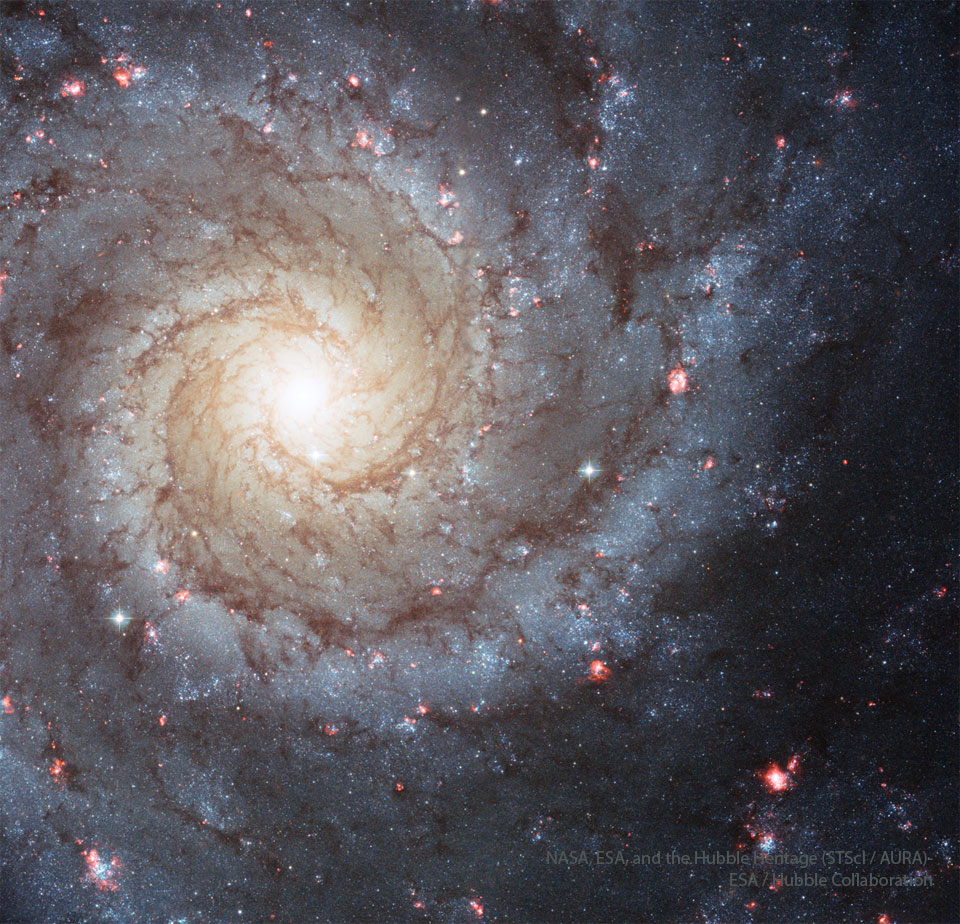
NASA's Hubble Space Telescope has captured a breathtaking face-on view of M74, a stunning 'Grand Design' spiral galaxy located 32 million light-years away. This cosmic portrait reveals its elegant arms, brightly lit by newborn stars and intricately woven with dark lanes of cosmic dust, making it one of the universe's most photogenic objects. It offers a spectacular glimpse into a sprawling 'island universe' containing approximately 100 billion stars.
The Full Story
Key Takeaways
- 1 M74 is a 'Grand Design' spiral galaxy, celebrated for its perfectly formed arms.
- 2 It's an 'island universe' of 100 billion stars, 32 million light-years away in Pisces.
- 3 Hubble Space Telescope's composite image reveals bright blue young stars and dark dust lanes, with reddish glows indicating active star-forming regions.
- 4 Studying M74 helps scientists understand galaxy formation, star birth, and galactic evolution.
💡 Think of it this way:
Imagine peering down at a magnificent, perfectly symmetrical cosmic pinwheel, where each sparkling 'arm' is a highway of billions of stars and glittering nurseries, all frozen in a cosmic dance millions of years ago.
How We Know This
The stunning image of M74 was meticulously assembled from archival data captured by the Hubble Space Telescope. Hubble, positioned in Earth's orbit, avoids atmospheric distortions, allowing for incredibly sharp views. Scientists created a 'composite image' by combining observations taken through different filters, including those sensitive to the light emitted by hydrogen atoms. This technique allowed them to specifically highlight regions where hydrogen gas is glowing due to intense star formation, revealing otherwise hidden details.
What This Means
Continued study of M74 and similar 'Grand Design' galaxies will help refine our models of how spiral arms form and persist over cosmic timescales. Future telescopes, such as the James Webb Space Telescope, could peer even deeper into M74's dusty star-forming regions with its infrared capabilities, revealing even younger, still-forming stars and providing unprecedented details about the earliest stages of stellar birth in other galaxies. This research contributes directly to our understanding of the universe's past, present, and future evolution.
Why It Matters
Studying galaxies like M74 helps us understand how these massive star cities form, grow, and evolve across the cosmos. It provides crucial clues about the life cycle of stars and the structure of our own Milky Way galaxy, offering a deeper appreciation for the incredible beauty and complexity of the universe.