Back to Articles Image Of The Day

Star Trails: How Earth's Silent Spin Paints the Night Sky

📖 3 min read 📊 beginner 🏷️ NASA APOD

In Brief

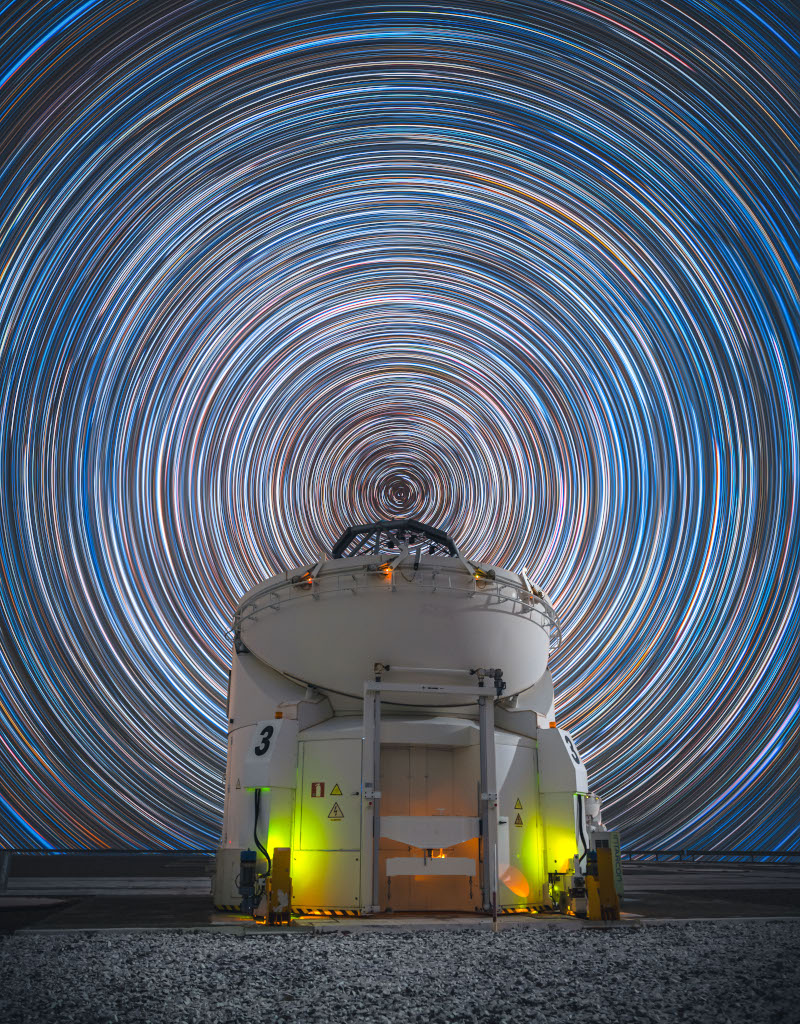
Even though we don't feel it, our planet is constantly spinning at incredible speeds. A stunning new image from Chile's Paranal Observatory captures this invisible motion, revealing Earth's rotation through the beautiful, arcing paths of stars across the night sky.
Star Trails: How Earth's Silent Spin Paints the Night Sky

The Full Story

Imagine standing perfectly still, yet you're hurtling through space at an astonishing speed. That's exactly what's happening to all of us on Earth! At the latitude of ESO's Paranal Observatory in Chile, for example, the ground beneath your feet is zipping eastward at over 1,500 kilometers per hour – faster than the speed of sound at sea level. Even though this motion is completely imperceptible to us, a clever photographic technique called 'star trails' can reveal this incredible cosmic ballet. Star trails are created by taking long-exposure photographs of the night sky with a camera fixed in one place. As Earth rotates, the stars appear to move across the sky, drawing graceful, illuminated arcs. Each arc is essentially a record of a star's apparent path as our planet spins. The longer the exposure, or the more individual exposures stacked together, the longer and more pronounced these beautiful trails become, painting the celestial sphere with streaks of starlight. Looking at these star trail images, you'll notice that the arcs are concentric, meaning they all share a common center. This central point is incredibly significant: it's the south celestial pole. Think of it as the imaginary point in space directly above Earth's South Pole, where our planet's axis of rotation extends outwards. From the Southern Hemisphere, stars appear to revolve around this pole, just as stars in the Northern Hemisphere appear to circle Polaris, the North Star. The featured image is a fantastic example of this phenomenon, composed from a digital stack of 300 consecutive 25-second exposures. This painstaking process allowed astronomers to capture the continuous, arcing motion of the stars as Earth quietly spun beneath them. In the foreground, one of the observatory's impressive 1.8-meter auxiliary telescopes, AT 3, stands as a silent witness, faintly illuminated against the backdrop of our rotating planet, showcasing a perfect blend of natural wonder and human ingenuity.

Key Takeaways

  • 1 Earth rotates at incredible speeds, though we don't feel it directly.
  • 2 Star trails are photographic evidence of Earth's rotation, showing stars as illuminated arcs.
  • 3 The South Celestial Pole is the stationary point in the Southern sky around which all other stars appear to revolve due to Earth's spin.

💡 Think of it this way:

It's like watching a time-lapse video of clouds moving across the sky; you don't feel the wind, but the video clearly shows the clouds' journey across the landscape.

How We Know This

To create this stunning star trail image, astronomers used a standard camera fixed to a tripod at the Paranal Observatory. They captured 300 individual photographs, each with a 25-second exposure, continuously over a period of time. These hundreds of separate images were then digitally combined, or 'stacked,' on top of each other. This stacking process merges the light from each star across all exposures into continuous, arcing lines, revealing the beautiful paths traced by the stars as Earth rotated during the observation period.

What This Means

While star trails themselves aren't new discoveries, they constantly remind us of the fundamental mechanics of our solar system. Understanding Earth's rotation is crucial for everything from setting our clocks and navigating to planning space missions and understanding climate patterns. Images like these help foster a deeper appreciation for the physics governing our planet and inspire curiosity about the cosmos, encouraging us to look up and ponder our place in the vast, dynamic universe.

Why It Matters

This image beautifully illustrates a fundamental principle of our universe: Earth is constantly moving. It helps us visualize our planet's cosmic dance and reminds us of the dynamic nature of our home in space.

Related Topics

#Astronomy #Earth's Rotation #Star Trails #Astrophotography #Paranal Observatory