Back to Articles Image Of The Day

Unveiling Earth's Full Shadow: A 22-Year Cosmic Puzzle Solved

πŸ“– 3 min read πŸ“Š beginner 🏷️ NASA APOD

In Brief

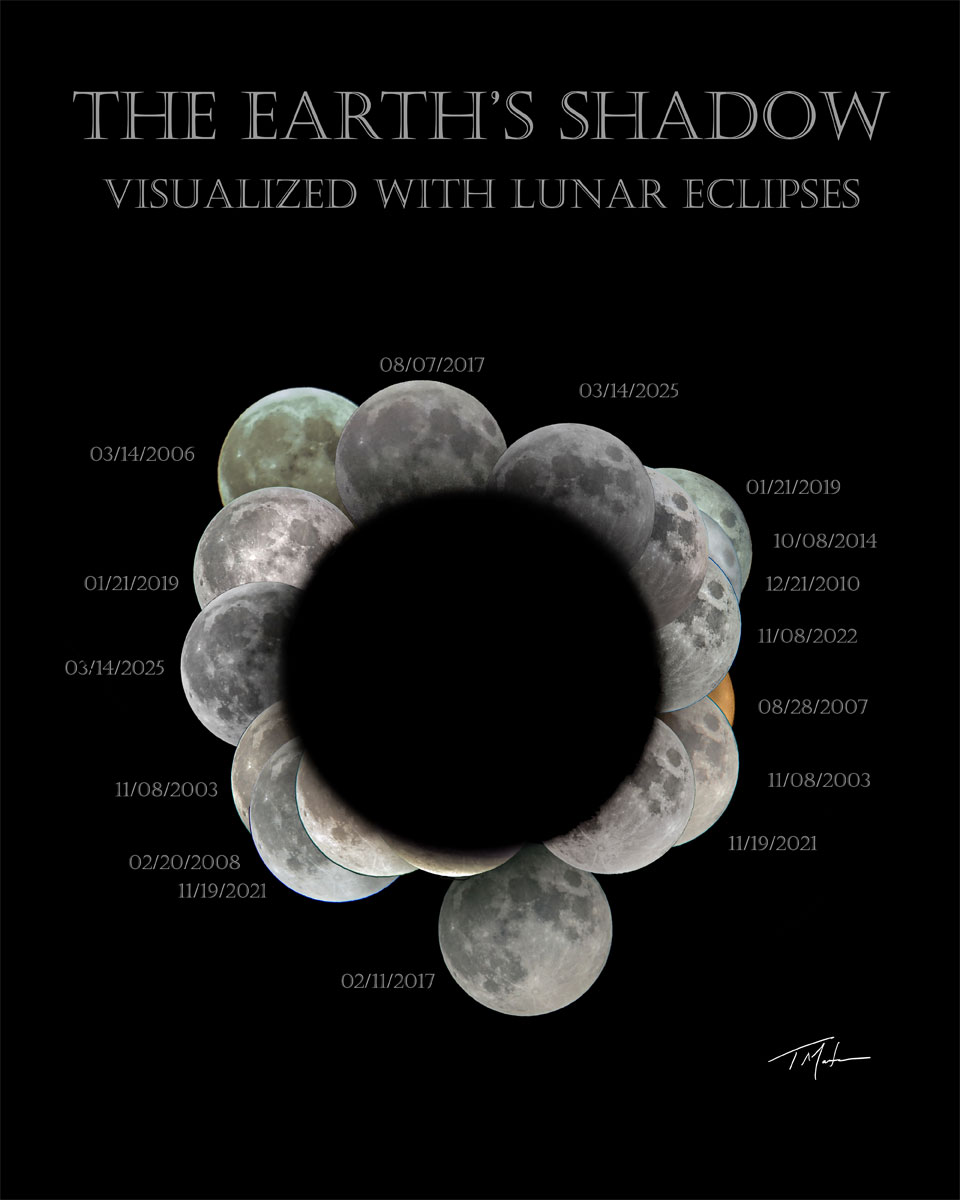
For the first time, an astrophotographer painstakingly combined images from two decades of lunar eclipses to reveal the complete, circular shadow Earth casts into space. This isn't a mysterious 'hole' but a stunning visualization of our planet's immense silhouette against the Moon. It's a testament to long-term observation and modern digital magic.
Unveiling Earth's Full Shadow: A 22-Year Cosmic Puzzle Solved

The Full Story

What appears to be a giant, mysterious void in space isn't an alien phenomenon or a black hole – it's actually our own planet's shadow! When Earth passes directly between the Sun and the Moon, it casts an immense shadow that temporarily darkens the Moon during a lunar eclipse. For centuries, observers like ancient Greek philosopher Aristotle noted that this shadow on the Moon was always curved, offering early clues that our Earth is a sphere, not flat. However, because the Moon is relatively small compared to Earth's shadow, we only ever see a partial arc of this grand cosmic shade during any single eclipse. The real breakthrough in visualizing our planet's complete shadow comes from modern digital technology and the dedication of an astrophotographer. Over an incredible 22 years, this persistent individual captured images from multiple lunar eclipses. By carefully aligning and digitally stitching together all these different 'slices' of Earth's shadow, they managed to reconstruct and showcase the full, perfectly circular silhouette that our planet casts into the void. But if Earth casts such a dramatic shadow, why don't we see a lunar eclipse every month? The answer lies in the subtle tilt of the Moon's orbit. The Moon doesn't orbit Earth in the exact same plane that Earth orbits the Sun. Instead, its path is slightly angled, meaning that for most full moons, it passes either just above or just below Earth's shadow, missing the spectacular show. Look closely at some detailed images of lunar eclipses, and you might spot an even more fascinating detail: a faint, ethereal blue band at the edge of Earth's shadow. This isn't a trick of light; it's our own atmosphere at work! As sunlight filters through Earth's atmosphere on its way to the Moon, our air scatters more of the blue light than the red light. This effect is similar to why our sky appears blue during the day and sunsets often glow with reds and oranges – it’s literally the light of our atmosphere being projected onto the Moon, creating a delicate blue halo around the shadow. This incredible compilation not only confirms what scientists have long understood but makes it visually breathtaking and accessible. It’s a powerful reminder of the predictable and beautiful mechanics governing our solar system. And for those eager to witness this phenomenon firsthand, keep an eye on the sky: a new lunar eclipse is just around the corner, set to be best visible in parts of North and South America, Europe, and Africa. It’s a chance to see a piece of that very same grand shadow with your own eyes!

Key Takeaways

  • 1 Earth's complete circular shadow in space has been visualized by combining 22 years of lunar eclipse images.
  • 2 Ancient observations of the curved shadow on the Moon hinted at Earth's spherical shape.
  • 3 Lunar eclipses don't happen monthly because the Moon's orbit is slightly tilted.
  • 4 A faint blue band sometimes seen during eclipses is caused by Earth's atmosphere filtering sunlight.
  • 5 An upcoming lunar eclipse will offer another chance to witness this cosmic phenomenon.

πŸ’‘ Think of it this way:

Imagine trying to trace the full circle of a basketball's shadow on a wall, but you can only ever see a small curve at a time. This project is like painstakingly collecting hundreds of those partial curves and piecing them together to finally see the entire, perfect circular shadow.

How We Know This

The complete visualization of Earth's shadow was achieved through dedicated astrophotography and modern digital imaging techniques. An astrophotographer spent 22 years capturing images of various partial lunar eclipses. Each eclipse provided a different 'slice' or segment of Earth's shadow on the Moon. By carefully aligning and digitally stitching these numerous individual images together, a full, cohesive picture of the entire circular shadow could be reconstructed, revealing its complete shape stretching out into space.

What This Means

This remarkable project offers a profound visual confirmation of fundamental astronomical principles, making abstract concepts like Earth's spherical shape and celestial mechanics incredibly tangible. It highlights the power of long-term observation and the ability of digital technology to reveal phenomena that were historically only partially glimpsed. For the public, it provides a stunning and engaging way to connect with our place in the solar system, understand the beautiful predictability of cosmic events, and appreciate the 'cosmic ballet' that plays out above us every day.

Why It Matters

This amazing project helps us truly 'see' our planet's cosmic presence and understand basic astronomy in a tangible way. It's a beautiful reminder of Earth's shape, the dance of celestial bodies, and there's even an upcoming lunar eclipse for you to witness a piece of this phenomenon yourself!

Related Topics

#Lunar Eclipse #Earth's Shadow #Astrophotography #Celestial Mechanics #Space Visualization