Back to Articles Image Of The Day

Cosmic Elephant's Trunk: A Stellar Nursery Unveiled

πŸ“– 3 min read πŸ“Š beginner 🏷️ NASA APOD

In Brief

Gaze upon the magnificent Elephant's Trunk Nebula, a vast cosmic cloud in the constellation Cepheus, spanning over 20 light-years. This majestic structure, resembling an elephant's trunk, is not just a beautiful sight but a bustling factory where new stars are actively being born from dense pockets of gas and dust.
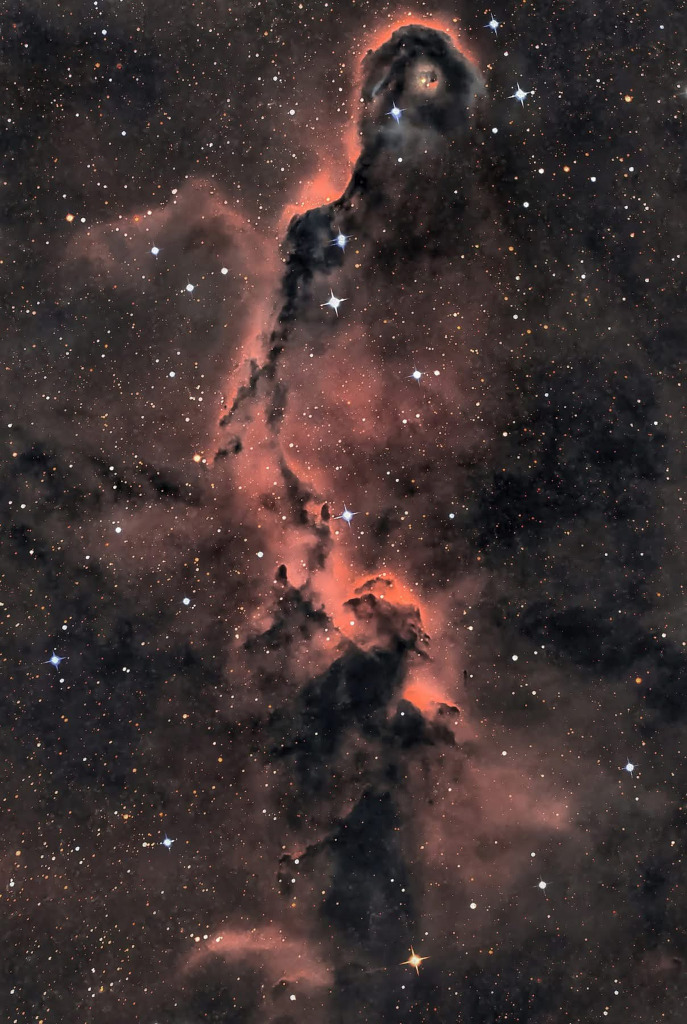
Cosmic Elephant's Trunk: A Stellar Nursery Unveiled

The Full Story

Deep within the high-flying constellation of Cepheus, a truly remarkable cosmic structure gracefully unfurls across the vastness of space: the Elephant's Trunk Nebula. Known scientifically as vdB 142 and part of the much larger IC 1396 complex, this spectacular cloud truly lives up to its name, stretching over 20 light-years long like a gigantic, ghostly proboscis winding through the heavens. But what exactly are we seeing? This isn't just a wispy cloud; it's an 'emission region,' meaning the gas within it is glowing brightly, energized by powerful radiation from nearby young, hot stars. Our powerful telescopic views reveal dazzling, swept-back ridges and deep pockets of cool, dark interstellar dust and gas. These dark areas are crucial – they are denser concentrations of the raw materials, similar to the building blocks that made our own Sun billions of years ago. Within these dark, tendril-shaped clouds lies the true wonder of the Elephant's Trunk. These aren't just shadows; they are cosmic nurseries, meticulously hiding 'protostars' – baby stars still in their earliest stages of formation. Gravity is tirelessly pulling these vast clouds of gas and dust together, compressing them until their cores become hot and dense enough to ignite, eventually bursting into fully-fledged, shining stars. It's a stellar construction zone, constantly humming with the promise of new life. To truly grasp the scale of this cosmic leviathan, consider its immense distance: nearly 3,000 light-years from Earth. While the entire IC 1396 complex spans an impressive 5 degrees across our sky – ten times the width of a full Moon – the Elephant's Trunk itself, from top to bottom, stretches across almost 1 degree, which is roughly twice the angular size of a full Moon. Imagine seeing two full Moons side-by-side in the sky, and you'll have a sense of this nebula's impressive visual footprint. Observing structures like the Elephant's Trunk Nebula with powerful telescopes allows astronomers to witness the intricate dance of gas, dust, and gravity that leads to star formation. This isn't just about beautiful pictures; it's about understanding the fundamental processes that shape our galaxy. By studying these stellar nurseries, scientists gain insights into the lifecycle of stars, how planetary systems might form around them, and the conditions necessary for cosmic creation. Every new detail we observe in regions like the Elephant's Trunk refines our understanding of how stars, including our own Sun, are born and evolve. This knowledge helps us predict what might happen in other star-forming regions across the universe and gives us clues about the ingredients present when new planets begin to take shape. It’s like finding missing pages in the universe’s own instruction manual, helping us better comprehend our cosmic origins and destiny.

Key Takeaways

  • 1 The Elephant's Trunk Nebula is a vast, beautiful cloud resembling an elephant's trunk.
  • 2 It's a 'stellar nursery' where new stars are actively forming from dense gas and dust.
  • 3 Protostars, or baby stars, are hidden within its dark, dense tendrils.
  • 4 The nebula is over 20 light-years long and located about 3,000 light-years away in the constellation Cepheus.
  • 5 Studying it helps us understand star formation and our cosmic origins.

πŸ’‘ Think of it this way:

Imagine a giant celestial clay sculpture, where the sculptor (gravity) is busy molding raw cosmic clay (gas and dust) into brand new, shining stars. Or think of it as a cosmic construction zone, always busy building something magnificent.

How We Know This

Astronomers use powerful telescopes, both on Earth and in space, to capture the faint light and intricate details of nebulae like the Elephant's Trunk. These instruments act like giant cosmic eyes, collecting light from thousands of light-years away to reveal the hidden processes of star birth and the glowing gas of emission regions.

What This Means

Continued study of stellar nurseries like the Elephant's Trunk Nebula will help us refine our models of star formation, predict where new stars and potentially planets might emerge, and ultimately piece together the grand narrative of how the universe builds itself, one star at a time. This impacts our understanding of exoplanet formation and the conditions for life beyond Earth.

Why It Matters

Understanding how stars form helps us piece together the story of our own Sun, our solar system, and ultimately, our place in the universe. It reveals the ongoing cycle of creation and rebirth in the cosmos.

Related Topics

#Nebula #Star Formation #Astronomy #Space #Cosmic Nursery