Back to Articles Image Of The Day

Perseids Dazzle Dark Skies: A Total Eclipse Cleared the View!

📖 3 min read 📊 beginner 🏷️ NASA APOD

In Brief

This year's Perseid meteor shower put on an exceptional display, largely because the Moon was nowhere to be seen in the night sky. Instead, it was busy creating a spectacular total solar eclipse visible from Greenland and Spain, leaving Earth's skies wonderfully dark for optimal meteor viewing.
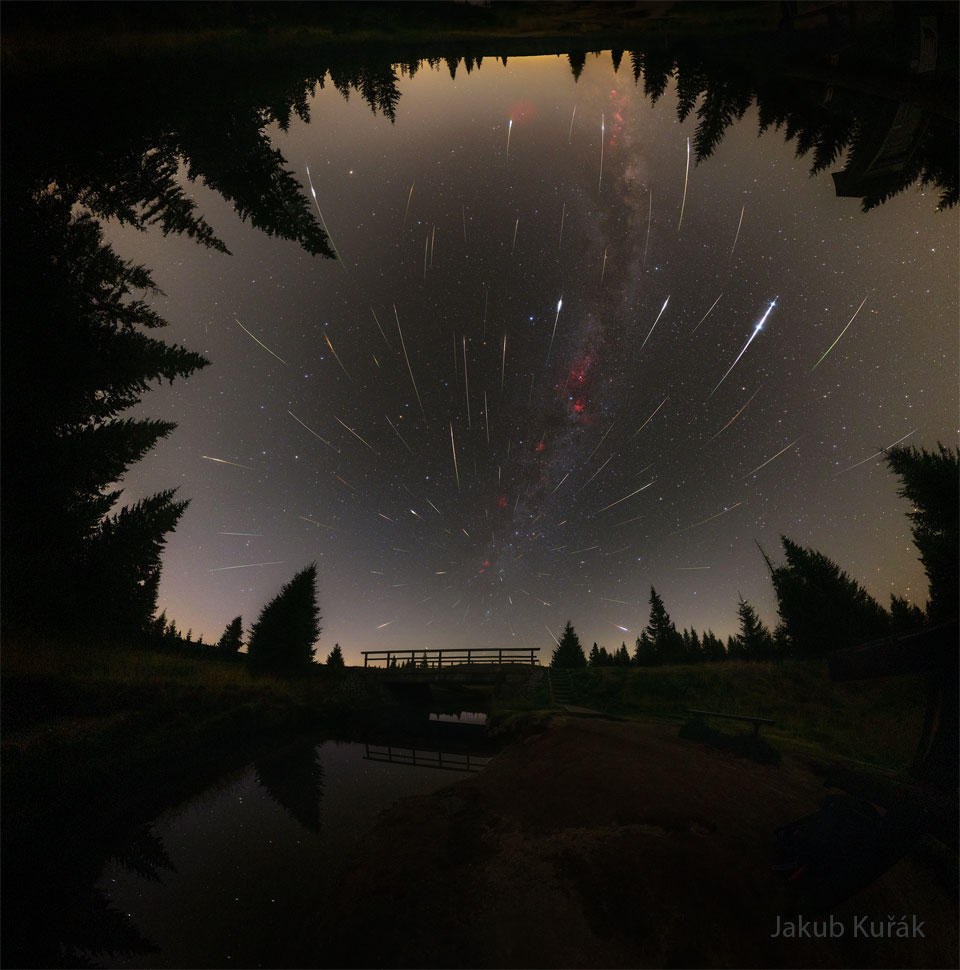
Perseids Dazzle Dark Skies: A Total Eclipse Cleared the View!

The Full Story

The night sky delivered a special treat recently with the annual Perseid meteor shower. While this 'shooting star' display is a highlight every August, the 2026 showing was particularly spectacular. Observers around the world reported an unusually high number of bright meteors streaking across the heavens, creating a truly memorable experience for skygazers. The key to this dazzling performance was an unexpected assist from the Moon. Usually, our lunar neighbor can be quite bright, washing out fainter celestial sights. However, during the Perseids' peak, the Moon was out of sight from Earth's night sky. Why? It was perfectly aligned with the Sun, creating a rare total solar eclipse! While lucky viewers in places like Greenland and Spain witnessed the Moon completely block out the Sun during the day, this alignment meant that for most of the world's night, the Moon wasn't present to dim the meteor show. So, where do these 'shooting stars' come from? The Perseids are actually tiny pieces of cosmic debris shed by Comet Swift-Tuttle. This comet, a magnificent icy traveler, journeys around the Sun, leaving a trail of dust and rock in its wake. Every year, as Earth makes its own orbit around the Sun, we pass through this dusty debris stream, resulting in the Perseid meteor shower. When these small particles – typically no bigger than a grain of sand – slam into Earth's atmosphere at incredibly high speeds, they burn up due to friction, creating the brilliant flashes of light we call meteors. Perseid meteors tend to be exceptionally fast and bright. This is because Comet Swift-Tuttle's debris orbits the Sun in a direction partly opposite to Earth's orbital motion. Imagine two cars heading towards each other; the combined speed of impact is much higher than if one was slowly catching up to the other. This head-on collision creates more dramatic and luminous streaks. From a visual perspective, all the Perseid meteors appear to originate from a single point in the sky, known as the 'radiant.' This radiant is located within the constellation Perseus, which gives the shower its name. The stunning featured image, compiled from multiple nights of observation in Jizerka, Czech Republic, beautifully illustrates how these bright streaks can be traced back to this common origin point, creating a mesmerizing celestial fan across the night sky.

Key Takeaways

  • 1 The 2026 Perseid meteor shower was exceptionally bright and visible.
  • 2 A total solar eclipse removed the Moon from the night sky, creating ideal dark conditions for meteor viewing.
  • 3 Perseids are tiny debris from Comet Swift-Tuttle burning up in Earth's atmosphere.
  • 4 These meteors are fast and bright due to the debris' orbital direction opposing Earth's.
  • 5 All Perseids appear to radiate from the constellation Perseus.

💡 Think of it this way:

Think of it like trying to watch a movie in a dimly lit room versus a completely dark one – the darker the room, the clearer and more vibrant the picture! The Moon's absence was like turning off all the lights for our cosmic show.

How We Know This

The Perseid meteor shower is observed with the simplest and most accessible 'technology' available: our own eyes! Skygazers and amateur astronomers simply find a dark location away from city lights, lie back, and look up. Photographs, like the featured image compilation from Jizerka, Czech Republic, are created by taking long-exposure shots over several nights and digitally stacking or combining them to capture multiple meteor streaks, revealing their radiant point.

What This Means

Understanding meteor showers like the Perseids helps scientists map the paths of comets and track debris in our solar system, offering insights into the formation and evolution of planetary bodies. For the public, these events provide a tangible and awe-inspiring connection to space, fostering a greater appreciation for astronomy. Looking ahead, predicting the conditions for future meteor showers, including the Moon's phase, will continue to help skygazers plan for optimal viewing experiences, ensuring these celestial fireworks remain a cherished annual event.

Why It Matters

This annual celestial event offers a stunning reminder of our planet's journey through space and the captivating dance of cosmic objects, visible even without special equipment. It's a chance for everyone to connect with the vast universe right from their own backyard and appreciate the predictable beauty of our solar system.

Related Topics

#Perseids #Meteor Shower #Comet Swift-Tuttle #Solar Eclipse #Stargazing