Why Spain's Solar Eclipse Glowed Gold: A Sunset Spectacle
In Brief
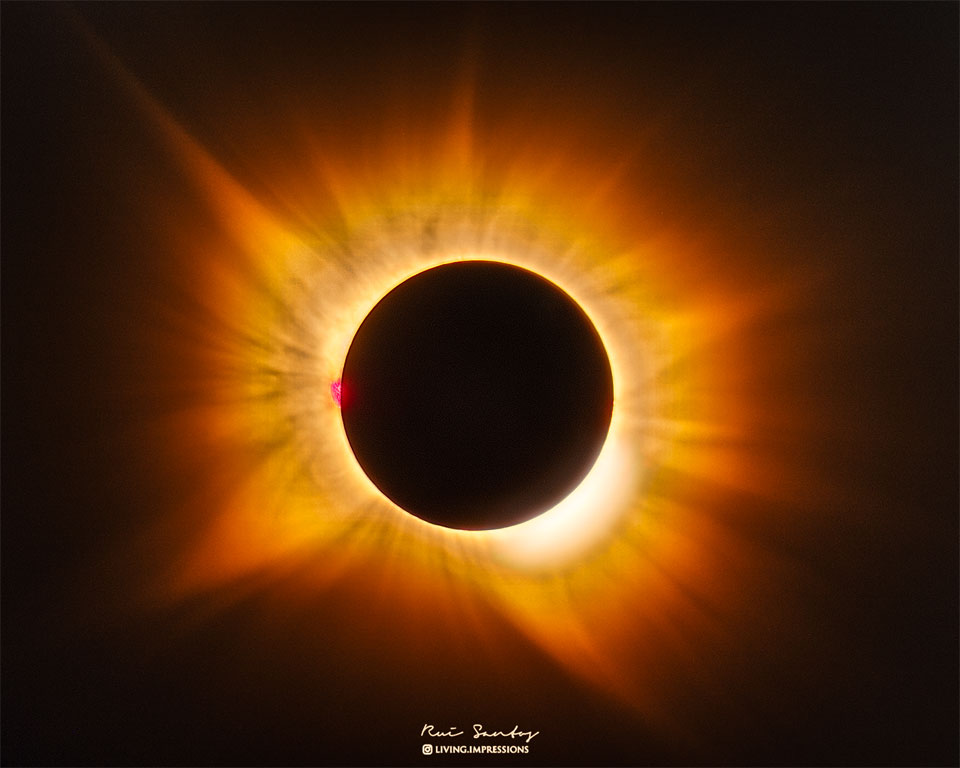
Last week, observers in Spain witnessed a rare total solar eclipse where the Sun's ethereal outer atmosphere, the corona, appeared an unusual and stunning golden hue instead of its typical pearly white. This fiery glow was created by a combination of the setting Sun's low angle in the sky and an added filter of smoke from local forest fires. The golden spectacle offered a unique view, contrasting sharply with a resilient pink prominence that remained unchanged.
The Full Story
Key Takeaways
- 1 The solar eclipse corona in Spain appeared golden instead of its usual white.
- 2 This golden color was caused by the Sun being low on the horizon, scattering blue light.
- 3 Smoke from nearby forest fires acted as an additional filter, intensifying the golden hue.
- 4 A pink hydrogen prominence remained its original color, showing its distinct light emission.
- 5 Local atmospheric conditions can significantly alter the appearance of celestial events.
💡 Think of it this way:
Imagine looking at a sunset through a pair of sunglasses – the sunglasses act like a filter. Now, add a hazy, smoky sky on top of that. The more 'stuff' the sunlight has to pass through, the more the blue light gets scattered away, leaving behind richer oranges, reds, and golds, just like what happened to the eclipse's corona.
How We Know This
The stunning image featured in the news was captured using a technique called HDR-processed, multiple-exposure photography. This method involves taking many photographs at different exposure levels – from very short exposures to capture the bright inner parts of the corona and any prominences, to much longer exposures to reveal the faint outer reaches. These individual images are then meticulously processed and combined to create a single, detailed photograph that accurately represents the vast range of brightness, allowing us to see both the subtle glow of the corona and brighter features like prominences in one incredible shot.
What This Means
This golden eclipse reminds us of the delicate dance between celestial events and our planet's ever-changing atmosphere. It underscores that while the mechanics of an eclipse are predictable, its visual presentation can be profoundly affected by terrestrial factors like the time of day and even air quality. For future eclipse chasers and scientists, it highlights the importance of considering local atmospheric conditions when observing and documenting these breathtaking events, further enriching our understanding and appreciation of their unique beauty.
Why It Matters
This event beautifully illustrates how our own planet's atmosphere and even local conditions, like wildfires, can dramatically transform how we perceive cosmic phenomena. It reminds us that every eclipse is a unique blend of celestial mechanics and terrestrial influences, offering a different visual treat and deepening our appreciation for both space and Earth.