Back to Articles Image Of The Day

Yellowstone's Hot Spring and Our Milky Way: A Tale of Two Wonders

📖 3 min read 📊 beginner 🏷️ NASA APOD

In Brief

A stunning panoramic image captures Yellowstone's vibrant Silex Spring beneath the majestic band of our home galaxy, the Milky Way. While the spring's brilliant colors are created by microbial life thriving in its hot waters, the galaxy overhead shines with billions of distant stars, showcasing both earthly and cosmic marvels.
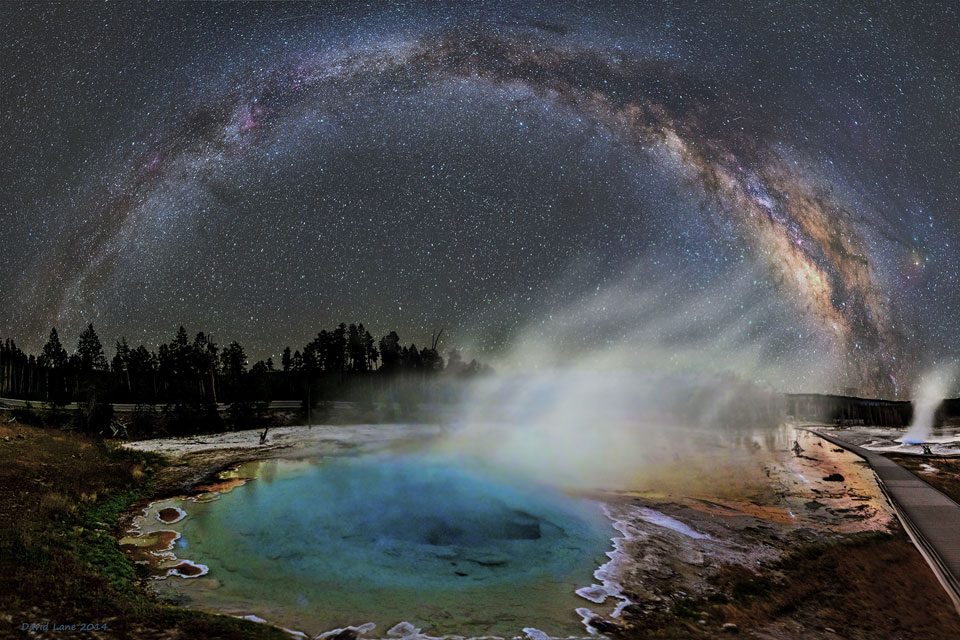
Yellowstone's Hot Spring and Our Milky Way: A Tale of Two Wonders

The Full Story

Imagine looking up into a clear night sky, seeing the breathtaking arc of our home galaxy, the Milky Way, stretching overhead. Now picture that same sky above a steaming, vividly colored pool right here on Earth. That's the extraordinary view captured in a recent panoramic image from Yellowstone National Park, blending two vastly different, yet equally awe-inspiring, natural wonders into a single frame. At the heart of our earthly scene is Silex Spring, a stunning hot spring nestled within Yellowstone National Park in Wyoming, USA. Its vibrant oranges, greens, and yellows aren't reflections of the stars, but rather living tapestries created by billions of tiny bacteria and other microbes. These microscopic communities thrive in the scalding hot water, which is heated by magma – molten rock – churning deep beneath Earth's surface. This powerful underground heat source is part of the famous Yellowstone Hotspot, a geothermal engine driving the park's iconic geysers and springs. High above this terrestrial spectacle, completely independent of the spring's colorful display, arches the majestic central band of our own Milky Way Galaxy. What appears as a shimmering cloudy stream is actually a dense collection of billions of stars, so numerous they blend into a luminous band from our perspective on Earth. Each point of light is a sun, many with their own planets just like ours, all swirling together in this immense cosmic 'island' we call home. While the Milky Way reminds us of the universe's grandeur, the Yellowstone Hotspot beneath Silex Spring holds a different kind of awe-inspiring power. This isn't just any geothermal activity; Yellowstone sits atop a supervolcano. Geologists study this area intensely because roughly 640,000 years ago, a massive eruption reshaped a large part of North America. Though scientists assure us there's no immediate threat, understanding the processes beneath Yellowstone is crucial for predicting its future behavior and potential impact, reminding us of Earth's dynamic and sometimes volatile nature. Capturing both the detailed beauty of Silex Spring and the faint glow of the distant galaxy in a single image is no small feat. This particular photograph isn't a single click, but a masterful 16-image panorama taken in 2014. This technique allows photographers to stitch together multiple shots, creating an incredibly wide and detailed view that captures the full splendor of both the foreground and the night sky, often involving specialized cameras and careful post-processing to bring out the subtle colors and faint starlight.

Key Takeaways

  • 1 A single panoramic image showcases both Yellowstone's colorful Silex Spring and the Milky Way Galaxy overhead.
  • 2 The spring's vivid colors are caused by bacteria thriving in hot water, heated by the Yellowstone supervolcano hotspot.
  • 3 The Milky Way is our home galaxy, a vast collection of billions of stars, completely unrelated to the spring's colors.
  • 4 Yellowstone sits atop a supervolcano, whose past eruptions have significantly impacted North America, making it a key area of geological study.
  • 5 The stunning photo is a composite of 16 individual images, demonstrating advanced astrophotography techniques.

💡 Think of it this way:

Imagine a tiny, colorful, steaming puddle in your backyard reflecting the entire starry sky above you – that's a bit like seeing a vibrant hot spring on Earth beneath the immense, sparkling sweep of our home galaxy.

How We Know This

The stunning image isn't a single snapshot but a carefully crafted "panorama." This means the photographer took 16 separate pictures – some focusing on the vibrant Silex Spring in the foreground, others on the faint glow of the Milky Way in the night sky – and then meticulously stitched them together like a digital quilt. This advanced technique allows for a much wider and more detailed view than a single photograph could capture, especially when trying to balance bright foreground elements with distant, subtle celestial objects.

What This Means

This image serves as a powerful reminder of the interconnectedness of Earth's natural wonders and the vast cosmos we inhabit. It underscores the importance of studying both our planet's dynamic geology, like the powerful Yellowstone supervolcano, and the universe beyond our atmosphere. For us, it means appreciating the fragile beauty and immense forces at play on our home planet, while also gaining a cosmic perspective from the stars, inspiring curiosity and supporting scientific efforts to understand and monitor these incredible phenomena.

Why It Matters

This captivating image reminds us of both the incredible natural beauty and powerful geological forces right here on Earth, like the Yellowstone supervolcano, and the vast, starry universe we're a part of. It offers a grand perspective on our place in the cosmos, highlighting wonders both beneath our feet and light-years away.

Related Topics

#Yellowstone #Milky Way #Astrophotography #Supervolcano #Geology