Back to Articles Image Of The Day

Saturn Crowned Moon King: Nearly 300 Moons Confirmed!

📖 3 min read 📊 beginner 🏷️ NASA APOD

In Brief

Astronomers have confirmed that Saturn is now home to an astonishing 293 moons, far outnumbering any other planet in our solar system. A recent telescopic 'family portrait' beautifully captures six of its largest icy satellites, including the colossal moon Titan. This ever-growing celestial collection cements Saturn's reign as the solar system's ultimate moon collector.
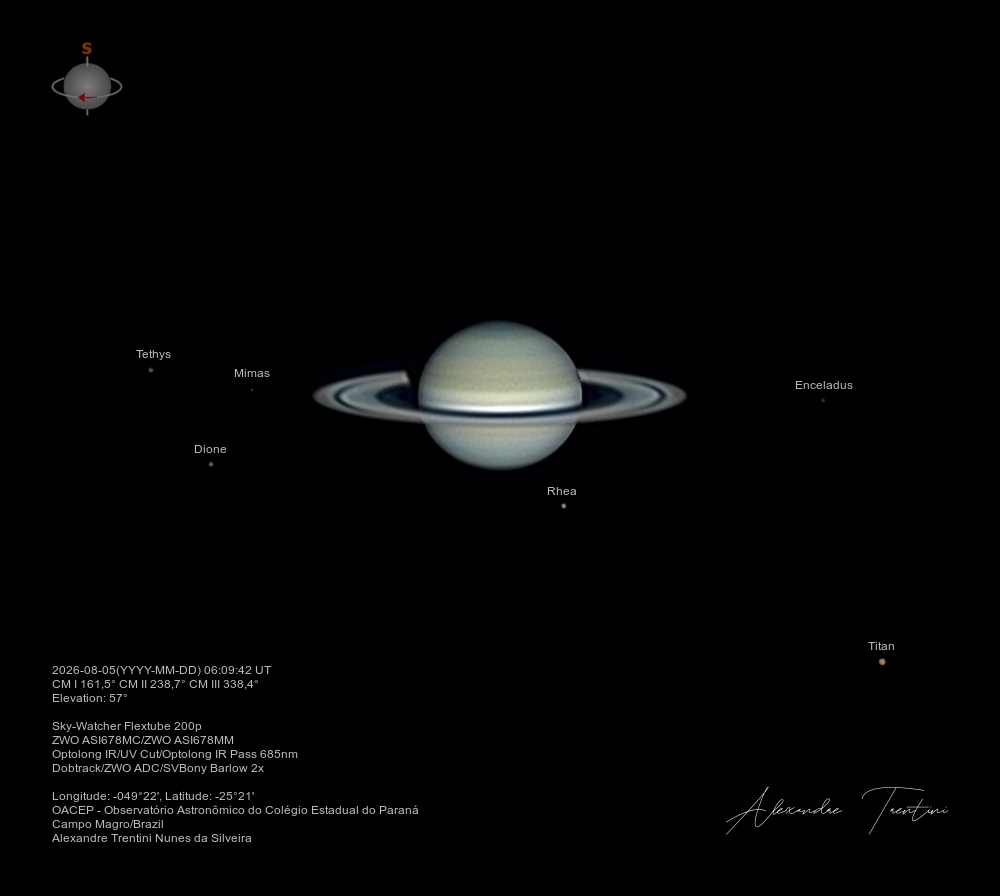
Saturn Crowned Moon King: Nearly 300 Moons Confirmed!

The Full Story

Our solar system has a new reigning champion in the moon department: Saturn! As of June 2026, scientists have officially confirmed an incredible 293 moons orbiting the ringed gas giant. This mind-boggling number easily dwarfs Jupiter's respectable but far smaller count of 115 confirmed moons, making Saturn a truly unique celestial body in our cosmic neighborhood. This isn't just a static number; new moons are continually being discovered and confirmed through dedicated observations. Most of Saturn's known moons are on the smaller side, often just a few kilometers (or even less!) across, and tend to have irregular shapes. These tiny 'cosmic pebbles' are often found in tilted, distant orbits, suggesting they might be captured asteroids or fragments from ancient collisions. However, Saturn also boasts a collection of majestic, spherical moons that are much larger and orbit closer to the planet, some even interacting with its famous rings. A recent stunning 'family portrait' taken on August 5th beautifully captures six of Saturn's most prominent large moons. Featured prominently is Titan, Saturn's largest moon and indeed the second-largest moon in the entire solar system! At 5,150 kilometers in diameter, Titan is even larger than our own Moon and slightly bigger than the planet Mercury. Discovered way back in 1655 by Dutch astronomer Christiaan Huygens, Titan is unique for its thick, nitrogen-rich atmosphere and surface lakes of liquid methane. The image also showcases other icy giants like Mimas, Tethys, Enceladus, Dione, and Rhea, each a fascinating world in its own right. How do we find so many moons? The process involves a combination of powerful ground-based telescopes and intrepid space missions. Early discoveries, like Titan, were made with improving telescopes. Later, robotic explorers like NASA's Voyager probes and the Cassini spacecraft dramatically expanded our knowledge, flying directly past Saturn and its moons, capturing detailed images, and even discovering moons hidden within the rings. Today, advanced telescopic imaging and sophisticated tracking techniques continue to unveil new, faint objects orbiting the planet. This ever-growing family of moons offers more than just bragging rights. Each moon is a frozen archive, preserving clues about the early chaos and formation of our solar system. By studying their compositions, orbits, and interactions, scientists can piece together the cosmic story of how planets and their companions came to be. Furthermore, moons like Titan, with its complex chemistry, and Enceladus, with its subsurface ocean and plumes of water vapor, are prime targets in the search for extraterrestrial life, showing us that habitable environments might exist in unexpected places. The discovery of nearly 300 moons around Saturn underscores the dynamic nature of our solar system and the incredible secrets it still holds. As technology advances, we can expect the count to continue rising, offering endless opportunities to explore these diverse and mysterious mini-worlds, each with its own unique story to tell.

Key Takeaways

  • 1 Saturn holds the record for the most moons in our solar system, with 293 confirmed.
  • 2 Its moons range from tiny, irregular 'pebbles' to the massive, atmosphere-rich Titan, which is larger than Mercury.
  • 3 Discoveries are ongoing, thanks to both powerful ground-based telescopes and historic space missions like Voyager and Cassini.

💡 Think of it this way:

Imagine our solar system as a grand cosmic playground, and Saturn as the ultimate collector of marbles, boasting nearly 300 tiny treasures, while Jupiter, though impressive, only managed to gather about a hundred. Most of Saturn's moons are like little cosmic pebbles, but a few, like Titan, are genuine footballs!

How We Know This

Scientists use powerful ground-based telescopes to meticulously scan the skies around Saturn, looking for faint specks of light that move with the planet. Once a potential moon is spotted, they track its movement over many nights to confirm its orbit, officially classifying it as a moon. Spacecraft like NASA's Voyager and Cassini missions have also been crucial, flying close to Saturn to discover and study many moons up close, providing detailed images and data that ground observations can't achieve.

What This Means

This ongoing discovery process suggests Saturn may hold even more hidden moons, waiting to be found by future observations. Continued study of these diverse worlds offers invaluable insights into the formation and evolution of our entire solar system. For instance, moons like Titan and Enceladus are prime targets for astrobiology, potentially harboring conditions for life. Future missions could explore these unique environments further, helping us understand the potential for life beyond Earth and how planetary systems develop across the cosmos.

Why It Matters

Understanding Saturn's vast moon system gives us crucial clues about how our solar system formed and evolved billions of years ago. Each moon is a miniature world, with some like Titan and Enceladus potentially harboring conditions suitable for life, expanding our knowledge of where life might exist beyond Earth.

Related Topics

#Saturn #Moons #Solar System #Astronomy #Space Exploration