Back to Articles Image Of The Day

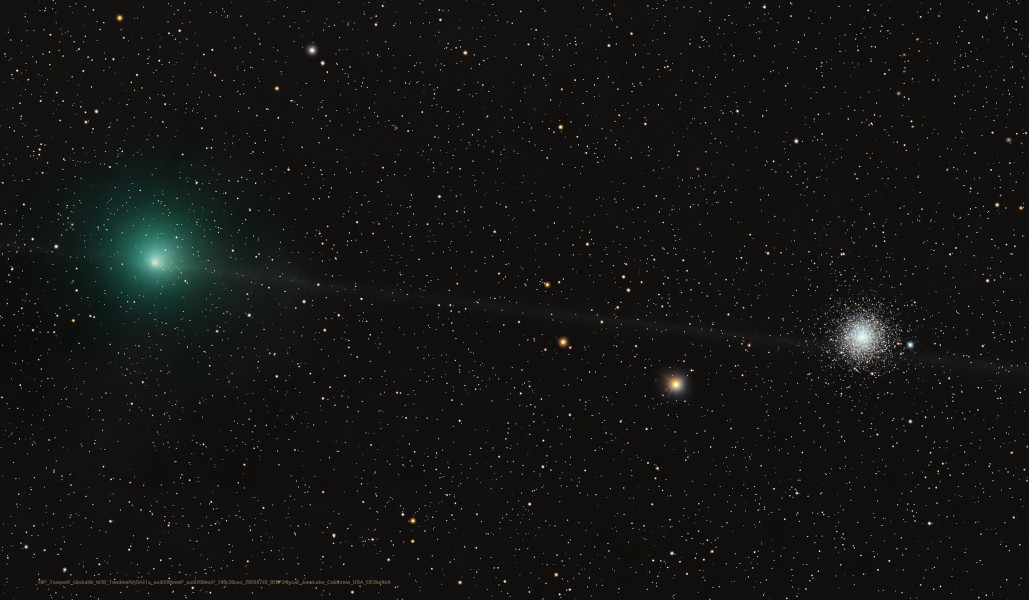
Cosmic Illusion: Comet Appears to Pierce Star Cluster!

📖 3 min read 📊 beginner 🏷️ NASA APOD

In Brief

A stunning new image shows a distant comet seemingly streaking right through the middle of an ancient ball of stars. This incredible 'cosmic illusion' highlights how perspective can play tricks in space, as the two objects are actually separated by mind-boggling distances.
Cosmic Illusion: Comet Appears to Pierce Star Cluster!

The Full Story

Space is full of breathtaking sights, but sometimes, what we see can be a grand illusion. A recent telescopic image perfectly captures such a moment, featuring a comet that appears to be soaring directly through a dense cluster of stars. For a brief period, comet 10P/Tempel 2, a dusty snowball of ice and rock, seemed to 'photobomb' Messier 30 (M30), an ancient globular star cluster, creating a visual spectacle that's both beautiful and misleading. Comet Tempel 2 is a periodic comet, meaning it regularly journeys around the Sun, putting on a show for us every few years. When it was captured in this image on July 29, its faint, greenish glow and narrow dust trail were just 3.5 light-minutes away from Earth. To put that in perspective, light from the comet took only about three and a half minutes to reach the telescope. This makes Tempel 2 a relatively close cosmic neighbor during its visit. Now, let's talk about its 'partner' in the image: Messier 30. This isn't a comet at all, but a magnificent globular star cluster – a spherical collection of hundreds of thousands, even millions, of stars, all tightly packed together and held by gravity. M30 is an ancient resident of our Milky Way galaxy, and it's incredibly far away. While Tempel 2 was a mere 3.5 light-minutes distant, M30 resides a staggering 28,000 light-years away! This vast distance means the 'piercing' effect is purely an alignment from our perspective here on Earth; the comet was never actually near the star cluster. Messier 30 also carries a fascinating historical legacy. It's the 30th entry in the famous catalog created by 18th-century French astronomer Charles Messier. Messier was primarily a comet hunter, but he often encountered other fuzzy, nebulous objects that didn't move against the background stars. To avoid confusing these stationary objects with the comets he sought, he began compiling a list of 'things that are not comets.' His 'Messier Catalogue of Nebulae and Star Clusters' became an invaluable guide for future astronomers, including M30. Even though Messier's telescopes would have shown both Tempel 2 and M30 as similar faint, fuzzy blobs, he would have recognized M30 as a stationary 'non-comet.' Modern telescopes, however, offer us much clearer views, allowing us to appreciate the intricate details of both the comet's diffuse coma and the sparkling density of the star cluster. This recent image is a perfect example of how these instruments allow us to observe such dramatic, albeit fleeting, celestial alignments, enhancing our understanding and appreciation of our complex universe.

Key Takeaways

  • 1 A comet (Tempel 2) and a star cluster (M30) appeared to align, creating a visual illusion.
  • 2 Despite appearances, the comet was 3.5 light-minutes away, while the star cluster was 28,000 light-years distant.
  • 3 Messier 30 is part of Charles Messier's catalog of 'non-comets,' which he created while hunting for comets.
  • 4 Modern telescopes provide detailed views that reveal the true nature of these objects, unlike those available to Messier.

💡 Think of it this way:

Imagine seeing a tiny fly buzzing across your window, making it look like it's flying right through a distant mountain. The fly is actually very close to you, while the mountain is miles away. That's similar to what's happening with this comet and star cluster!

How We Know This

This captivating image was captured using a modern telescopic camera. By carefully pointing the telescope at this specific region of the night sky, astronomers recorded the light from both the relatively fast-moving comet and the much more distant, stationary star cluster as they briefly appeared to cross paths from our vantage point on Earth.

What This Means

Such cosmic alignments are a wonderful reminder of the dynamic and vast nature of our universe. They not only provide stunning visual spectacles but also highlight the immense scale of space, where objects appearing close can be light-years apart. For scientists, these rare 'chance encounters' offer unique opportunities to study different celestial objects in context, continually inspiring public interest and new discoveries in astronomy.

Why It Matters

This captivating image is a beautiful reminder of the vast scale and dynamic nature of our universe. It shows us that what we see through a telescope isn't always as it appears, challenging our perception and sparking wonder about the cosmos.

Related Topics

#Comet #Star Cluster #Messier Catalog #Astronomy #Cosmic Illusion