Rubin Observatory Reveals a Universe of Galaxies in One View!
In Brief
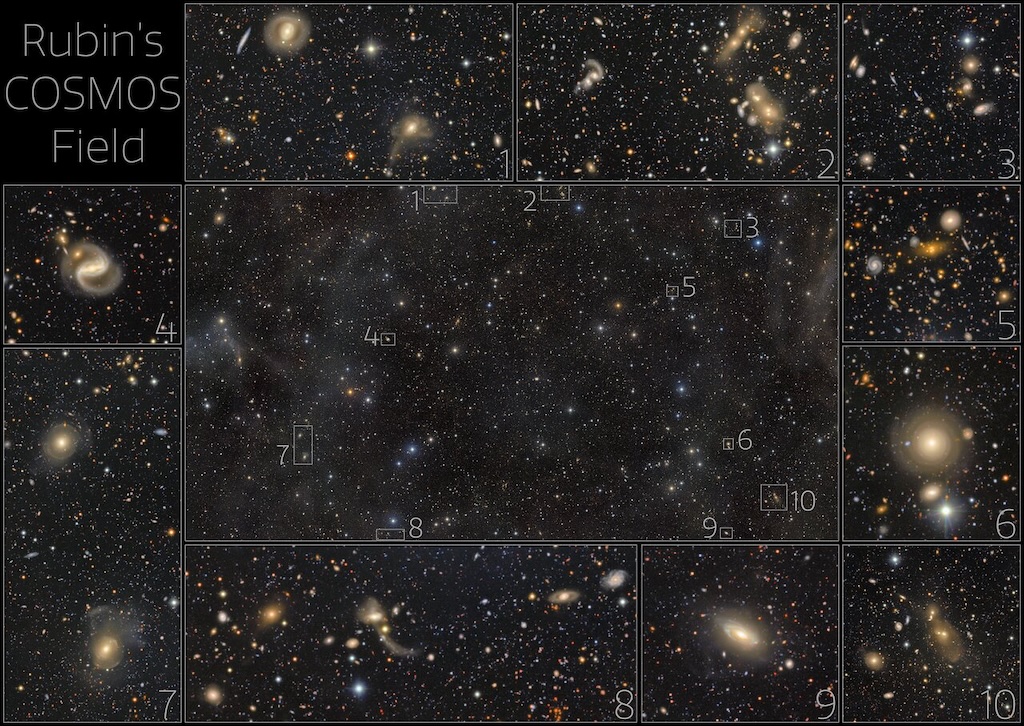
A new image from the NSF-DOE Vera C. Rubin Observatory in Chile unveils over half a million galaxies packed into a single, vast patch of sky known as the 'COSMOS field'. This stunning snapshot gives us an unprecedented look at the incredible diversity of galaxies, some so distant their light traveled billions of years to reach Earth. Rubin will repeatedly observe this field, creating a cosmic time-lapse of how the universe changes.
The Full Story
Key Takeaways
- 1 Over half a million galaxies captured in one view by the Rubin Observatory.
- 2 The 'COSMOS field' offers a clear window to distant galaxies, some billions of light-years away.
- 3 Rubin will repeatedly observe this field for 10 years, creating a dynamic 'cosmic movie' of the changing universe.
💡 Think of it this way:
Imagine you're trying to understand how an entire city grows and changes over decades. Instead of just one photo, Rubin is taking a high-resolution 'time-lapse' video of the cosmic 'city', allowing us to see every building (galaxy) move, form, and interact over billions of years.
How We Know This
The Vera C. Rubin Observatory is equipped with an incredibly large mirror and the world's largest digital camera – a 3.2-billion-pixel marvel. Unlike other telescopes that focus on tiny, detailed spots, Rubin is built to scan vast areas of the sky rapidly and repeatedly. It's like having a super-fast, super-wide-angle lens that takes continuous, high-resolution pictures of the entire observable sky, day after day, for a decade.
What This Means
This 'cosmic movie' from Rubin will revolutionize our understanding of numerous astronomical mysteries. It will provide crucial data for studying how galaxies form and grow, mapping the distribution of dark matter and dark energy (the mysterious components of our universe), detecting transient events like supernova explosions as they happen, and even identifying potentially hazardous asteroids in our solar system. Essentially, Rubin will build the most comprehensive, dynamic map of the universe ever created, offering insights into everything from our cosmic neighborhood to the farthest reaches of space and time.
Why It Matters
This isn't just a collection of pretty pictures; it's a revolutionary way to understand the universe around us. By studying these countless galaxies and how they evolve over time, scientists can unlock secrets about the cosmos's past, present, and future, including how our own Milky Way galaxy came to be.