Back to Articles Image Of The Day

Unmasking Saturn's Ghostly Ring Spokes: A Cosmic Mystery Solved?

📖 4 min read 📊 beginner 🏷️ NASA APOD

In Brief

Strange, fleeting shadows known as 'spokes' mysteriously appear and disappear on Saturn's iconic rings. New timelapses from decades of observations help us understand these 'ghostly' streaks, which seem to vary with Saturn's seasons. Scientists believe these spokes are formed by dust and ice particles levitating above the rings due to invisible electric forces.
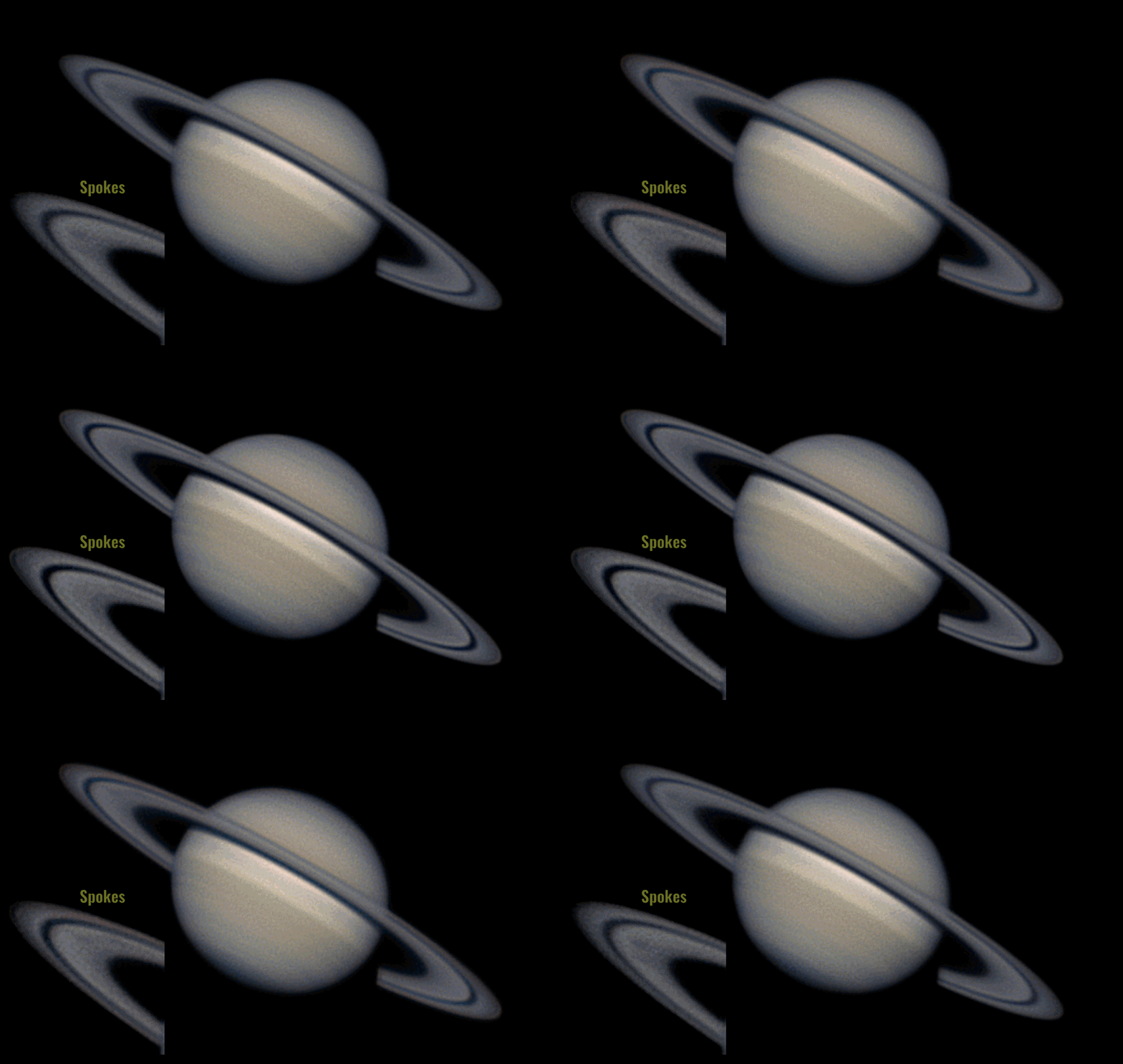
Unmasking Saturn's Ghostly Ring Spokes: A Cosmic Mystery Solved?

The Full Story

Saturn, often called the 'Jewel of the Solar System,' is famous for its stunning rings. But look closely at a recent timelapse, and you might spot something truly intriguing: ghostly, dark streaks that appear and disappear on the B ring. These aren't aliens or cosmic phantoms, but a long-standing mystery in planetary science known as 'spokes.' A single day on Saturn whizzes by in just 10 Earth hours, so even a two-hour observation gives us a significant glimpse into its dynamic ring system, showing these spokes emerge and fade away as the planet spins. Astronomers have been tracking these elusive spokes for decades, ever since NASA's Voyager 2 spacecraft first spotted them in the early 1980s. Later, the Cassini mission and the Hubble Space Telescope provided even more detailed observations. What's particularly fascinating is that the appearance of these spokes isn't constant; it changes with Saturn's seasons. Just like Earth, Saturn has a tilt to its axis, causing it to experience distinct seasons as it orbits the Sun. During Saturn's equinox, when the rings are less tilted away from the Sun, the spokes become more prominent, suggesting a connection to how sunlight and solar wind interact with the rings. So, what causes these fleeting phenomena? While their exact origin is still a topic of active research, the leading hypothesis involves an incredible interplay of invisible forces. Scientists propose that the spokes are actually tiny dust and ice particles that momentarily 'levitate' above the main ring plane. This levitation isn't magic; it's thought to be caused by electromagnetic interactions. Imagine the charged particles from the Sun, known as the solar wind, crashing into Saturn's powerful magnetic field. This cosmic collision can create electric charges within the rings, especially the tiny particles that make them up. When these electric charges build up, they can briefly repel and lift small groups of dust and ice particles. As these particles hover above the ring plane, they cast temporary shadows – like tiny, dark clouds – which we perceive as the spokes. Because these interactions are subtle and fleeting, the spokes appear and disappear, giving them their 'ghostly' quality. The seasonal variation observed during Saturn's equinox supports this idea, as more direct sunlight and solar wind could enhance these electromagnetic effects. Understanding Saturn's spokes is more than just appreciating a beautiful cosmic quirk; it helps us grasp the complex physics governing planetary rings. Rings aren't just static structures; they are dynamic environments shaped by gravity, sunlight, and electromagnetic forces. By studying these spokes, we gain insights into how planetary magnetic fields interact with the solar wind, how dust and ice behave in space, and ultimately, how planetary systems evolve. It reminds us that even within our own solar system, there are still profound mysteries waiting to be fully unraveled, driving future exploration and discovery.

Key Takeaways

  • 1 Ghostly 'spokes' are observed appearing and disappearing on Saturn's B ring.
  • 2 These spokes are temporary shadows, likely caused by levitating dust and ice particles.
  • 3 Their appearance varies with Saturn's seasons, becoming more prominent during equinoxes.
  • 4 The levitation is hypothesized to be due to electromagnetic interactions between solar wind and Saturn's magnetic field.
  • 5 Understanding spokes helps explain ring dynamics and fundamental space physics.

💡 Think of it this way:

Imagine static electricity making your hair stand on end, but on a gigantic scale with countless tiny ice and dust particles. When these particles briefly 'levitate' above Saturn's rings, they cast a shadow, much like a tiny cloud briefly blocking the sun, creating the spokes we see.

How We Know This

The discovery was made by observing Saturn's rings over several decades using powerful space telescopes and probes, including NASA's Voyager 2, the Cassini spacecraft, and the Hubble Space Telescope. Scientists created timelapses – sequences of images taken over time – to capture the fleeting appearance and disappearance of the spokes as Saturn rotated.

What This Means

Further study of Saturn's spokes could provide a deeper understanding of plasma physics in space, the behavior of dust in planetary rings, and the intricate ways solar wind interacts with planetary magnetic fields. This knowledge could inform future missions to ringed planets and exoplanets, helping us decode the formation and evolution of entire solar systems.

Why It Matters

Understanding these spokes helps us unravel the secrets of Saturn, one of our solar system's most magnificent planets. It teaches us about fundamental forces like electromagnetism at play in space and shows us there are still many cosmic mysteries to solve, even close to home.

Related Topics

#Saturn #Rings #Spokes #Planetary Science #Space Mystery