Back to Articles Image Of The Day

Webb Telescope Spots Mysterious 'Comets' in a Dying Star's Cloud

📖 3 min read 📊 beginner 🏷️ NASA APOD

In Brief

The James Webb Space Telescope has captured stunning infrared images of the Helix Nebula, revealing strange, comet-like knots of gas and dust. These mysterious blobs, found in the aftermath of a star's death, are Earth-sized in mass but span incredible distances, challenging our understanding of how stars evolve. Scientists are trying to figure out how these unexpected structures form and what they can tell us about our own Sun's future.
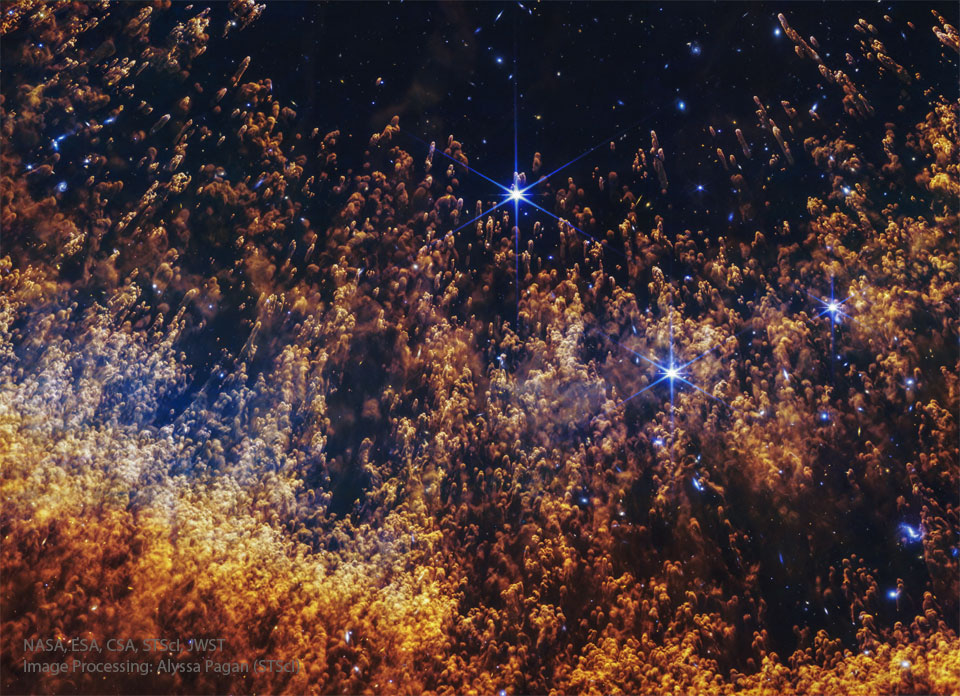
Webb Telescope Spots Mysterious 'Comets' in a Dying Star's Cloud

The Full Story

The universe constantly surprises us, and the latest breathtaking images from the James Webb Space Telescope (JWST) are no exception. Peering through the cosmic dust in infrared light, JWST has delivered an incredibly detailed view of the Helix Nebula, a dazzling cloud formed from the dying breath of a Sun-like star located about 650 light-years away in the constellation Aquarius. What makes these new images so fascinating are the thousands of bizarre, 'cometary knots' – dense clumps of gas and dust that look strikingly like tiny comets soaring through the nebula. These unusual structures are far from tiny in reality. Each 'cometary knot' has a mass comparable to our entire Earth, yet they stretch across distances several times larger than Pluto's orbit around the Sun! Scientists were initially baffled by their existence, as current models of stellar evolution didn't predict such complex formations. What's more, these aren't unique to the Helix Nebula; similar knots have been observed in other stellar death clouds like the famous Ring Nebula and the Dumbbell Nebula, deepening the cosmic mystery surrounding their origins. So, what could create such colossal yet enigmatic structures? One leading hypothesis suggests that these knots form as the central, dying star expels a powerful but less dense stellar wind. Imagine a cosmic leaf blower pushing through already existing, denser pockets of gas. This energetic wind acts like a sculptor, driving out and shaping the gas, causing it to fragment and evolve into these distinct, comet-shaped blobs. The interaction between the old, slower-moving gas and the new, fast-moving stellar wind is thought to be the key to their formation. Understanding these 'cometary knots' is crucial because planetary nebulae like the Helix are stellar graveyards, representing the dramatic final chapter in the lives of stars similar to our own Sun. When our Sun eventually runs out of fuel billions of years from now, it too will shed its outer layers, forming its own beautiful, albeit temporary, nebula. By studying the Helix Nebula and its mysterious knots, astronomers gain invaluable insights into the complex processes that govern stellar death, helping us predict the ultimate fate of our own solar system.

💡 Think of it this way:

Imagine a dying campfire that, instead of just fading away, suddenly starts spitting out glowing, miniature smoke rings that linger and change shape. That's a bit like what these mysterious knots are doing in the Helix Nebula – unexpected, puzzling structures in a star's final farewell.

How We Know This

The groundbreaking observations were made possible by the James Webb Space Telescope. Unlike older telescopes that primarily see in visible light, JWST is designed to see the universe in infrared. This is vital because infrared light can penetrate through thick clouds of dust and gas that would otherwise obscure our view, allowing JWST to reveal the incredible detail and hidden structures of these knots that were previously less clear.

What This Means

The discovery and detailed imaging of these cometary knots open new avenues for research. Scientists will continue to analyze the vast amounts of data from JWST to refine their hypotheses, perhaps even discovering new clues about how these knots form and evolve. This will lead to more accurate computer models of stellar evolution, giving us a clearer picture of not just the Helix Nebula's dramatic past, but also the inevitable future of countless stars across the cosmos, including our very own Sun.

Why It Matters

This matters because it gives us a glimpse into the dramatic final stages of stars like our Sun. Understanding these cosmic 'comets' helps scientists piece together the life cycle of stars and what our solar system might look like billions of years from now, when the Sun reaches the end of its life.

Related Topics

#Helix Nebula #James Webb Space Telescope #Stellar Evolution #Planetary Nebula #Cosmic Knots