Back to Articles Image Of The Day

Rare 'Fire Rainbow' Lights Up West Virginia Sky!

📖 3 min read 📊 beginner 🏷️ NASA APOD

In Brief

A breathtaking atmospheric phenomenon, informally known as a 'fire rainbow,' was recently captured over West Virginia. This vibrant arc of color is not a rainbow at all, but a circumhorizon arc, created by sunlight shining through millions of tiny, perfectly aligned ice crystals high in the atmosphere. Its infrequent appearance makes it a truly special sky surprise.
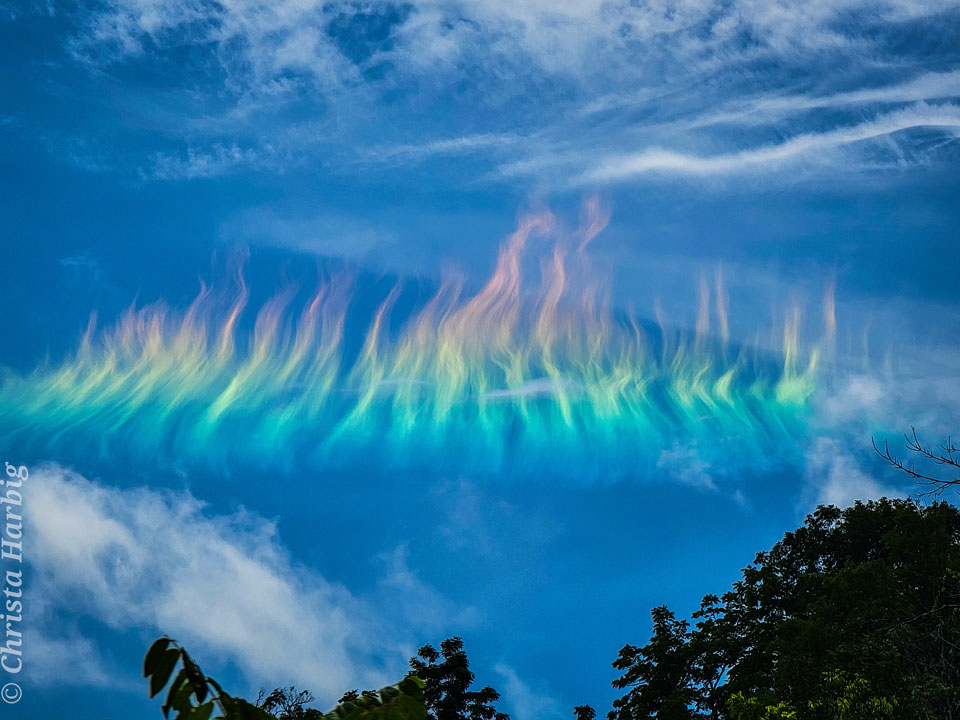
Rare 'Fire Rainbow' Lights Up West Virginia Sky!

The Full Story

Imagine looking up and seeing a brilliant, rainbow-colored arc stretching across the horizon, glowing with an almost flame-like intensity. That's exactly what observers witnessed when a rare 'fire rainbow,' technically known as a circumhorizon arc, appeared over North Fork Mountain in West Virginia in 2021. This isn't a typical rainbow, which forms when sunlight passes through raindrops; instead, it's a much more elusive atmospheric marvel. So, what exactly creates this stunning display? The magic happens high in the sky, within thin, wispy cirrus clouds, specifically a type called cirrus fibratus. These clouds are not made of water droplets but of countless tiny ice crystals. For a fire rainbow to form, these ice crystals must be shaped like flat, hexagonal plates, and crucially, they need to be aligned almost perfectly parallel to the ground. Think of them as billions of microscopic, six-sided prisms floating horizontally in the air. When sunlight hits these perfectly positioned ice crystals, each crystal acts like a tiny prism, bending or 'refracting' the light. Because the sun's rays enter one side of the hexagonal crystal and exit another, they get split into all the colors of the rainbow, just like a prism. When millions of these crystals refract light in unison, our eyes perceive a continuous, vibrant band of color stretched across the horizon, often appearing so bright and colorful it resembles a fiery strip. However, getting all these conditions just right is quite a feat, which is why fire rainbows are somewhat unusual to witness. The sun must be exceptionally high in the sky – at least 58 degrees above the horizon. This specific angle is critical for the sunlight to enter and exit the horizontally aligned ice crystals in just the right way to produce the arc we see. If the sun is too low or the crystals aren't aligned, the effect simply won't happen. That's why catching a glimpse of one is often a delightful surprise for sky-watchers. The photograph taken in West Virginia captures this incredible interplay of light, ice, and atmospheric conditions, showcasing one of Earth's most beautiful and fleeting optical phenomena. It serves as a vivid reminder that sometimes the most spectacular sights aren't light-years away in space, but right here in our own atmosphere, waiting for us to look up and appreciate them.

Key Takeaways

  • 1 A 'fire rainbow' is a rare atmospheric phenomenon called a circumhorizon arc, not a true rainbow.
  • 2 It forms when sunlight passes through millions of horizontally aligned, flat, hexagonal ice crystals in high cirrus clouds.
  • 3 Specific conditions, like the sun being at least 58 degrees high, are required for this vibrant, flame-like display to appear.

💡 Think of it this way:

Imagine shining a flashlight through a tiny, perfectly cut diamond, but instead of one diamond, you have billions of them floating high above you, each catching and bending the sun's light to create a giant, fiery-colored streak across the sky.

How We Know This

This breathtaking natural phenomenon was 'discovered' and shared through careful observation and photography. A keen-eyed photographer captured the rare circumhorizon arc using a standard camera near North Fork Mountain, West Virginia. This method highlights that some of the most stunning scientific observations can be made by simply looking up and appreciating the intricate workings of our natural world.

What This Means

While a 'fire rainbow' isn't a new scientific discovery in the traditional sense, its observation encourages a deeper appreciation for atmospheric optics and the complex physics governing our weather and sky phenomena. Documenting these events helps scientists better understand atmospheric conditions, crystal formations, and light interactions, even as it inspires awe and wonder in the general public, reminding us to always keep an eye on the incredible beauty unfolding above us.

Why It Matters

This spectacular natural light show reminds us of the incredible physics happening right above our heads every day. It encourages us to look up, appreciate the beauty of our planet's atmosphere, and marvel at how sunlight interacts with the smallest ice crystals to paint the sky with such vivid colors.

Related Topics

#Atmospheric Optics #Fire Rainbow #Weather Phenomena #Cirrus Clouds #Natural Beauty