Meet the 'Dark Doodad': A Mysterious Cosmic Shadow
In Brief
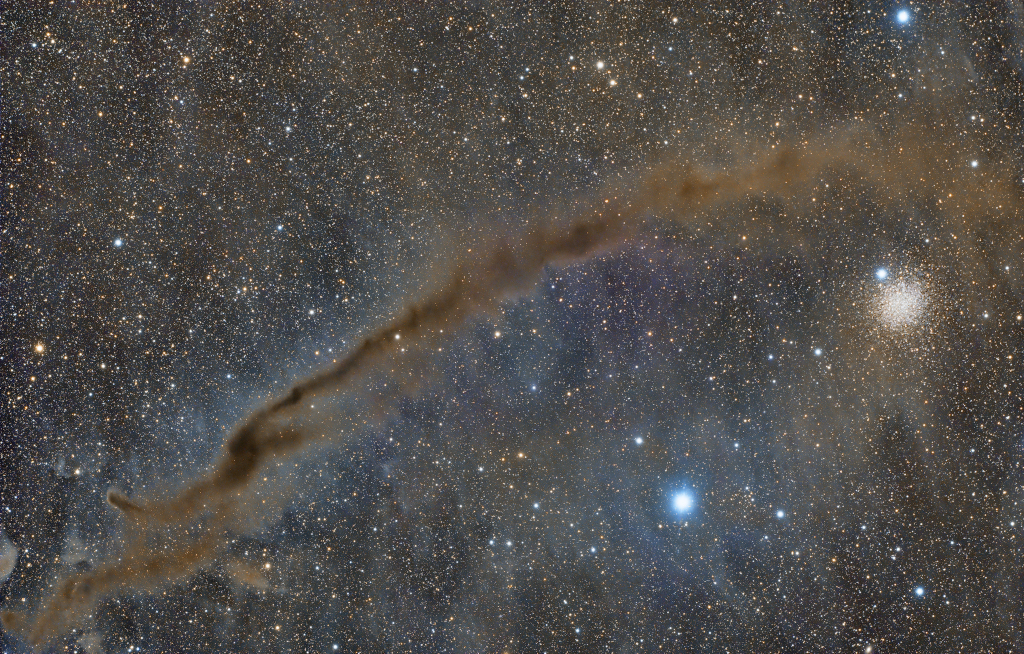
Imagine a long, shadowy finger reaching across the night sky – that's the Dark Doodad Nebula, a massive cloud of dust and gas drifting in our galaxy. This intriguing cosmic silhouette is a potential birthplace for new stars, offering clues about how our universe creates its luminous residents. Discovered by chance, its quirky name adds to its charm.
The Full Story
Key Takeaways
- 1 The Dark Doodad Nebula is a long, dark cloud of dust and gas in our galaxy.
- 2 It appears as a silhouette because it blocks light from stars behind it.
- 3 These dark clouds are critical 'star nurseries' where new stars are born.
- 4 Its quirky name was coined in 1986 by an astro-imager.
- 5 It's about 700 light-years away and over 30 light-years long.
💡 Think of it this way:
Think of the Dark Doodad like a cosmic shadow puppet. It's not a hole in space, but rather a dense, opaque cloud of dust and gas blocking the light from the brighter stars behind it, much like a hand creating a silhouette against a bright screen.
How We Know This
Astronomers observe the Dark Doodad primarily by looking for its dark silhouette against brighter starfields using telescopes and advanced cameras. They also use radio telescopes to detect the faint emissions from the cold gas and dust within it, helping to map its structure and composition, even though it doesn't shine brightly in visible light.
What This Means
Studying the Dark Doodad and similar nebulae provides critical insights into the process of star formation, helping us understand how stars like our Sun are born and evolve. This contributes to our larger understanding of the structure and evolution of the Milky Way galaxy and the universe as a whole, revealing the intricate cycle of cosmic matter.
Why It Matters
This discovery helps us understand how stars are born in our own Milky Way galaxy. By studying these dark clouds, scientists piece together the incredible story of cosmic creation, from swirling dust to brilliant new suns, which ultimately impacts how we understand our place in the universe.