Back to Articles Image Of The Day

When Wildfire Smoke Paints Our Sun Red: A Glimpse into its Future

📖 3 min read 📊 beginner 🏷️ NASA APOD

In Brief

An astonishing image captured the Sun appearing fiery red through thick wildfire smoke in British Columbia, Canada. This natural filter allowed a rare, direct view of our star, even revealing sunspots normally hidden from direct sight. It offered a surprising preview of how our Sun might look billions of years from now.
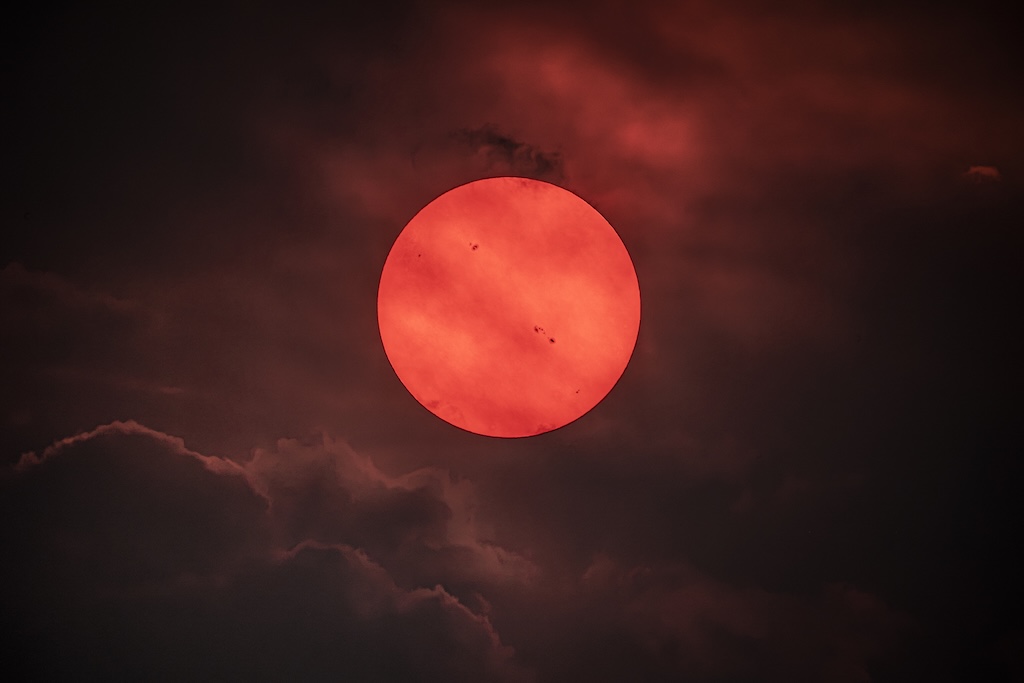
When Wildfire Smoke Paints Our Sun Red: A Glimpse into its Future

The Full Story

Imagine gazing up at the sky and seeing a deep crimson sun, looking much like an alien star orbiting a distant exoplanet. Yet, this striking view wasn't from another galaxy, but right here on Earth. On July 22, 2026, residents of the Okanagan region in British Columbia, Canada, witnessed our very own Sun take on this eerie, blood-red hue. The dramatic scene was captured in an extraordinary image, showcasing a temporary transformation of our familiar star, all thanks to a thick veil of wildfire smoke. The scientific explanation behind this crimson spectacle is quite fascinating. Smoke from Pacific Northwest wildfires drifted over the region, filling the atmosphere with countless tiny particles. These particles act like a natural, colossal filter. They are especially good at scattering and blocking light with shorter wavelengths – the blues and violets – while allowing the longer, redder wavelengths to pass through more easily. This process made the Sun appear significantly dimmer and much redder than usual, creating a truly otherworldly sight. It's the same principle that gives us vivid, colorful sunsets and sunrises, but amplified dramatically by the dense smoke. What made this event even more special was the rare opportunity it presented to safely observe the Sun directly (though it's crucial to remember that it is *never* safe to stare directly at the Sun without proper protection, even through smoke). The smoke acted as a powerful natural dimming filter, allowing a photographer to capture details on the Sun’s surface that are usually invisible to the naked eye. In this particular image, several dark patches, known as sunspots, are clearly visible. One prominent feature, located just below and to the right of the center, was AR 4493 – a giant, rapidly evolving active region on the Sun’s surface where intense magnetic activity creates cooler, darker areas. This temporary reddening of our Sun, caused by Earthly wildfires, offers a surprising preview of a much grander, cosmic transformation our star will undergo in the far distant future. Roughly six billion years from now, our Sun will actually begin to turn redder and expand dramatically as it approaches its 'red giant' phase. In this phase, it will swell up, cool down, and its outer layers will indeed glow with a reddish hue, eventually engulfing the inner planets, including Earth. So, while the 2026 view was a fleeting atmospheric trick, it served as a vivid, albeit scaled-down, cosmic dress rehearsal for the Sun’s ultimate destiny. Beyond the stunning visuals, this event serves as a powerful reminder of how interconnected our planet's systems are. From the devastating impact of wildfires on our environment to their unexpected effect on how we perceive celestial objects, the atmosphere constantly mediates our view of the universe. It underscores that even familiar sights like our Sun can reveal new wonders when viewed through a different lens, be it a natural smoky filter or the vast expanse of cosmic time.

Key Takeaways

  • 1 Wildfire smoke can act as a natural filter, turning our Sun a dramatic red and dimming its light.
  • 2 This rare atmospheric event allowed for a direct, albeit temporary, view of sunspots like AR 4493.
  • 3 The red Sun appearance, though caused by smoke, offers a surprising preview of the Sun's distant future as a red giant.
  • 4 Atmospheric conditions greatly influence our perception of celestial objects and connect Earthly events to cosmic phenomena.

💡 Think of it this way:

Think of it like looking through natural, smoky sunglasses. Just as colored glasses can change how you see the world, wildfire smoke acts as a giant filter, transforming our bright yellow Sun into a dim, crimson orb.

How We Know This

The unique atmospheric conditions created by wildfire smoke acted as a powerful natural solar filter. This allowed a photographer to safely capture the Sun directly with a camera, something usually only possible with specialized solar filters designed for telescopes or during an extremely rare total solar eclipse. The smoke particles effectively dimmed the Sun's intensity and blocked much of the harmful blue light, making the sunspots clearly visible and rendering the Sun in its striking crimson color.

What This Means

This striking image reminds us of the profound impact Earth's atmosphere has on our view of the cosmos, from local weather events like wildfires to the vivid colors of a sunset. It underscores how planetary processes can temporarily alter our perspective on even the most familiar celestial objects. Furthermore, it offers a fleeting, albeit atmospheric, preview of the incredible changes our Sun will undergo billions of years from now, transforming into a red giant and dramatically reshaping our solar system. It highlights the importance of understanding both our local environment and the vast scales of cosmic evolution.

Why It Matters

This unique sight highlights how atmospheric conditions, from local wildfires to the distant future of our star, can dramatically change our view of the cosmos. It reminds us of the delicate balance between Earth's environment and our cosmic surroundings, connecting terrestrial events to grand celestial processes.

Related Topics

#Sun #Wildfires #Solar Activity #Red Giant #Atmospheric Optics