Back to Articles Image Of The Day

Forbidden Love & Cosmic Clouds: A Stellar Bridge Over Twin Volcanoes

📖 3 min read 📊 beginner 🏷️ NASA APOD

In Brief

This breathtaking image captures a rare celestial event where the distant Barnard's Loop appears to connect two ancient volcanoes in the Andes mountains. While folklore tells of a mythical romance uniting these peaks, a colossal cosmic gas cloud provided a real-life "sky bridge" through a trick of perspective. It's a testament to careful planning and a stunning view of our universe.
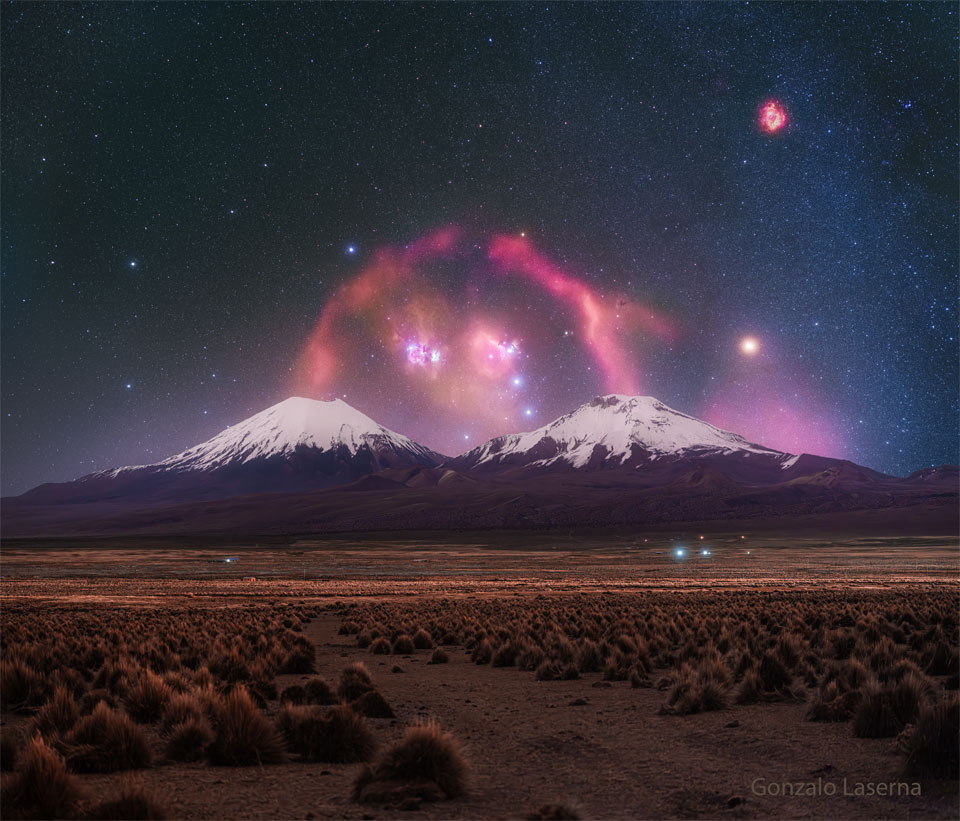
Forbidden Love & Cosmic Clouds: A Stellar Bridge Over Twin Volcanoes

The Full Story

Perched majestically in the Andean landscape of Bolivia are the twin volcanoes of Parinacota and Pomerape. These colossal peaks are steeped in ancient folklore, often told as a tragic tale of a mythical prince and princess whose forbidden romance eternally binds them. Geologically, these volcanoes aren't connected by a shared pool of magma beneath the Earth, nor have they erupted in a millennium. And usually, nothing in the sky visually links them either… until a truly unique celestial alignment was captured. The 'connection' you see arching over these majestic volcanoes is none other than Barnard's Loop. This isn't a physical bridge between the Earth and the heavens, but rather a colossal arc of glowing gas, a magnificent nebula hundreds of light-years across. Barnard's Loop is a massive cloud of ionized hydrogen gas, part of the much larger Orion Molecular Cloud Complex—a stellar nursery where new stars are born. Although it spans a huge area of the night sky, it's typically too faint to be seen with the naked eye, revealing itself only through long-exposure photography. This incredible alignment is a remarkable feat of astrophotography and a profound trick of perspective. From a very specific location in Bolivia, in mid-April, a dedicated photographer carefully planned and executed a series of camera exposures. By capturing light over an extended period, the faint glow of Barnard's Loop was revealed, appearing to perfectly frame and connect the twin volcanic peaks. It's a testament to how precisely timing and positioning can unveil hidden celestial spectacles. The image offers more than just the cosmic bridge. Look closely, and you'll spot other famous celestial objects sharing the frame. Right in the center, the iconic Orion Nebula, another breathtaking star-forming region, glows vibrantly. To the right, the bright, reddish hue of Betelgeuse, a well-known supergiant star, stands out. And further to the upper right, the delicate beauty of the Rosette Nebula adds another layer to this cosmic tapestry, reminding us of the rich celestial scenery surrounding us. This photograph is more than just a pretty picture; it's a powerful blend of science, art, and ancient storytelling. It inspires us to consider the vastness of the cosmos and our place within it, showing how seemingly disparate elements—Earthly landmarks, distant star nurseries, and human legends—can be brought together in a single, awe-inspiring view. It encourages us to look up, explore the night sky, and appreciate the hidden wonders that patient observation can reveal.

Key Takeaways

  • 1 A rare astronomical alignment captured Barnard's Loop appearing to connect two ancient volcanoes.
  • 2 Barnard's Loop is a colossal cloud of glowing gas and a star-forming region hundreds of light-years away.
  • 3 The connection is an optical illusion, achieved through precise photographic timing and location.
  • 4 The image also showcases other famous celestial objects like the Orion Nebula and Betelgeuse.

đź’ˇ Think of it this way:

Imagine standing in just the right spot to see a distant rainbow perfectly arching over two specific landmarks – this celestial alignment is a grander, cosmic version of that precise visual connection.

How We Know This

The stunning image was created by a photographer in Bolivia using a series of long-exposure camera shots. These multiple exposures were carefully planned and taken on the same day and from the same specific location in mid-April. This technique allowed enough light from the faint Barnard's Loop to be collected and reveal its ghostly presence, making it appear to arc between the volcanic peaks.

What This Means

This type of astrophotography powerfully demonstrates how our perspective can reveal stunning, unexpected connections between Earth's landscapes and distant cosmic phenomena. It serves as a beautiful reminder of the intricate beauty of our universe, inspiring curiosity and encouraging more people to engage with astronomy and the wonders of the night sky. It also highlights the artistic and scientific value of carefully planned observational photography.

Why It Matters

This image reminds us of the immense beauty and wonder visible in our night sky, encouraging us to look up and discover the hidden connections between our world and the cosmos. It highlights how art, science, and ancient stories can beautifully intertwine.

Related Topics

#Astrophotography #Barnards Loop #Andes Mountains #Cosmic Alignment #Nebulae