Back to Articles Image Of The Day

The Bubble Nebula: A Giant Star's Cosmic Breath

📖 3 min read 📊 beginner 🏷️ NASA APOD

In Brief

Imagine a star so powerful it blows a perfect, 10-light-year-wide bubble in space! That's the Bubble Nebula, a stunning cosmic structure sculpted by a massive, super-hot star. This celestial marvel gives us a peek into the violent yet beautiful processes that shape our universe.
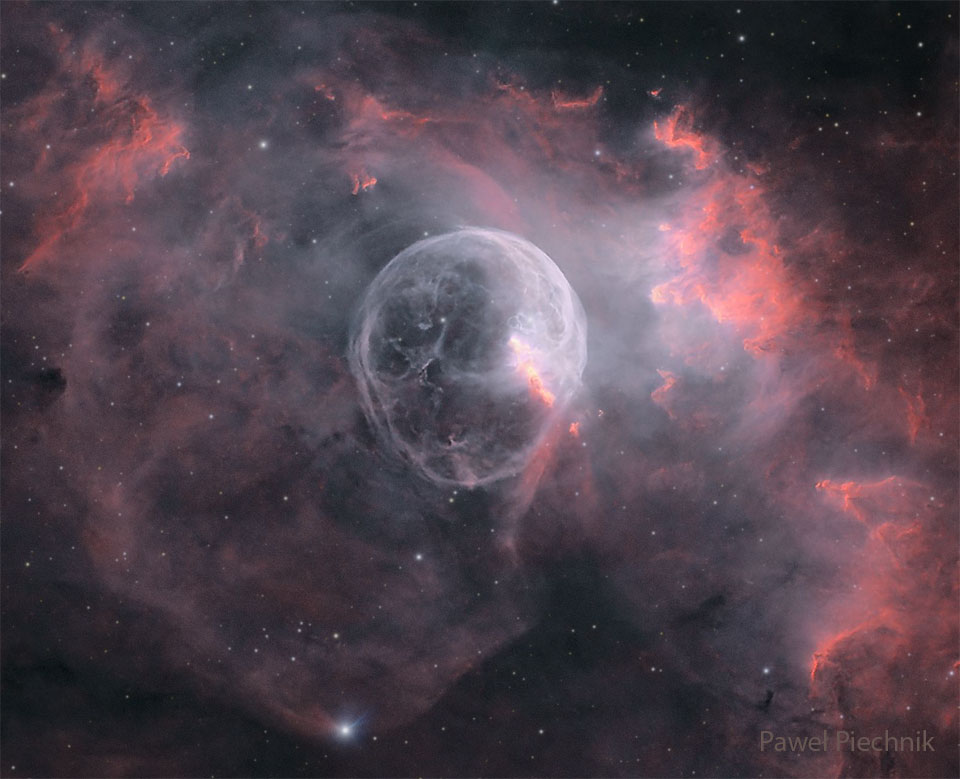
The Bubble Nebula: A Giant Star's Cosmic Breath

The Full Story

Step into the cosmic gallery and feast your eyes on the stunning NGC 7635, affectionately known as the Bubble Nebula. This mesmerizing, head-like apparition, captured with incredible detail from Krakow, Poland, is not just a pretty picture; it's a testament to the powerful forces at work in the universe. Located a mere 11,000 light-years away in the boastful constellation Cassiopeia, this massive bubble stretches an astounding 10 light-years across – that's roughly twice the distance our sun travels in its orbit around the Milky Way in a year! So, what could possibly create such a colossal and seemingly delicate structure? The answer lies at the heart of the bubble itself: a monstrous, super-hot star, visible slightly to the right of the bubble's center. This isn't just any star; it's an absolute behemoth, likely weighing in at 10 to 20 times the mass of our own Sun. Such massive stars live fast and die young, but during their fiery lives, they are incredibly energetic and dramatic. This giant star is a cosmic sculptor, constantly blasting out a 'fierce stellar wind' – a torrent of high-energy particles and intense radiation. Imagine a cosmic hurricane, continuously pushing outwards from the star. As this powerful wind and radiation expand, they collide with and sweep up the surrounding 'denser material' – a thick cloud of gas and dust called a molecular cloud. This relentless pressure creates a spherical cavity, much like blowing up a balloon, forming the glowing gas structure we see as the Bubble Nebula. Despite its ethereal appearance, its very existence is proof of violent, continuous processes. The Bubble Nebula offers astronomers a spectacular natural laboratory to study the life and influence of massive stars. Observing such structures helps us understand how these cosmic giants interact with their environment, how their powerful winds can trigger new star formation, or even disperse the material needed for it. It's a dramatic illustration of how the universe is constantly being reshaped, with stars acting as both creators and destroyers on a grand scale, leaving behind breathtaking cosmic art for us to admire and study.

Key Takeaways

  • 1 The Bubble Nebula is a 10-light-year-wide cosmic bubble created by a massive, super-hot star.
  • 2 A "fierce stellar wind" and intense radiation from the star push against surrounding gas and dust, sculpting the bubble.
  • 3 Studying nebulae like this helps scientists understand the violent processes and life cycles of giant stars and their impact on star formation.

💡 Think of it this way:

Think of a powerful fan blowing a giant soap bubble, pushing against the surrounding air to create its delicate, spherical shape. Only here, the 'fan' is a star and the 'bubble' is made of glowing gas!

How We Know This

This stunning view was captured from Krakow, Poland, using a "long exposure" technique. This method allows telescopes to collect light over an extended period, revealing faint and intricate details that would be invisible in a quick snapshot, much like leaving your camera shutter open longer to get a brighter picture in low light.

What This Means

Understanding nebulae like the Bubble Nebula is crucial for deciphering the universal story of stellar evolution. It provides clues about how massive stars, which are relatively rare but incredibly influential, inject energy and heavy elements back into the cosmos. These findings contribute to our knowledge of how galaxies evolve, how new stars and planets are born, and the dynamic interplay between stars and the vast cosmic material around them.

Why It Matters

This discovery helps us understand how giant stars dramatically influence their surroundings, creating stunning art in space and even affecting where new stars might form. It's a vivid reminder of the incredible, dynamic forces at play far beyond Earth.

Related Topics

#Nebula #Massive Stars #Stellar Winds #Cosmic Structures #Astrophotography