Our Milky Way's Closest Neighbor: The Large Magellanic Cloud
In Brief
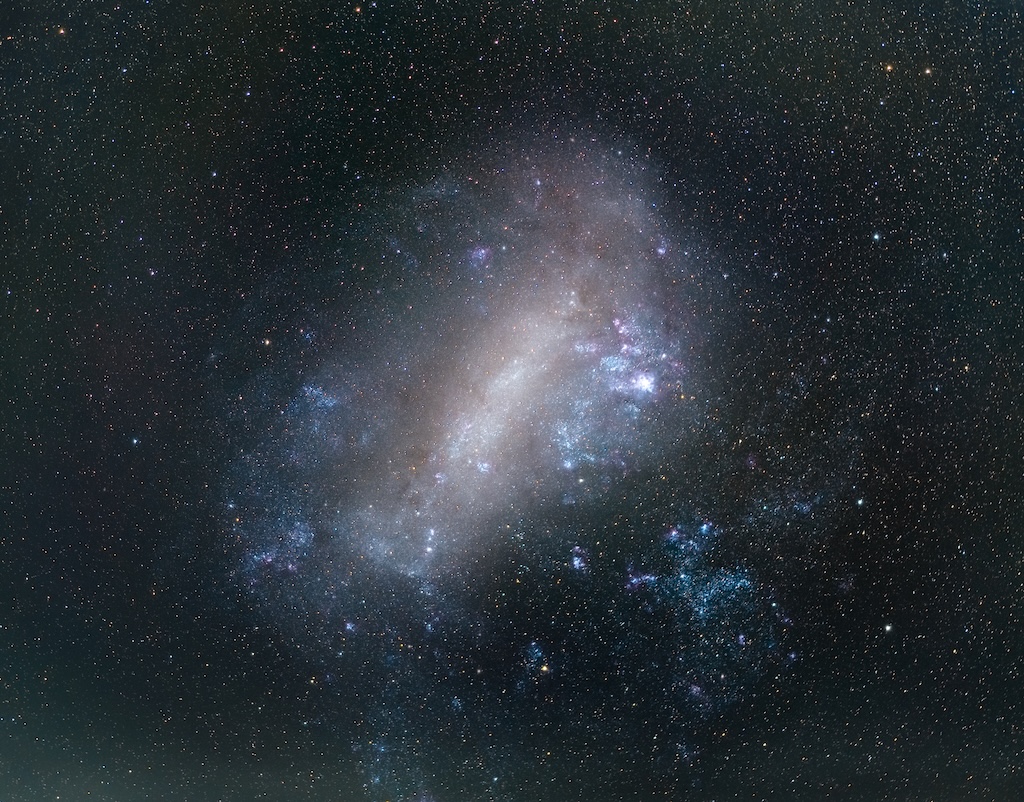
Imagine seeing another galaxy with just your eyes! The Large Magellanic Cloud (LMC), a nearby dwarf galaxy, is a stunning sight visible from Earth's Southern Hemisphere. It's bustling with new stars, fueled by a cosmic dance with our own Milky Way.
The Full Story
Key Takeaways
- 1 The Large Magellanic Cloud (LMC) is one of the Milky Way's closest galactic neighbors, visible to the unaided eye from southern latitudes.
- 2 It is a 'dwarf irregular galaxy' that is significantly smaller than our Milky Way but a member of our Local Group.
- 3 The LMC is unusually active in forming new stars, likely due to the strong gravitational pull from the Milky Way.
- 4 Astronomers predict a galactic collision and merger between the LMC and the Milky Way in about two billion years.
💡 Think of it this way:
Think of the LMC and the Milky Way like two dance partners, with the larger Milky Way gently pulling and shaping the LMC, eventually leading to a slow, cosmic embrace.
How We Know This
Astronomers study the LMC using powerful telescopes to observe its countless stars, vast clouds of gas, and dust. By measuring its distance, charting the movement of its components, and analyzing patterns of star formation, scientists can map its structure and understand its evolution. Combining these observations with sophisticated computer simulations of gravitational interactions allows them to predict its dynamic future with our own galaxy.
What This Means
Studying the Large Magellanic Cloud provides a unique 'live' laboratory to understand galactic interactions. It offers vital clues about how galaxies evolve, how star formation is triggered on cosmic scales, and what the future holds for our own Milky Way as it continues its gravitational dance with its neighbors. This research deepens our understanding of the universe's past and future.
Why It Matters
This glimpse into the Large Magellanic Cloud helps us understand how galaxies interact, grow, and evolve over billions of years, offering a sneak peek into our own Milky Way's dramatic future.