Back to Articles Image Of The Day

NASA's Desert Crash Reveals Sun's Ancient Secrets & Cosmic Origins

📖 3 min read 📊 beginner 🏷️ NASA APOD

In Brief

In 2004, a NASA probe designed to collect samples from the Sun unexpectedly crash-landed in the Utah desert when its parachutes failed. Despite the dramatic impact, scientists managed to salvage precious solar particles from the wreckage. These samples have since revealed incredible new details about the Sun's composition and how our entire Solar System first formed.
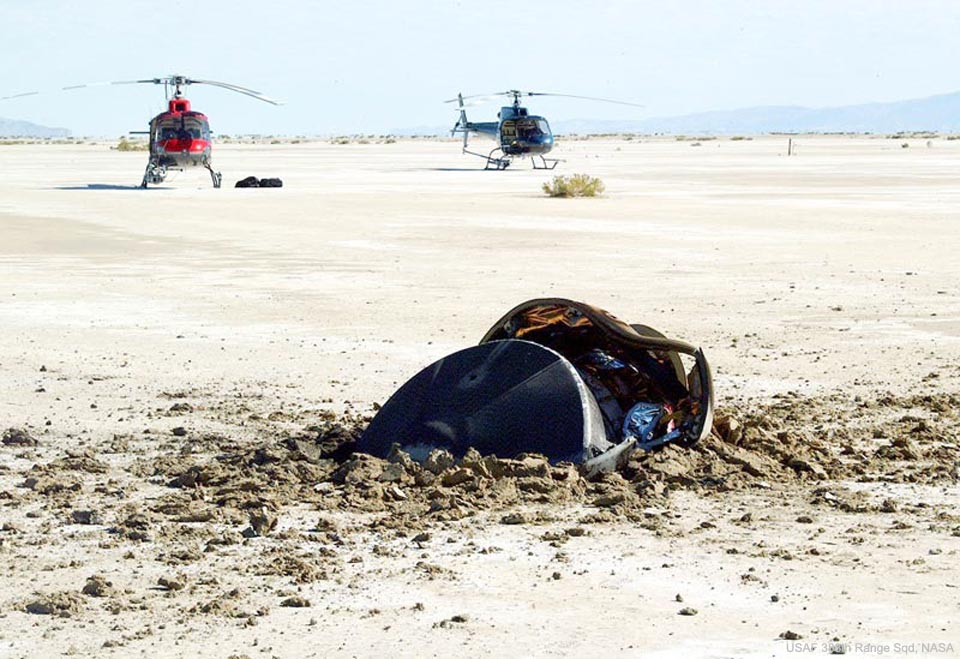
NASA's Desert Crash Reveals Sun's Ancient Secrets & Cosmic Origins

The Full Story

Picture this: a "flying saucer" plummeting towards the Utah desert at over 300 kilometers per hour, tracked by radar and chased by helicopters. This wasn't a scene from a sci-fi movie with alien invaders, but a very real, dramatic moment in 2004 for NASA's Genesis mission. The saucer was actually the Genesis sample return capsule, a precious container of solar wind particles, and its unexpected hard landing was due to a critical parachute malfunction. It was a heart-stopping moment for the scientists who had spent years working on the mission. The Genesis mission, launched in 2001, was NASA's groundbreaking effort to collect actual pieces of our Sun. Our star constantly emits a stream of charged particles called the "solar wind." While Earth's magnetic field protects us by deflecting most of these particles, scientists knew that collecting them directly could offer an invaluable snapshot of the Sun's original composition. This composition holds the fundamental building blocks of our entire Solar System, from the smallest asteroid to the largest gas giant, and even the elements that make up you and me. Despite the catastrophic crash, the story took a surprisingly positive turn. Thanks to the meticulous design and the dedication of recovery teams, many of the ultra-pure collector arrays – the delicate surfaces that had trapped the solar wind particles – remained in good enough condition for analysis. Scientists carefully sifted through the wreckage, delicately extracting the tiny, invaluable samples that had traveled millions of miles from the Sun, survived a fiery re-entry, and then a desert impact. Once analyzed, these precious samples delivered a scientific goldmine. Genesis helped us uncover new details about the precise mix of elements that make up the Sun. Even more remarkably, the data revealed subtle but significant differences in the abundance of certain elements between the Sun and planets like Earth. These tiny chemical signatures are like ancient fingerprints, pointing to how the initial cloud of gas and dust that formed our Solar System wasn't perfectly uniform. These discoveries are far more than just cosmic trivia; they provide crucial insights into one of the most fundamental questions in astronomy: how did our Sun and planets form billions of years ago? By understanding the primordial ingredients, scientists can refine their models of planetary formation, stellar evolution, and even shed light on the conditions that might lead to the development of life. The dramatic crash of Genesis ultimately opened a window into the distant past of our cosmic home.

Key Takeaways

  • 1 NASA's Genesis capsule crash-landed in 2004 after collecting solar wind samples.
  • 2 The mission aimed to understand the Sun's original composition, which is the blueprint for our Solar System.
  • 3 Despite the crash, salvaged samples revealed new details about the Sun and provided clues about how planets formed billions of years ago.

💡 Think of it this way:

Imagine trying to catch microscopic dust motes flung off a giant campfire millions of miles away, then bringing them back to Earth. That's essentially what the Genesis mission aimed to do with solar wind particles.

How We Know This

The Genesis spacecraft spent years orbiting the Sun at a special point, using ultra-pure collector arrays – think of them like special, super-clean tennis rackets – to 'catch' tiny atoms and particles constantly streaming from our star. These arrays then folded up inside a robust return capsule for their journey back to Earth, designed to parachute gently down, though this didn't go as planned.

What This Means

These insights are crucial for understanding the basic recipe from which our entire Solar System was cooked up. They help scientists refine models of how stars like our Sun form, how planets coalesce from cosmic dust, and ultimately, provide a deeper context for our own place in the universe. Future missions will continue to build on this foundational data, potentially exploring other celestial bodies with similar sample return techniques, learning both from Genesis's design successes and its parachute failure.

Why It Matters

Understanding the Sun's ingredients is like looking back in time to the very moment our cosmic neighborhood, including Earth and ourselves, began. These findings offer crucial clues about our origins and how the planets around us came to be, deepening our understanding of our place in the universe.

Related Topics

#NASA #Genesis Mission #Solar Wind #Solar System Formation #Space Exploration