Back to Articles Image Of The Day

The Cosmic Bat Nebula: A Hauntingly Beautiful Star Nursery

📖 3 min read 📊 beginner 🏷️ NASA APOD

In Brief

Don't let its spooky name fool you! The Cosmic Bat Nebula is a bustling cosmic nursery where brand new stars are being born. Its eerie red glow comes from energetic young stars illuminating vast clouds of hydrogen gas, hinting at the stellar drama unfolding within its dusty 'wings.'
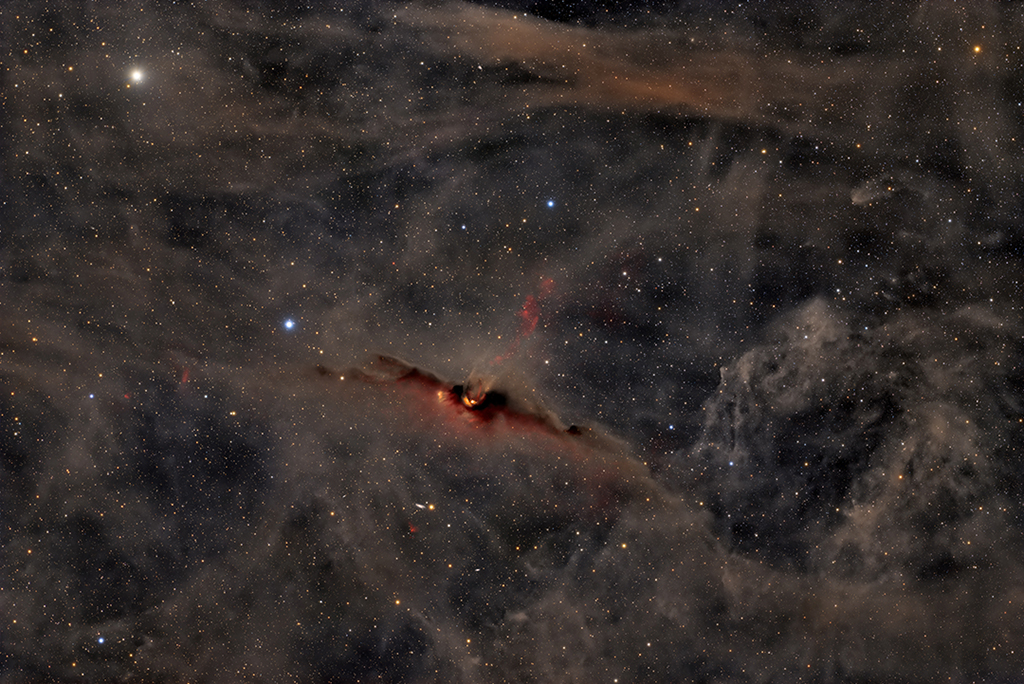
The Cosmic Bat Nebula: A Hauntingly Beautiful Star Nursery

The Full Story

Happy Summerween! While trick-or-treating might be a few months away for many, the universe has its own kind of spooky spectacle on display year-round: the Cosmic Bat Nebula. Despite its haunting name and fiery red appearance, this vast cloud of gas and dust, officially known as LDN 43, is far from eerie. Instead, it's a vibrant, bustling factory where brand new stars are being born, illuminating the darkness with their nascent power. Think of the Cosmic Bat Nebula as a giant, cosmic maternity ward. Nebulae are essentially vast clouds of gas (mostly hydrogen) and dust, spread across incredible distances in space. Within these dense clouds, gravity begins to pull material together. As these clumps grow denser and hotter, they eventually ignite, giving birth to a star. With a wingspan stretching 12 light-years – that's about 70 trillion miles – the Cosmic Bat Nebula provides ample material for countless new suns. So, what gives this 'Cosmic Bat' its ominous red glow? It's all thanks to the very young stars hidden within its dusty embrace. These newborn stars, still cocooned in their stellar nurseries, blast out powerful ultraviolet (UV) light. When this UV light hits the surrounding hydrogen gas, it excites the hydrogen atoms, causing them to emit light, much like a neon sign glowing when electricity passes through it. This particular process makes the hydrogen glow a distinct, fiery red. We can even see a tell-tale 'jet' of glowing hydrogen emerging from what looks like the bat's head, a clear sign of energetic star formation activity deep inside. Why does studying nebulae like the Cosmic Bat matter to us? Because they hold the secrets to our own cosmic origins. Our Sun, Earth, and everything on it, including you and me, were formed from the gas and dust within a similar nebula billions of years ago. By observing these distant stellar nurseries, astronomers can piece together the complex puzzle of how stars form, how planets might gather around them, and ultimately, how life gets its start in the universe. It's like looking back in time at our own family album. It's worth noting that while there's another famous 'Bat Nebula' (NGC 6995), LDN 43, our Cosmic Bat, offers its own unique insights into the earliest stages of star birth. Future observations with powerful telescopes will allow astronomers to peer even deeper into its dusty folds, revealing more about the embryonic stars and perhaps even the nascent planetary systems hidden within, further enriching our understanding of the universe's grand creation story.

Key Takeaways

  • 1 The Cosmic Bat Nebula (LDN 43) is a vibrant region where new stars are being formed.
  • 2 Its distinct red glow is caused by powerful ultraviolet light from young stars exciting the surrounding hydrogen gas.
  • 3 Studying this nebula helps scientists understand the fundamental processes of star and planet formation, including our own solar system.

💡 Think of it this way:

Imagine a giant, dusty cave where new baby lights are being born, and their first bright rays make parts of the cave walls glow like a neon sign.

How We Know This

Astronomers use powerful telescopes to capture the faint light emitted by these distant cosmic clouds. By analyzing the colors and intensity of this light – specifically the distinctive red glow of hydrogen – they can deduce what elements are present, how hot they are, and even detect the energetic processes of star birth happening millions of miles away.

What This Means

Understanding the Cosmic Bat Nebula provides crucial data for refining our models of star and planet formation. This knowledge helps us predict where new stars might form, understand the conditions necessary for planets to emerge, and ultimately, give us a clearer picture of the cosmic environments that could potentially harbor life beyond Earth.

Why It Matters

Studying nebulae like the Cosmic Bat helps us understand how stars, planets, and even life itself come into existence across the universe, including our own Sun and Earth.

Related Topics

#Nebula #Star Formation #Astronomy #Cosmic Bat #Space