Back to Articles Image Of The Day

Cosmic Crossroads: Our Galaxy's Glow Meets Space Dust's Shine

📖 3 min read 📊 beginner 🏷️ NASA APOD

In Brief

A breathtaking image from Chile reveals two ethereal light bands across the night sky. One is the familiar central band of our Milky Way galaxy, while the other, known as zodiacal light, is sunlight reflecting off tiny dust particles in our solar system. Scientists have recently discovered that much of this space dust originates from comets influenced by Jupiter.
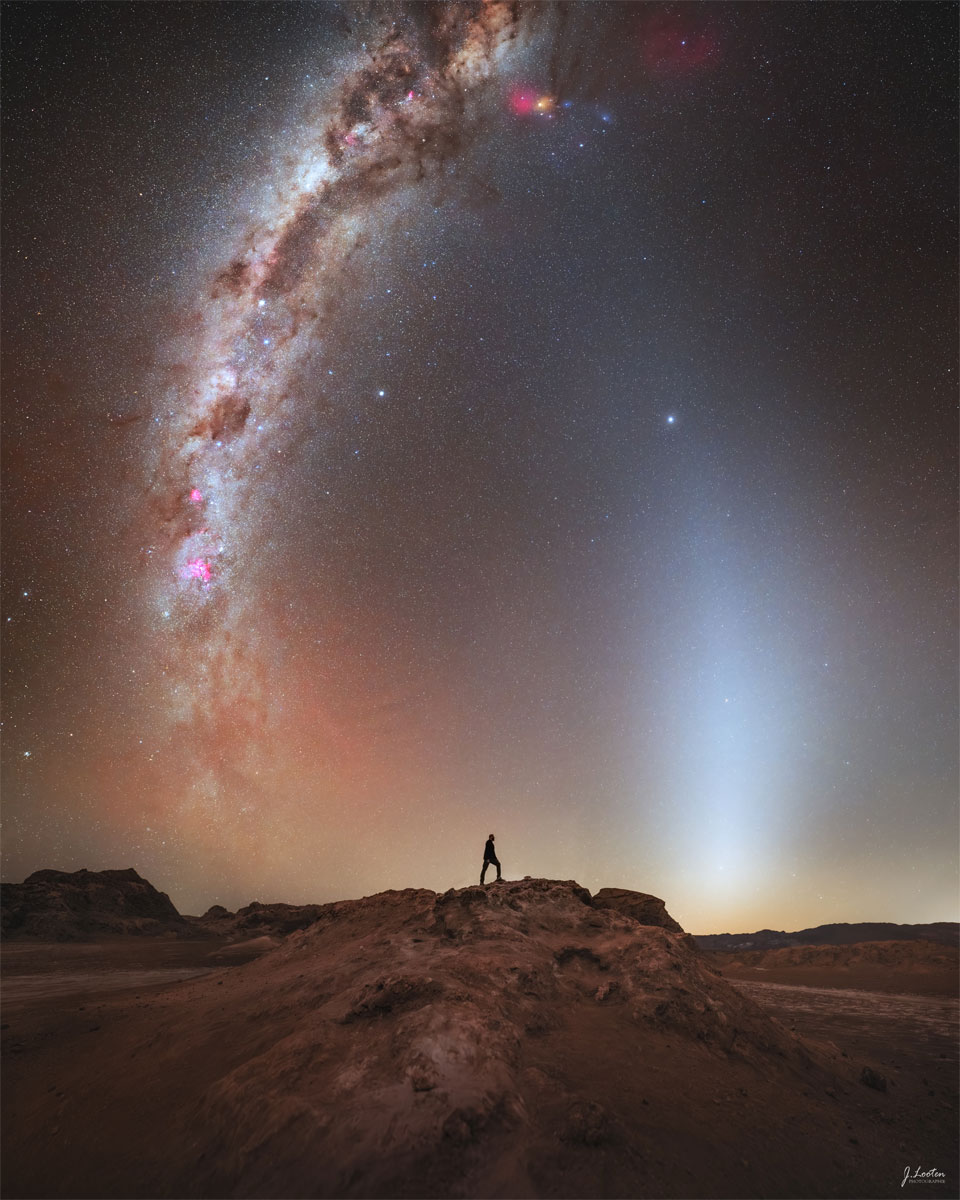
Cosmic Crossroads: Our Galaxy's Glow Meets Space Dust's Shine

The Full Story

From the incredibly dark skies of Chile's Atacama Desert, a captivating celestial scene unfolded, showcasing two distinct bands of light that often go unnoticed by casual observers. The most prominent band, stretching across the left side of the frame, is our very own Milky Way galaxy. We see it as a brilliant ribbon because our Sun, along with Earth, resides within its vast, flat disk. When we look along this disk from our vantage point, we're essentially looking through billions of stars, gas, and dust, which coalesce into this familiar, glowing band. Contrasting with the Milky Way's majestic sweep, a more subtle, pyramid-shaped glow rises from the horizon on the right – this is the zodiacal light. Often called 'false dawn' or 'false dusk,' it's caused by sunlight reflecting off countless microscopic dust particles scattered throughout our solar system. Much like dust particles catching the light in a sunbeam, these cosmic motes become visible when the Sun is just below the horizon, illuminating them from an angle that allows us to perceive their faint glow against the dark sky. For a long time, the exact origin of this interplanetary dust was a mystery. Scientists once thought it might be leftover material from the early days of our solar system's formation. However, a significant discovery made within this century revealed a surprising truth: most of the zodiacal dust actually comes from comets. These icy wanderers, as they journey through space, shed tiny bits of their material, creating a trail of dust. Crucially, the massive gravitational pull of Jupiter plays a vital role, often nudging these comets and their dust into orbits that contribute to the zodiacal cloud. This insight is more than just an interesting tidbit; it's a window into the dynamic processes constantly at play in our solar system. Comets are like cosmic time capsules, carrying pristine material from the solar system's formation. By understanding how they shed dust and how that dust is distributed, we gain deeper knowledge about the evolution of planetary systems, the delivery of materials like water to early Earth, and the ongoing interactions between planets and smaller bodies. It highlights that our solar system is not a static place, but a vibrant, ever-changing environment. Observing phenomena like zodiacal light requires exceptionally dark skies, making locations like the Atacama Desert invaluable to astronomers and astrophotographers. Light pollution from cities can easily overwhelm these faint glows, underscoring the importance of preserving dark sky sites for both scientific discovery and the simple wonder of experiencing the universe around us.

Key Takeaways

  • 1 The image showcases two distinct celestial light shows: our Milky Way galaxy and the mysterious zodiacal light.
  • 2 Zodiacal light is caused by sunlight reflecting off microscopic dust particles floating in our solar system, best seen at twilight.
  • 3 Scientists recently discovered that most of this interplanetary dust originates from comets, especially those influenced by Jupiter's gravity.

💡 Think of it this way:

Imagine standing inside a giant, flat dinner plate – the Milky Way band is like looking across the plate from your position. The zodiacal light is like seeing dust motes dancing in a sunbeam within a dim room, but on a cosmic scale.

How We Know This

Astronomers captured this stunning image using specialized cameras and long exposure times from an extremely dark location. By combining such observations with scientific modeling of dust particle trajectories and compositions, researchers were able to pinpoint comets, particularly those interacting with Jupiter's gravity, as the primary source of the dust creating the zodiacal light.

What This Means

Understanding the origin and distribution of zodiacal dust provides crucial insights into the active processes within our solar system, including cometary dynamics and how material is exchanged and recycled. This knowledge helps us better understand the early formation and evolution of planets, and can even inform studies of similar dust disks observed around other stars, hinting at their own planetary formation processes.

Why It Matters

These celestial spectacles offer a stunning reminder of our place within our vast galaxy and the dynamic processes shaping our solar system. Understanding the origin of space dust helps us learn about comets, planetary evolution, and the constant recycling of material in our cosmic neighborhood.

Related Topics

#Astronomy #Milky Way #Zodiacal Light #Comets #Space Dust