Back to Articles Image Of The Day

Mars Pathfinder: Bouncing Our Way to a Martian First!

📖 3 min read 📊 beginner 🏷️ NASA APOD

In Brief

On July 4, 1997, the Mars Pathfinder spacecraft made an unforgettable landing by literally bouncing onto the Red Planet inside a giant airbag cocoon. This daring mission delivered Sojourner, the first successful robotic rover, to explore Mars's surface.
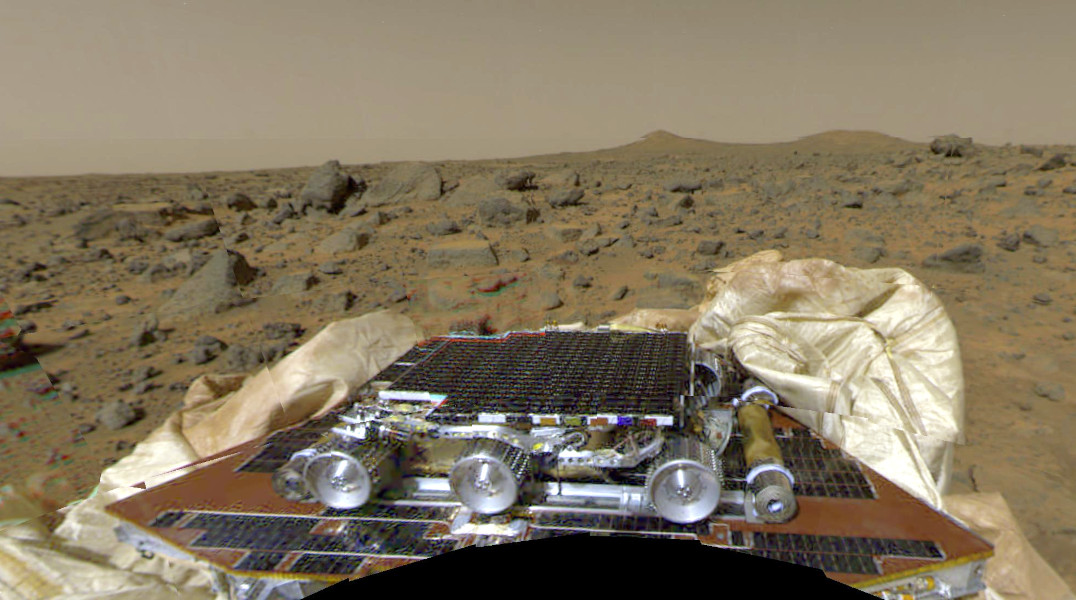
Mars Pathfinder: Bouncing Our Way to a Martian First!

The Full Story

July 4th, 1997, wasn't just Independence Day on Earth; it marked a spectacular display of cosmic fireworks on Mars! The Mars Pathfinder spacecraft, after a journey of millions of miles, arrived with a dramatic flair. Instead of a delicate descent, Pathfinder came equipped with a truly novel landing system. After deploying a giant parachute to slow its fall, a cluster of retro-rockets fired, and then, wrapped in a protective cocoon of airbags, it slammed into the Martian surface. Like a giant beach ball, the entire spacecraft bounced an astonishing 15 times or more before finally rolling to a stop. This airbag landing was revolutionary. Prior missions had used skids or lander legs, but the "bounce-and-roll" method offered a robust, relatively simple, and cost-effective way to get scientific instruments safely onto an alien world. Once the bouncing ceased, the airbags deflated and retracted, revealing the Pathfinder lander, which was subsequently renamed the Carl Sagan Memorial Station in honor of the famed astronomer. One of its first acts was to transmit a stunning color mosaic of its surroundings back to eagerly awaiting mission operators on Earth. And what a scene it was! In the foreground of that iconic image, nestled atop the unfolded Pathfinder lander, was a small, six-wheeled robot. This was Sojourner, a solar-powered rover about the size of a large house cat, and it was about to make history. Sojourner became the first successful robotic rover to roam the surface of another planet. Its mission: to explore the immediate vicinity of the lander, examine rocks, and gather data on the Martian environment, proving that mobile exploration on Mars was not just a dream, but a reality. Pathfinder and Sojourner touched down in a region called Ares Vallis, an ancient floodplain believed to have once been carved by massive outflows of water. Scientists chose this site because it offered a rich geological tapestry, with various rocks and sediments that could reveal clues about Mars's watery past. The images and data transmitted back by Pathfinder and Sojourner provided invaluable insights into the composition of Martian rocks and soil, the atmospheric conditions, and the potential for past habitability, all against a dusty, brownish sky with distant Martian hills. The Mars Pathfinder mission was a monumental success, far exceeding its planned operational lifetime. More than just a successful landing and a few cool pictures, it fundamentally reshaped our approach to Mars exploration. The groundbreaking airbag landing technology and the successful deployment and operation of Sojourner paved the way for a generation of more sophisticated and larger rovers, including Spirit, Opportunity, Curiosity, and Perseverance. Pathfinder didn't just land on Mars; it opened the doors to a new era of mobile robotic exploration, continuously inspiring humanity's quest to understand our planetary neighbor.

Key Takeaways

  • 1 Mars Pathfinder achieved the first-ever successful airbag landing on Mars in 1997.
  • 2 It delivered Sojourner, the first successful robotic rover to explore the surface of another planet.
  • 3 The mission provided crucial early insights into Mars's geology, atmosphere, and evidence of past water.
  • 4 Pathfinder's success revolutionized planetary landing techniques and paved the way for all subsequent Mars rover missions.

💡 Think of it this way:

Imagine throwing a giant beach ball from space onto a rocky playground – that's how Pathfinder landed!

How We Know This

The Pathfinder spacecraft used a multi-stage landing sequence: a heat shield for atmospheric entry, a large parachute to slow down, and then a novel system of inflatable airbags to cushion its final impact, causing it to bounce many times before settling. Once on the surface, the lander unfurled, releasing the small, solar-powered Sojourner rover to explore the immediate surroundings.

What This Means

Pathfinder proved that a relatively low-cost mission could successfully deliver and operate a rover on Mars. This success directly inspired and enabled the development of all subsequent Mars rovers, which have drastically expanded our knowledge of the Red Planet's history, geology, and potential for life. It cemented the idea that mobile robots are crucial for planetary exploration and set a new standard for future interplanetary missions.

Why It Matters

This historic mission proved a revolutionary way to land on Mars and gave us our very first mobile robot explorer, paving the way for all the Martian rovers we know and love today.

Related Topics

#Mars #Pathfinder #Sojourner #Space Exploration #NASA