Back to Articles Image Of The Day

Cosmic Explosion Near Galaxy's Heart Points to Star's Fiery End

📖 3 min read 📊 beginner 🏷️ NASA APOD

In Brief

Astronomers have spotted a 'blue blob' of X-rays near our galaxy's supermassive black hole, which they suspect is the glowing aftermath of a massive star's explosion 1,700 years ago. This potential supernova remnant is one of the closest ever found to the Milky Way's bustling core.
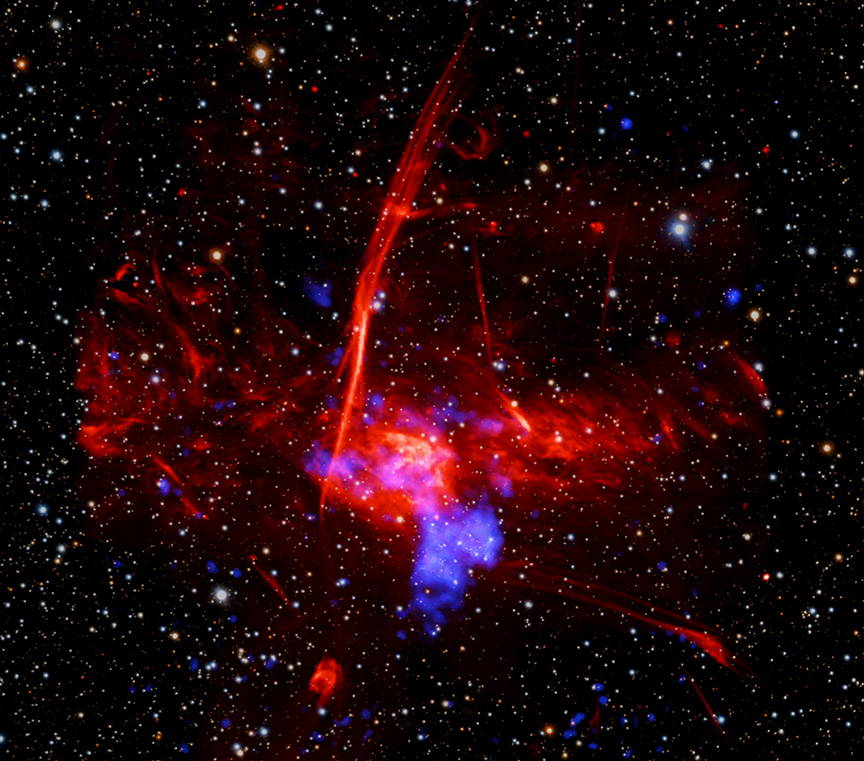
Cosmic Explosion Near Galaxy's Heart Points to Star's Fiery End

The Full Story

Peer into the bustling heart of our Milky Way galaxy, and you might just spot a mysterious 'blue blob' of X-ray light. Astronomers believe this shimmering cloud is the ghostly afterglow of a colossal star that exploded as a supernova some 1,700 years ago – around the time the Roman Empire was at its peak! This potential discovery, located surprisingly close to our galaxy's supermassive black hole, offers a rare glimpse into the dramatic lives and deaths of stars in one of the universe's most extreme neighborhoods. When a massive star runs out of fuel, it collapses under its own gravity before exploding in a spectacular supernova, briefly outshining an entire galaxy. What's left behind is a 'supernova remnant' – an expanding bubble of superheated gas and debris that continues to glow for thousands of years. The 'blue blob' we're seeing isn't visible light; it's X-rays, which are high-energy light waves produced by gas heated to millions of degrees as the shockwave from the explosion crashes into surrounding material. Think of it as a cosmic 'smoke ring' that continues to expand and glow long after the initial fireworks. This particular remnant isn't just anywhere; it's nestled within the dense, chaotic region known as Sagittarius C, a massive star-forming cloud stretching about 50 light-years across. This cosmic nursery, approximately 26,000 light-years from Earth, is incredibly active, constantly giving birth to new stars. What makes this discovery even more thrilling is its extreme proximity – a mere 260 light-years – to Sagittarius A*, the supermassive black hole lurking at the very center of our galaxy. Imagine a star meeting its end just a stone's throw (cosmically speaking) from the ultimate cosmic devourer! If confirmed, this would be one of the closest supernova remnants ever identified to the Galactic Center. Why does that matter? In such a packed and dynamic environment, the death of massive stars like this one isn't just an isolated event. These explosions are vital players in the cosmic drama, injecting heavy elements back into space and potentially triggering the formation of new stars by compressing gas clouds. Studying this remnant could help us understand the intricate interplay between stellar deaths, the birth of new stars, and the powerful magnetic fields and gas flows that dominate the unique environment around our galaxy's colossal black hole.

Key Takeaways

  • 1 A 'blue blob' of X-rays is a possible supernova remnant near the Milky Way's center.
  • 2 The star likely exploded 1,700 years ago, leaving behind an expanding cloud of superheated gas.
  • 3 If confirmed, it would be one of the closest supernova remnants to our galaxy's supermassive black hole.
  • 4 This discovery helps us understand star formation and death in extreme galactic environments.

💡 Think of it this way:

Imagine finding the ghostly fingerprint of an ancient cosmic explosion, revealing a spectacular death that illuminated our galaxy long ago, helping us piece together the universe's history.

How We Know This

Astronomers pieced together this cosmic puzzle by combining observations from multiple telescopes, much like combining different camera filters to see all layers of a painting. Optical data from Hawaii's PanSTARRS telescopes showed the background stars. Radio waves captured by South Africa's MeerKAT telescope revealed a large star-forming cloud. Finally, X-ray light, which reveals incredibly hot gas, was detected by NASA's Chandra X-ray Observatory and ESA's XMM-Newton. By layering these different 'views' of the universe, scientists could pinpoint and analyze the glowing 'blue blob' in detail.

What This Means

The confirmation of this supernova remnant would provide a unique laboratory for studying stellar evolution and its impact in an extreme environment. Future observations will aim to solidify its identity and precisely map its structure, allowing scientists to model how its powerful shockwaves interact with the dense gas and magnetic fields in Sagittarius C. This research could illuminate the mechanisms behind star formation near a supermassive black hole and deepen our understanding of the dynamic forces shaping our galaxy's very core.

Why It Matters

Understanding these powerful explosions in such a chaotic region helps us unravel how stars are born, die, and influence the entire galaxy, including the extreme environment around our supermassive black hole.

Related Topics

#Supernova #Galactic Center #X-ray Astronomy #Star Death #Sagittarius C