Saturn's Grand Spectacle: A Cassini Snapshot of Moons, Rings, and Shadows
In Brief
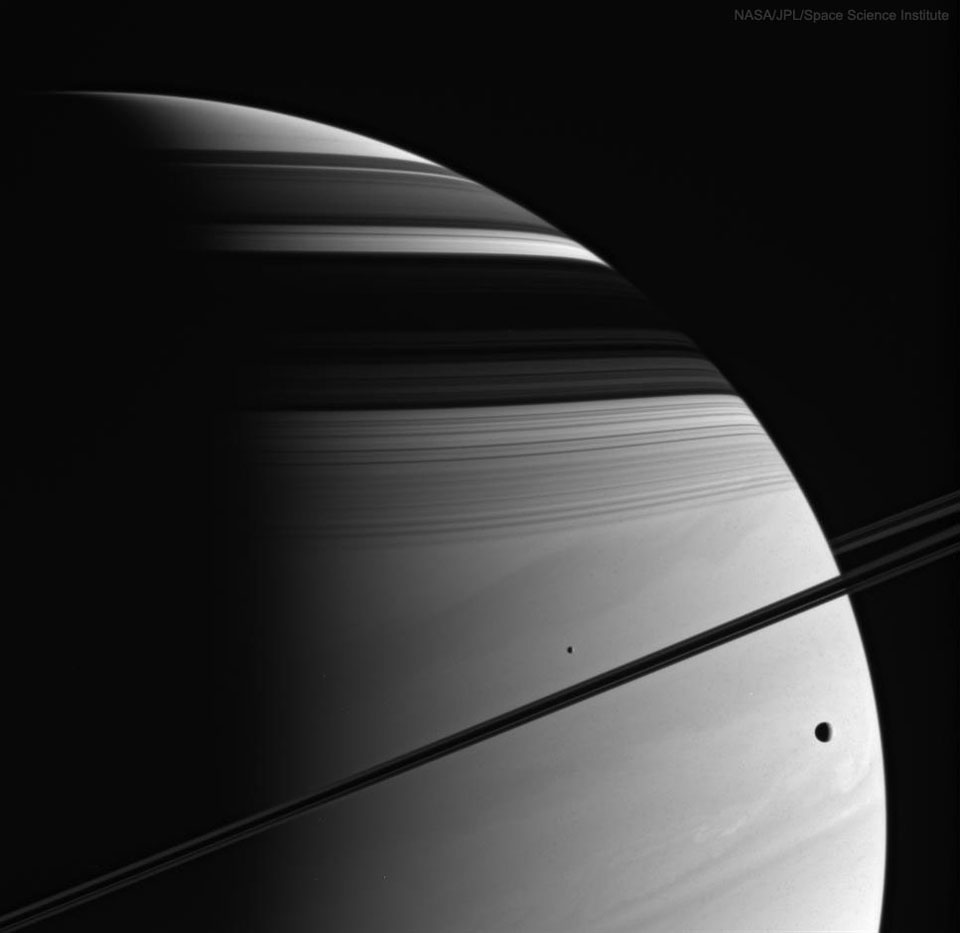
A stunning 2005 image from the Cassini spacecraft provides a unique view of Saturn, showcasing two of its icy moons flanking its magnificent, nearly edge-on rings. Dramatic shadows cast by the rings stretch across the planet's cloudy surface, offering an intricate portrait of this gas giant.
The Full Story
Key Takeaways
- 1 The 2005 Cassini image captures Saturn's moons (Mimas and Tethys), its edge-on rings, and the complex shadows they cast across the planet.
- 2 The view highlights the immense scale of Saturn's system and the dynamic interactions between its components.
- 3 Ring shadows provide clues to the intricate structure and composition of Saturn's magnificent rings.
- 4 The Cassini mission (2004-2017) provided unprecedented data, including this image, and concluded with a 'Grand Finale' dive into Saturn to protect potential life on its moons.
- 5 Observing these celestial interactions helps scientists understand planetary formation, dynamics, and atmospheric science, informing our understanding of the universe.
💡 Think of it this way:
Imagine catching a perfectly timed shot of a giant, spinning carousel, where tiny, glowing ornaments (moons) orbit on either side of a shimmering, paper-thin ribbon (rings) that casts long, dark patterns across the carousel's colorful base (Saturn's clouds).
How We Know This
The discovery was made using the Cassini spacecraft, a sophisticated robotic orbiter equipped with powerful cameras and instruments. Cassini spent over a decade circling Saturn, taking countless images and collecting data. For this specific picture, Cassini used a special 'violet-light' filter on its camera, which helped to enhance the visibility of Saturn's cloud textures and details that might be less apparent in normal visible light. The spacecraft acted as our 'eyes' in orbit around Saturn, sending its observations back to Earth for scientists to study.
What This Means
The data from Cassini, including images like this, continues to be a treasure trove for scientists. Future studies will delve deeper into the complex interactions between Saturn's rings and moons, helping us understand how planetary systems evolve. This knowledge can then be applied to studying exoplanets – planets outside our solar system – to better understand their formation and potential for life. Cassini's success also paves the way for future ambitious missions to gas giants and other icy worlds, pushing the boundaries of space exploration and our search for life beyond Earth.
Why It Matters
This breathtaking image reminds us of the incredible beauty and dynamic nature of our solar system's planets. It highlights the success of robotic missions like Cassini in exploring distant worlds and expanding our understanding of planetary systems beyond Earth.