Back to Articles Image Of The Day

Our Pale Blue Dot, Seen From Across the Solar System

πŸ“– 3 min read πŸ“Š beginner 🏷️ NASA APOD

In Brief

Imagine looking back at Earth from another planet. On July 19, 2013, two robotic spacecraft, one orbiting Mercury and another orbiting Saturn, simultaneously captured photos of our home planet, offering a unique, interplanetary perspective. These rare images highlight our tiny place in the vastness of space, seen from nearly opposite ends of the inner and outer Solar System.
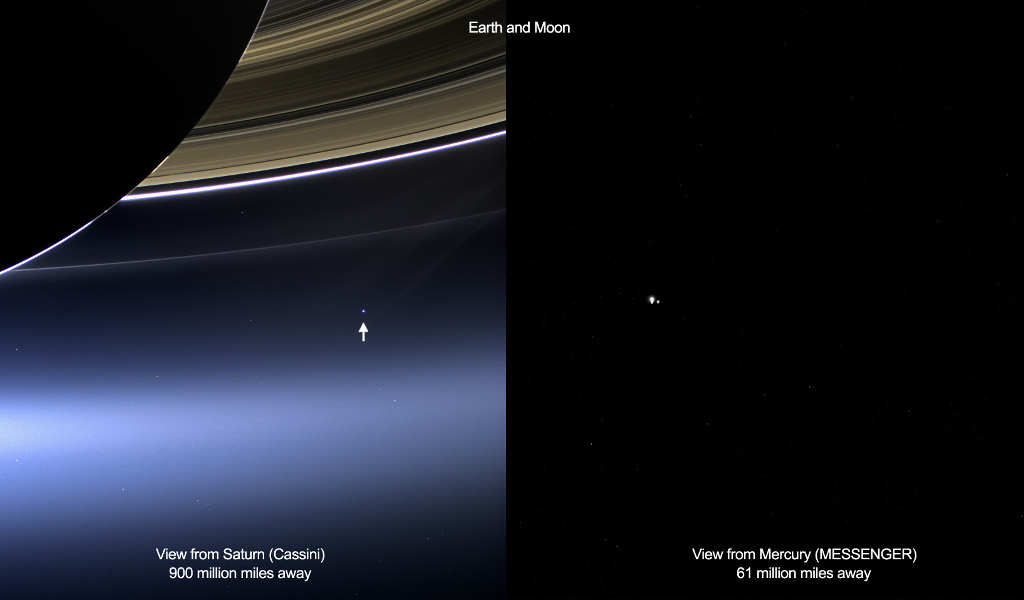
Our Pale Blue Dot, Seen From Across the Solar System

Disclosure: This post contains affiliate links. As an Amazon Associate, I earn from qualifying purchases.

The Full Story

Imagine gazing back at Earth from a distant vantage point, not just once, but from two entirely different worlds across our vast Solar System, all on the very same day. That’s exactly what happened on July 19, 2013, in an extraordinary moment of interplanetary photography. Our home planet was simultaneously captured by two intrepid robotic explorers: the Cassini spacecraft, orbiting the majestic ringed gas giant Saturn, and the MESSENGER spacecraft, whizzing around the sun-scorched innermost planet, Mercury. This was a truly unique "family photo" of Earth, seen from nearly opposite ends of our planetary neighborhood. From its lofty perch near Saturn, the Cassini spacecraft pointed its camera back towards the inner Solar System. In its iconic image, Earth appears as a delicate, pale blue dot nestled just below Saturn's brilliant rings, almost like a precious jewel hanging in the cosmic dark. This particular day was special not just for Cassini, but also for us on Earth! People all over our planet were encouraged to "wave at Saturn" knowing that Cassini was taking their picture from afar. It was a beautiful, shared moment, reminding us of our connection to the cosmos, even as we were being photographed from billions of miles away. Meanwhile, 1.6 billion miles closer to the Sun, the MESSENGER spacecraft, dutifully orbiting Mercury, was also snapping pictures of Earth. MESSENGER's mission was to study Mercury, and on this day, it was actually scanning for tiny, faint natural satellites that might be circling Mercury. During this search, it serendipitously caught a glimpse of the Earth-Moon system. Because Earth and our Moon are much brighter than any potential tiny Mercurian moons, they appeared overexposed in MESSENGER's images, shining brilliantly with reflected sunlight against the dark canvas of space. It’s like taking a photo of a candle flame with a camera set for a dark room – the flame would appear incredibly bright and bloomed. These dual images are more than just pretty cosmic postcards; they offer a profound perspective on our place in the universe. They vividly illustrate just how small and solitary our home planet appears when viewed from such immense distances. The "pale blue dot" image from Cassini echoes the famous photograph taken by Voyager 1, reinforcing the fragility and uniqueness of Earth. Seeing our world as a tiny speck of light encourages us to appreciate and protect this precious oasis of life, our only home. Both Cassini and MESSENGER were pioneers in their own right, delivering incredible discoveries about Saturn and Mercury respectively. However, like all space missions, their journeys eventually came to an end. Cassini concluded its epic thirteen-year mission at Saturn with a planned dive into the planet's atmosphere in 2017, burning up like a meteor to protect any potential life on Saturn's moons. MESSENGER, after four years orbiting Mercury, intentionally crashed onto Mercury's surface in 2015. Though these robotic explorers are now silent, their legacy lives on through the vast amounts of data and inspiring images, like these portraits of our home, that they sent back to us.

Key Takeaways

  • 1 On July 19, 2013, Earth was photographed simultaneously by two spacecraft, Cassini (orbiting Saturn) and MESSENGER (orbiting Mercury), marking an interplanetary first.
  • 2 Cassini captured Earth as a 'pale blue dot' below Saturn's rings, while MESSENGER imaged the brighter, overexposed Earth-Moon system during a search for Mercury's natural satellites.
  • 3 These unique images provide a powerful perspective on our planet's smallness and preciousness in the vast Solar System, showcasing the incredible reach of human ingenuity through robotic exploration.
LEGO NASA Apollo Saturn V Rocket

LEGO NASA Apollo Saturn V Rocket

Detailed LEGO model of the iconic Saturn V rocket. Perfect for display and space history enthusiasts.

Check Price on Amazon
*As an Amazon Associate, we earn from qualifying purchases.

πŸ’‘ Think of it this way:

It's like having two friends at opposite ends of a huge concert hall take a picture of you at the same moment – a truly unique snapshot from different viewpoints!

How We Know This

These images were taken by robotic spacecraft, Cassini orbiting Saturn and MESSENGER orbiting Mercury. Cassini used its wide-angle camera to capture the faint dot of Earth against the backdrop of Saturn's rings, while MESSENGER's cameras, designed for close-up observations of Mercury, captured a brighter, overexposed view of the Earth-Moon system during a search for tiny moons around Mercury. It's like using different types of camera lenses – one for a wide, distant shot, and another for a closer, more detailed look.

What This Means

This type of multi-point observation helps scientists understand atmospheric conditions on Earth and how our planet reflects sunlight from different angles. More importantly, it inspires future missions to explore our Solar System and beyond, pushing the boundaries of what's possible in space photography and providing unparalleled views of our home from alien skies. It also reminds us to keep looking up and appreciating our home world.

Why It Matters

This incredible feat reminds us that we are all inhabitants of one planet, a small, vibrant world sailing through the cosmos. It inspires wonder about our place in the universe and showcases humanity's reach through robotic explorers.

Related Topics

#Earth #Solar System #Space Exploration #Cassini #MESSENGER