Venus and Jupiter's Dazzling 'Cosmic Kiss' Graces Twilight Skies
In Brief
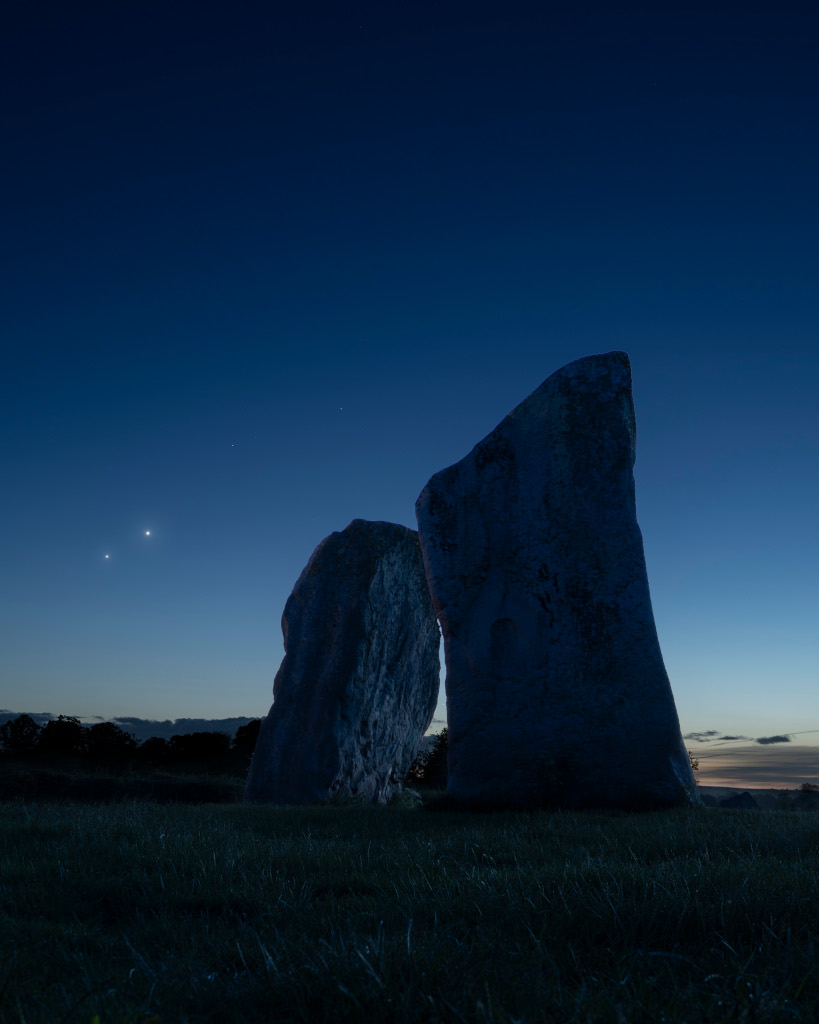
Recently, the two brightest planets in our night sky, Venus and Jupiter, put on a stunning show, appearing incredibly close together right after sunset. This beautiful alignment, easily visible without any special equipment, offered a rare chance to witness a celestial 'cosmic kiss' as they briefly shared the western horizon.
The Full Story
Key Takeaways
- 1 Venus and Jupiter appeared incredibly close in the twilight sky in a stunning 'cosmic kiss'.
- 2 This 'conjunction' occurs because Venus, an inner planet, orbits the Sun faster than outer planet Jupiter.
- 3 While conjunctions happen every ~13 months, easily visible ones like this occur roughly every three years.
- 4 The event was captured against the backdrop of Avebury, a 4,000-year-old stone circle, linking modern skywatching to ancient practices.
💡 Think of it this way:
Imagine two runners on a circular track. One runner (Venus) is much faster and on an inner lane, while the other (Jupiter) is slower and on an outer lane. Every so often, the faster runner catches up and briefly runs side-by-side with the slower one from our perspective.
How We Know This
This 'discovery' wasn't about finding something new, but rather about capturing a beautiful, predictable astronomical event. The stunning image was created using standard photographic techniques, strategically framing the conjunction of Venus and Jupiter with the ancient standing stones of Avebury, UK, at sunset. The 'method' involved knowing precisely when and where to look for the planetary alignment and having the right conditions to photograph it against a significant terrestrial landmark.
What This Means
These visible planetary alignments serve as a fantastic gateway to ignite public interest in astronomy and encourage simple skywatching. They remind us that the wonders of the universe are often right above our heads, easily accessible without specialized equipment. Future conjunctions will continue to offer unique photo opportunities and inspire new generations to connect with both the cosmos and human history, especially when viewed against ancient sites that highlight our long relationship with the night sky.
Why It Matters
This event was a perfect reminder of the simple wonders of our solar system, offering an easy and breathtaking view for anyone to enjoy. It connected modern sky-watchers with ancient observers who also gazed at these same celestial dances.