Eagle Nebula's Pillars of Creation: Star Factories Stand Strong
In Brief
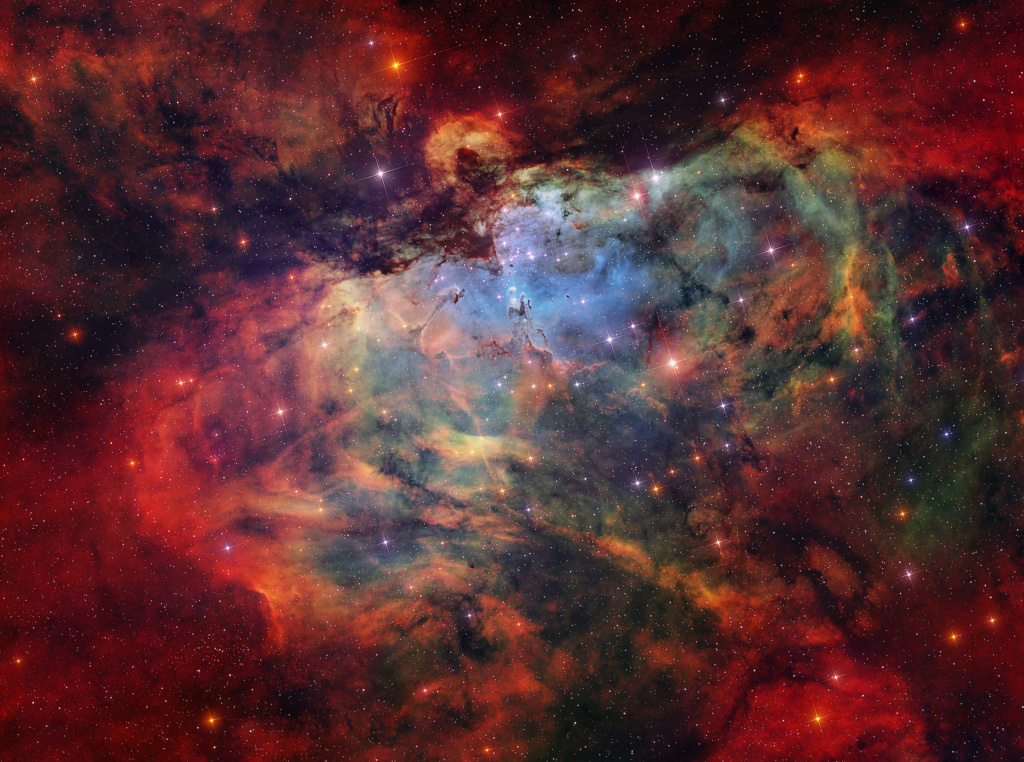
Recent observations confirm that the majestic Pillars of Creation within the Eagle Nebula are not only intact but are still actively creating new stars. Dispelling previous theories of their destruction, astronomers now believe these iconic cosmic nurseries will continue to thrive for millions of years. This offers a powerful glimpse into the ongoing process of star birth in our universe.
The Full Story
Key Takeaways
- 1 The Eagle Nebula's Pillars of Creation are confirmed to be actively forming new stars.
- 2 Past theories suggesting their destruction by a supernova are not supported by current evidence.
- 3 The Pillars are dense structures of cold gas and dust, essential ingredients for star birth.
- 4 Located 6,000 light-years away, we observe the Pillars as they were 6,000 years ago.
- 5 These cosmic nurseries are expected to continue creating stars for millions of years.
💡 Think of it this way:
Think of the Pillars of Creation as gigantic cosmic skyscrapers under construction, where gravity is the foreman, slowly but surely building new stars from dust and gas. Instead of wrecking balls, we once thought a supernova might have been a cosmic wrecking ball, but it turns out the construction continues!
How We Know This
Astronomers use powerful telescopes, both ground-based and orbiting in space, to capture stunning images and detailed data from nebulae like M16. By analyzing the different types of light (from visible light to infrared and ultraviolet) emitted and absorbed by the gas and dust, they can map its density, temperature, and motion. This allows them to identify regions where stars are forming, understand the conditions required for star birth, and track the evolution of these cosmic structures over time, helping to confirm or disprove theories about their future.
What This Means
The continued activity of the Pillars of Creation offers invaluable data for understanding the complete life cycle of stars and planetary systems. Future observations with advanced telescopes will allow scientists to peer even deeper into these dusty clouds, potentially uncovering more nascent stars and gaining a clearer picture of the initial conditions for planet formation. This research helps us refine our models of galaxy evolution and our place within the vast, star-filled universe.
Why It Matters
Understanding the Pillars of Creation helps us unravel the mysteries of how stars, including our own Sun, are born. It connects us to the grand cosmic cycle of creation and destruction, showing us that even in the vastness of space, life finds a way to begin, shaping the very building blocks of planets and potentially, life.