Thor's Helmet: A Giant Star's Cosmic Bubble Ready to Pop!
In Brief
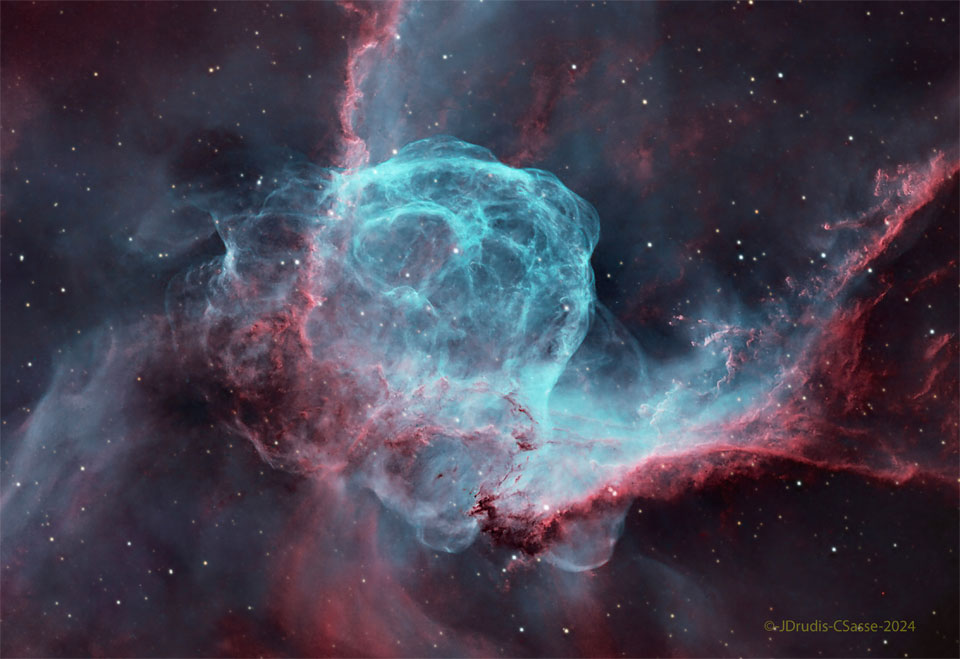
Astronomers have captured a stunning image of Thor's Helmet, a huge cosmic cloud shaped like a Viking god's headwear. This magnificent nebula is actually a bubble blown by a super-hot, massive star that's on the verge of exploding in a spectacular supernova.
The Full Story
Key Takeaways
- 1 Thor's Helmet is a 30 light-year wide cosmic bubble, not a solid object.
- 2 It's created by powerful winds from a massive, super-hot Wolf-Rayet star at its center.
- 3 This central star is in its final stages and will explode as a supernova within a few millennia.
💡 Think of it this way:
Imagine a giant blowing a bubble so big it's like a planet-sized soap bubble, except instead of soap, it's cosmic gas, and the giant is a dying star about to go supernova!
How We Know This
This stunning image of Thor's Helmet isn't just one snapshot. It's a careful blend of deep images taken through specialized filters that capture light emitted by specific elements in space. Scientists combined light from hydrogen, which glows red, and oxygen, which appears blue. By layering these 'colors' of light, astronomers can reveal intricate details and structures of the nebula that would otherwise be invisible, giving us a comprehensive view of this dynamic cosmic bubble.
What This Means
Observing objects like Thor's Helmet helps astronomers piece together the complex life cycles of massive stars. By studying the powerful winds from Wolf-Rayet stars and the resulting nebulae, we gain crucial insights into how these colossal stars shed their outer layers, preparing for their ultimate demise. Understanding these pre-supernova stages is vital for predicting and studying supernovae, which are responsible for forging and scattering heavy elements throughout the universe—elements that eventually form new stars, planets, and even the building blocks of life.
Why It Matters
This image gives us a rare peek into the dramatic final stages of a giant star's life, helping us understand how massive stars transform and enrich the universe with elements essential for new stars, planets—and even life itself.