Back to Articles Image Of The Day

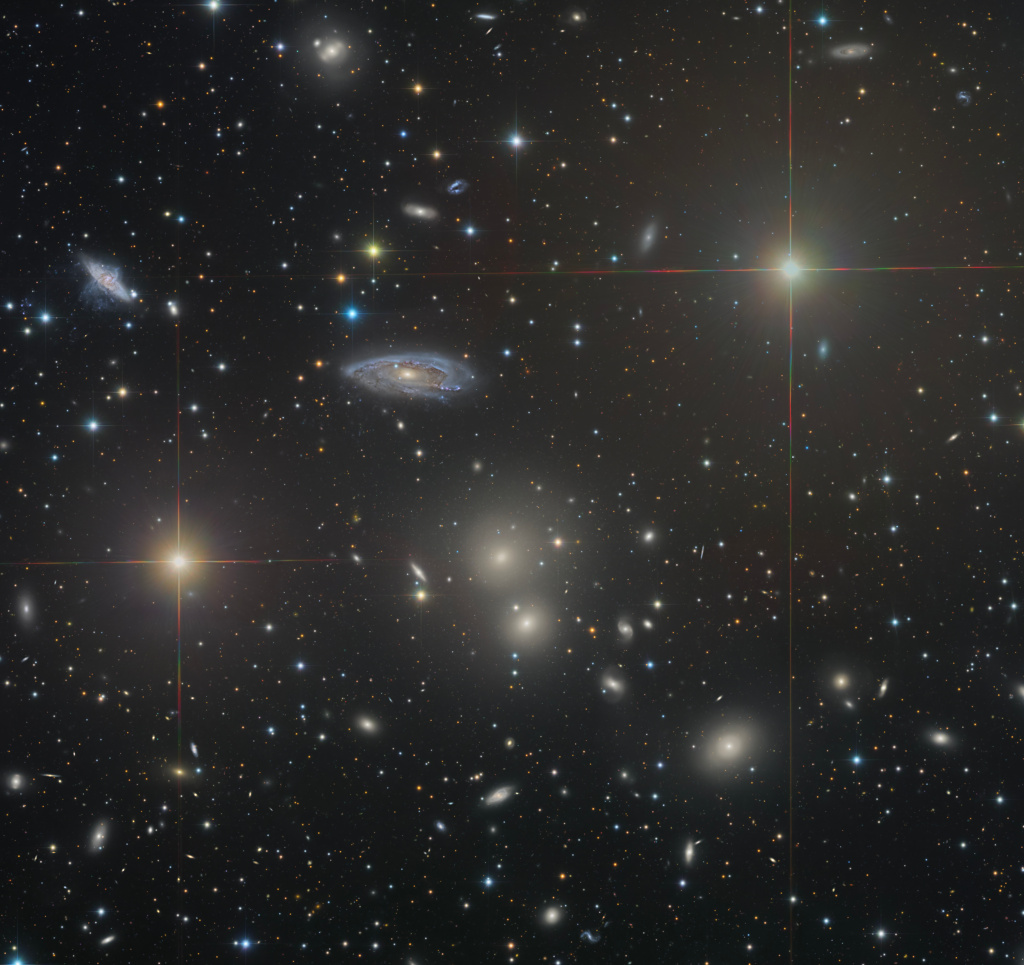
Hydra Cluster: Peering into a Cosmic Metropolis

📖 3 min read 📊 beginner 🏷️ NASA APOD

In Brief

Imagine gazing at stars near our Milky Way, then seeing an entire city of galaxies far beyond! The Hydra Cluster, located over 100 million light-years away, is a massive collection of galaxies, including giant ellipticals and a beautiful blue spiral. It offers a stunning glimpse into the universe's grand architecture.
Hydra Cluster: Peering into a Cosmic Metropolis

Disclosure: This post contains affiliate links. As an Amazon Associate, I earn from qualifying purchases.

The Full Story

When we look up at the night sky, we often see individual stars that seem close enough to touch. But what if we told you that behind some of those seemingly nearby 'spiky' stars, which are only hundreds of light-years away (a light-year is the distance light travels in a year, a mind-boggling six trillion miles!), lies an entire cosmic city over 100 million light-years in the distance? This incredible perspective is exactly what we get when we observe the Hydra Cluster of galaxies. Named for the constellation Hydra, this cluster is a true 'metropolis' in space. At its heart are three dominant giants: two grand, yellowish elliptical galaxies (named NGC 3311 and NGC 3309) that look like ancient, stately buildings, and a prominent blue spiral galaxy (NGC 3312) that resembles a vibrant, swirling cosmic pinwheel. Each of these colossal galaxies spans about 150,000 light-years across – that's one and a half times the diameter of our own Milky Way! Adding to the intrigue, an overlapping pair of galaxies, cataloged as NGC 3314, catches the eye, appearing almost like two cosmic dancers caught mid-embrace. The Hydra Cluster, also known as Abell 1060, isn't just a random collection; it's a testament to the power of gravity. Galaxies across the universe aren't just floating aimlessly; they are gravitationally bound together into these massive groups called 'galaxy clusters.' These clusters, in turn, are loosely bound into even larger structures known as 'superclusters,' which themselves form immense filaments and voids across the cosmos. The Hydra Cluster is one of three major galaxy clusters relatively 'close' to our Milky Way within a 200-million-light-year radius, making it a crucial neighbor in our cosmic neighborhood. Studying clusters like Hydra is like examining different cities on Earth to understand human civilization. By observing the types of galaxies within the cluster, how they interact, and their overall distribution, astronomers gain vital clues about the universe's history. It helps us understand the role of gravity on the largest scales, the mysterious dark matter that holds these colossal structures together, and how galaxies form, evolve, and sometimes collide over billions of years. This allows us to piece together the grand story of our universe and locate our own place within its magnificent, sprawling tapestry.

Key Takeaways

  • 1 The Hydra Cluster is a massive collection of galaxies over 100 million light-years from Earth.
  • 2 It contains diverse galaxies, including two giant ellipticals and a prominent blue spiral, each larger than our Milky Way.
  • 3 Galaxy clusters are fundamental building blocks of the universe's large-scale structure, held together by gravity.
National Geographic Planisphere Star Finder

National Geographic Planisphere Star Finder

Essential tool for identifying constellations and stars. Perfect for beginners learning the night sky.

Check Price on Amazon
*As an Amazon Associate, we earn from qualifying purchases.

💡 Think of it this way:

Think of our Milky Way as a house in a small town. The Hydra Cluster is like an entire bustling metropolis, far across the country, with hundreds of buildings (galaxies) held together in one massive urban area.

How We Know This

Astronomers use powerful ground-based and space-based telescopes to capture the incredibly faint light from objects millions of light-years away. By collecting this light, which has traveled across vast cosmic distances, they can create stunning images and analyze the light's properties to determine the galaxies' types, sizes, distances, and how they are moving and interacting within the cluster.

What This Means

By observing clusters like Hydra, scientists gain crucial insights into the forces that shape the universe, how galaxies interact and merge, and the distribution of dark matter – the invisible scaffolding of the cosmos. This research helps us piece together the grand story of cosmic evolution, predict the future behavior of galaxy groups, and ultimately understand where our own galaxy fits into this magnificent tapestry of the universe.

Why It Matters

Understanding these distant galaxy clusters helps scientists unravel how the universe formed and evolved, from the smallest stars to the largest cosmic structures, giving us context for our own place in the cosmos.

Related Topics

#Galaxy Cluster #Cosmic Structure #Astronomy #Hydra #Galaxies