Back to Articles Image Of The Day

Webb Telescope Unwraps Cosmic Soccer Balls in a Dazzling Nebula

📖 3 min read 📊 beginner 🏷️ NASA APOD

In Brief

The James Webb Space Telescope has peered into a mysterious nebula, Tc 1, revealing exactly where strange 'buckyball' molecules — carbon atoms shaped like soccer balls — are hiding. These cosmic buckyballs form a delicate spherical shell around the nebula's dying star, giving scientists new clues about how complex chemistry unfolds in space.
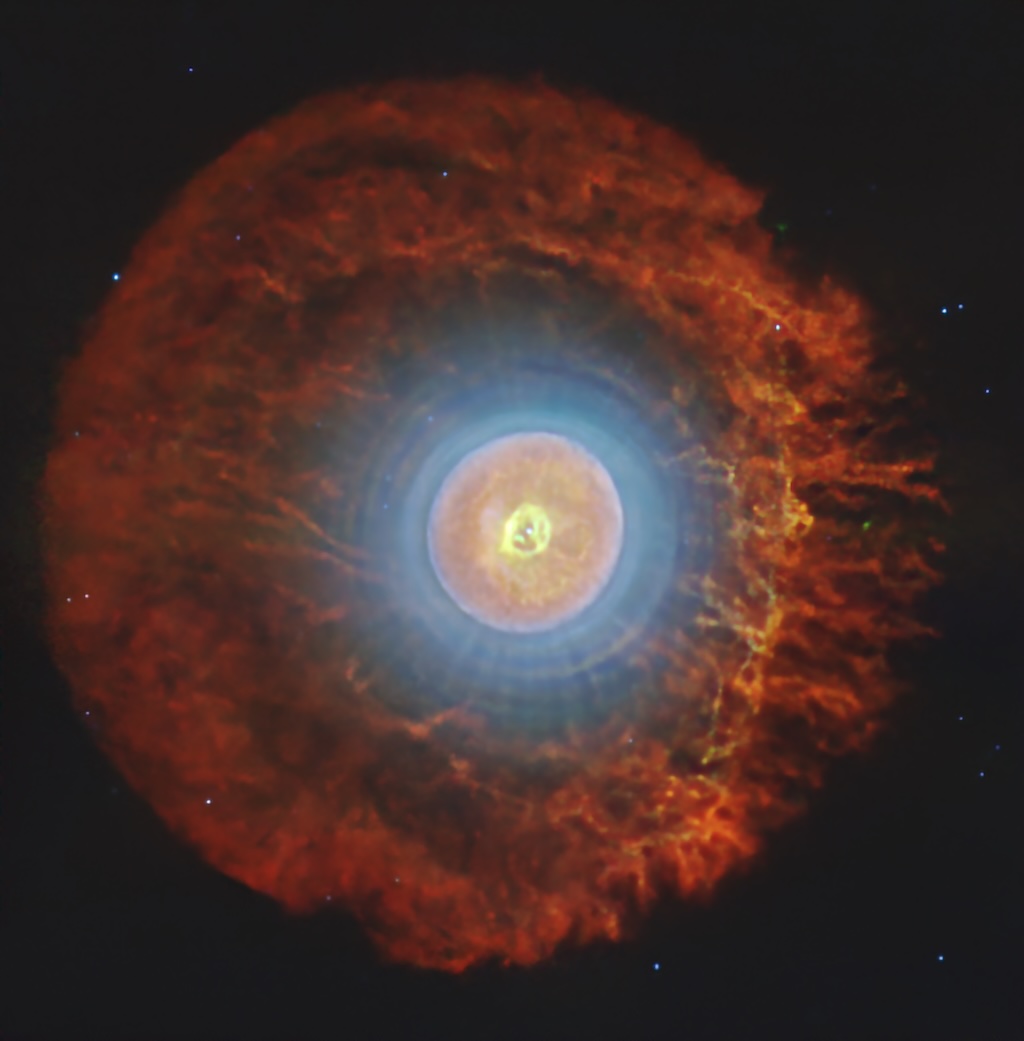
Webb Telescope Unwraps Cosmic Soccer Balls in a Dazzling Nebula

Disclosure: This post contains affiliate links. As an Amazon Associate, I earn from qualifying purchases.

The Full Story

Gaze upon the captivating beauty of planetary nebula Tc 1, a cosmic ghost left behind by a star nearing the end of its life. Captured in breathtaking detail by the James Webb Space Telescope, this isn't just a pretty picture – it's a cosmic chemical laboratory. This particular nebula holds a special place in astronomical history, as it's where scientists first identified peculiar molecules known as 'buckyballs' in 2010. Officially called Buckminsterfullerene, these remarkable molecules consist of 60 carbon atoms precisely arranged into the iconic shape of a soccer ball. They're named after architect Buckminster Fuller, whose innovative geodesic domes share their distinctive, elegant structure. Webb’s new, incredibly sharp data has allowed scientists to map out the buckyballs' hidden home within Tc 1. Instead of being scattered randomly, these C60 molecules are found in a striking arrangement: they populate a thin, perfectly spherical shell that encircles the nebula's central, dying star. You can actually see this shimmering shell as the bright, glowing orange edge in Webb's image. This precise geometric placement is a major clue, telling us a lot about the conditions and processes that lead to the formation of such complex carbon structures in the harsh environment of a stellar remnant. But the mysteries of Tc 1 don't end there. If you look closely near the heart of the nebula, a truly baffling feature comes into view: a delicate structure that looks uncannily like an upside-down question mark. This bizarre cosmic punctuation mark perfectly symbolizes the many unanswered questions this nebula still poses. Is it a unique interaction of stellar winds and gas, a chance alignment, or something far more exotic? Scientists are only just beginning to unravel what could create such an unusual shape in the depths of space. The presence and specific arrangement of buckyballs are incredibly significant. Carbon is the backbone of life as we know it, and finding such complex carbon molecules forming naturally in space helps us understand the universe's chemical toolkit. How these buckyballs form in the extreme temperatures and radiation of a dying star's atmosphere, and what role they might play in the broader cosmic cycle of matter, are fundamental questions for astronomers and chemists alike. They might even act as precursors or building blocks for even more complex organic compounds, potentially seeding new star systems with the ingredients for life. Ultimately, Webb's stunning observations of Tc 1 don't just give us beautiful images; they provide a new window into the universe's chemical evolution. By precisely locating where these cosmic soccer balls reside, scientists gain crucial data to test theories about stellar death, the dispersal of elements, and the formation of complex molecules. The tantalizing question mark serves as a powerful reminder that even in the most well-studied corners of the cosmos, there are always new wonders and profound questions waiting to be discovered.

Key Takeaways

  • 1 The James Webb Space Telescope revealed that 'buckyball' molecules in nebula Tc 1 form a spherical shell around the central star.
  • 2 Buckyballs are complex carbon molecules shaped like soccer balls, named after architect Buckminster Fuller's geodesic domes.
  • 3 A mysterious, upside-down question mark shape within the nebula highlights ongoing cosmic puzzles.
Hubble Space Telescope Deep Field Poster

Hubble Space Telescope Deep Field Poster

Stunning poster featuring iconic Hubble Space Telescope imagery. Perfect for space enthusiasts.

Check Price on Amazon
*As an Amazon Associate, we earn from qualifying purchases.

💡 Think of it this way:

Imagine a cosmic soccer ball, but made of 60 carbon atoms, floating in space. Now imagine billions of these tiny soccer balls forming a gigantic, shimmering bubble around a dying star, much like soap suds around a drain.

How We Know This

The James Webb Space Telescope (JWST) uses its powerful infrared 'eyes' to see through the dust and gas in space, which often block visible light. Unlike traditional telescopes, Webb can detect the unique 'fingerprints' of molecules like buckyballs, which glow at specific wavelengths in infrared light. By carefully analyzing the infrared light emitted from different parts of the Tc 1 nebula, scientists could pinpoint exactly where these carbon molecules are located and map out their remarkable spherical arrangement in exquisite detail.

What This Means

This discovery opens new avenues for understanding the complex chemistry happening across the universe, especially around dying stars. Learning how and where buckyballs form can shed light on the origins of other complex organic molecules – the very building blocks of life itself. Future observations with Webb will likely target similar cosmic environments, helping scientists piece together the grand story of chemical evolution beyond Earth and perhaps even the early universe.

Why It Matters

This discovery helps us understand how complex carbon molecules, the building blocks of life, can form and exist in extreme cosmic environments. It shows that the universe is full of surprising chemistry, constantly creating new and exotic materials even after a star's death, influencing the ingredients available for new solar systems.

Related Topics

#James Webb Space Telescope #Planetary Nebula #Buckyballs #Cosmic Chemistry #Carbon Molecules