Andromeda: Unveiling Our Closest Galactic Neighbor's Secrets
In Brief
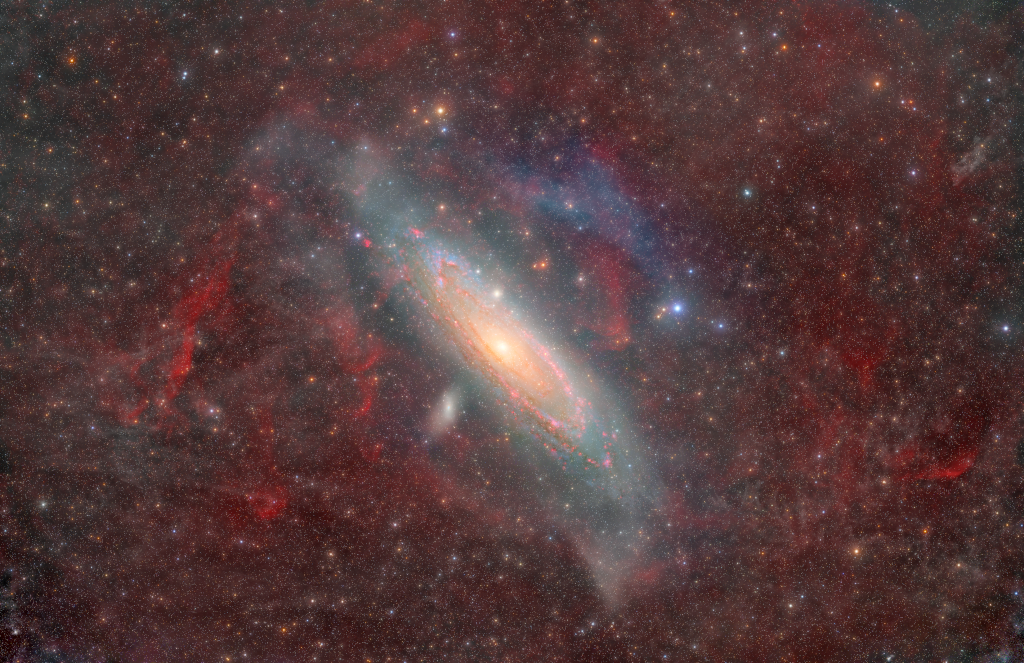
Stunning new images of the Andromeda galaxy, taken over hundreds of hours, reveal incredible details of its glowing gases and ancient spiral arms. This achievement highlights humanity's thousand-year journey of observing our nearest major galactic neighbor. These detailed views help unlock enduring mysteries about how galaxies grow and merge.
The Full Story
Key Takeaways
- 1 The Andromeda galaxy has been observed for over a thousand years, from ancient astronomers to modern telescopes.
- 2 New, detailed images reveal both foreground gas in our Milky Way and glowing gas within Andromeda's spiral arms, powered by young stars.
- 3 Studying Andromeda helps us understand key mysteries like how galaxies evolve, merge, and the nature of dark matter.
- 4 Modern telescopes use extensive observation time to capture faint light, revealing previously unseen details of distant galaxies.
💡 Think of it this way:
Imagine trying to study a distant city, but there's a thin fog in front of it and also smog rising from its streets. This new image is like using special filters to peer through both the fog and the smog, allowing us to see the city's true structure and activity in amazing detail.
How We Know This
Astronomers captured this incredible image by aiming powerful telescopes at Andromeda for a staggering 202 hours – that's like taking a single photo with an exposure time of over eight days! This long exposure allows the telescopes to collect extremely faint light from distant and diffuse gas clouds, making them visible. They also use special filters to isolate light emitted by specific elements like hydrogen and oxygen, which glow at different colors when energized, helping them map out the composition and activity within and around the galaxy.
What This Means
This detailed view of Andromeda will significantly advance our understanding of galactic evolution, offering vital clues on how galaxies like our own Milky Way grow, change, and eventually collide over cosmic timescales. It also provides a crucial laboratory for studying dark matter – the invisible 'glue' that holds galaxies together. By mapping the visible matter (like gas and stars) and comparing it to how the galaxy moves, astronomers can infer the distribution and properties of dark matter, bringing us closer to understanding one of the universe's biggest enigmas.
Why It Matters
Understanding Andromeda is like looking into our own galaxy's future and past. It helps us piece together the cosmic story of how galaxies, including our Milky Way, formed, evolved, and interact, giving us a clearer picture of our place in the vast universe.