Back to Articles Image Of The Day

The Vela Supernova Remnant: A Star's Explosive Echo from 12,000 Years Ago

📖 3 min read 📊 beginner 🏷️ NASA APOD

In Brief

Imagine a star so powerful it exploded 12,000 years ago, and we can still see its ghostly remains today! This incredible cosmic cloud, called the Vela Supernova Remnant, is the expanding shockwave from a massive star's death, still glowing across light-years of space.
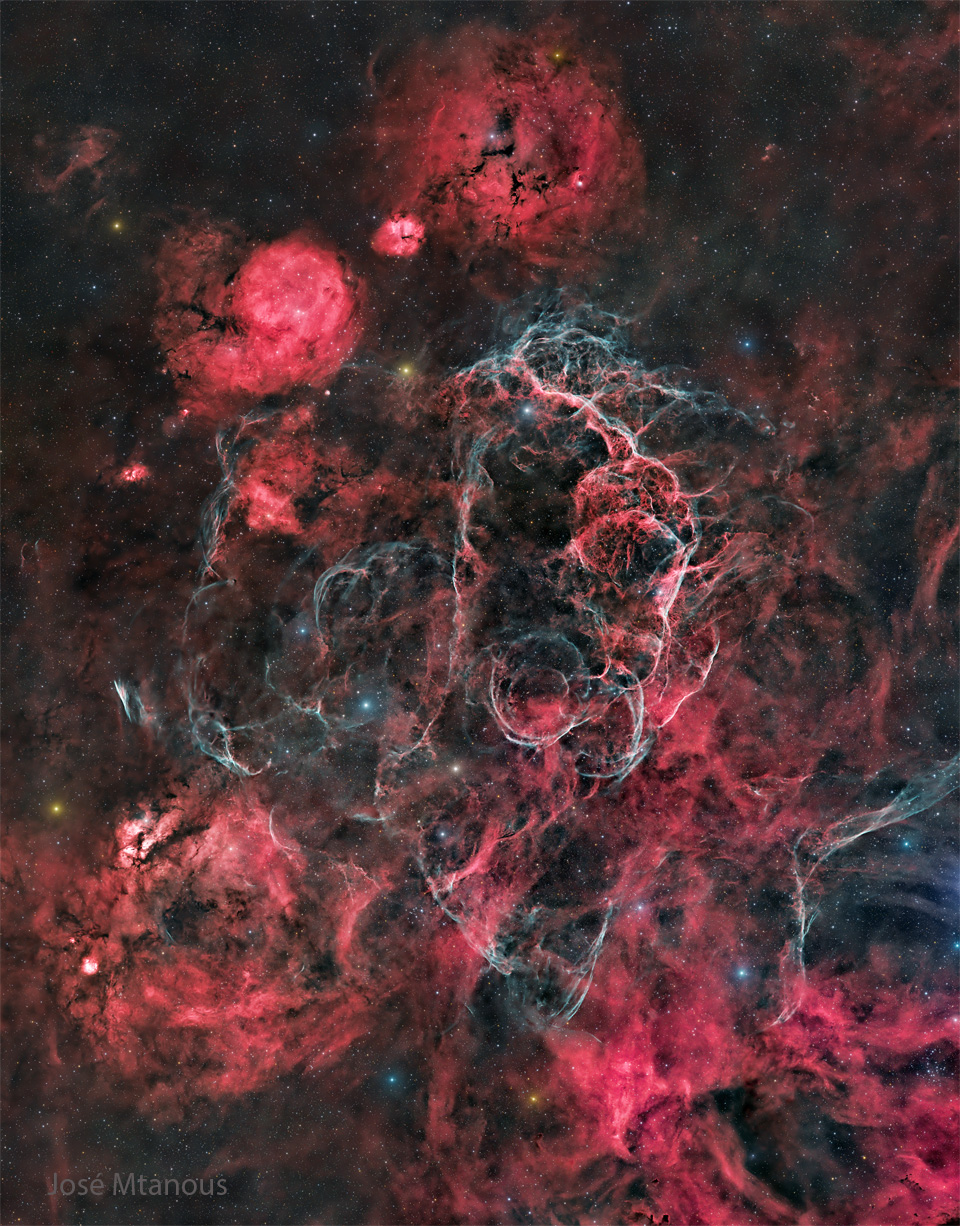
The Vela Supernova Remnant: A Star's Explosive Echo from 12,000 Years Ago

Disclosure: This post contains affiliate links. As an Amazon Associate, I earn from qualifying purchases.

The Full Story

Twelve thousand years ago, an event of colossal cosmic violence unfolded in a corner of our galaxy. A star, far more massive than our Sun, reached the end of its life, collapsing under its own gravity before exploding outwards in a spectacular supernova. While the bright flash of that explosion would have been a brief, strange point of light for early humans, its consequences continue to unfold across the vast canvas of space even today. The featured image brings to life the ghostly remnants of this ancient explosion: the Vela Supernova Remnant. This isn't just a pretty picture; it's a cosmic canvas showing the gigantic shockwave created as the star's outer layers hurtled into the surrounding interstellar gas and dust. These energetic collisions excite the gas, causing it to glow. The stunning red and blue filaments you see are like cosmic fingerprints, highlighting specific elements – hydrogen (red) and oxygen (blue) – as they emit light from their energized state. At the very heart of this incredible nebula lies an even more astonishing object: a pulsar. What was once the star's core has been crushed into a super-dense sphere, no bigger than a city, but weighing more than our Sun. This 'star-in-a-can' is so dense that a teaspoonful would weigh billions of tons, and it spins more than ten times every single second, sweeping beams of radiation across space like an incredibly fast cosmic lighthouse. Supernovae like Vela are not just beautiful cosmic fireworks; they are fundamental to life itself. When these massive stars explode, they don't just scatter their own material; they also forge and distribute heavier elements – like carbon, oxygen, and iron – across the galaxy. These are the very building blocks that eventually form new stars, planets, and even you and me. The Vela Remnant is a living laboratory demonstrating this cosmic recycling program. Observing such faint and diffuse structures requires immense patience and cutting-edge technology. The breathtaking detail in this image, taken over 60 hours from a dark-sky location in Namibia, combines visible light with specific filters to isolate the light from glowing hydrogen and oxygen. This method allows astronomers to map the structure and composition of the shockwave, providing invaluable insights into how stellar explosions reshape their galactic neighborhoods.

Key Takeaways

  • 1 A massive star exploded 12,000 years ago, leaving behind the spectacular Vela Supernova Remnant.
  • 2 This vast, glowing shockwave still expands through space, with a super-dense, rapidly spinning pulsar at its core.
  • 3 Supernovae like Vela are crucial for creating and distributing the heavy elements that form planets and life.
National Geographic Planisphere Star Finder

National Geographic Planisphere Star Finder

Essential tool for identifying constellations and stars. Perfect for beginners learning the night sky.

Check Price on Amazon
*As an Amazon Associate, we earn from qualifying purchases.

💡 Think of it this way:

Imagine dropping a pebble into a calm pond; the ripples spread out and gradually fade. The Vela Supernova Remnant is like the enormous, slow-motion ripples from a star-sized pebble, still expanding outward for thousands of years, carrying light and energy across the cosmos.

How We Know This

Astronomers captured this image by using sensitive telescopes and accumulating light over an incredibly long exposure time – more than 60 hours! Think of it like leaving a camera shutter open for days to gather every tiny photon. They also used special filters to highlight specific elements, like hydrogen (red) and oxygen (blue), making the faint structures of the shockwave stand out and revealing its composition.

What This Means

Studying remnants like Vela helps scientists refine models of star evolution, understand the physics of extreme environments, and trace the cosmic origins of the elements that make up everything around us – including ourselves. Future observations, perhaps with new generations of telescopes, will continue to unveil more secrets hidden within these magnificent stellar graves, furthering our understanding of the universe's most dramatic events.

Why It Matters

Understanding stellar explosions like Vela helps us piece together the life cycle of stars, how elements crucial for life are forged, and the incredible, dynamic nature of our universe.

Related Topics

#Supernova #Vela #Pulsar #Stellar Evolution #Cosmic Recycling