Back to Articles Image Of The Day

Catch the Blue Micromoon: This Year's Smallest Full Moon!

📖 3 min read 📊 beginner 🏷️ NASA APOD

In Brief

Tonight, gaze up at a rare celestial event: a 'blue micromoon.' This special full moon will appear slightly smaller and dimmer than usual, marking it as the farthest and smallest full moon of the year, and it's also the second full moon in the same calendar month.
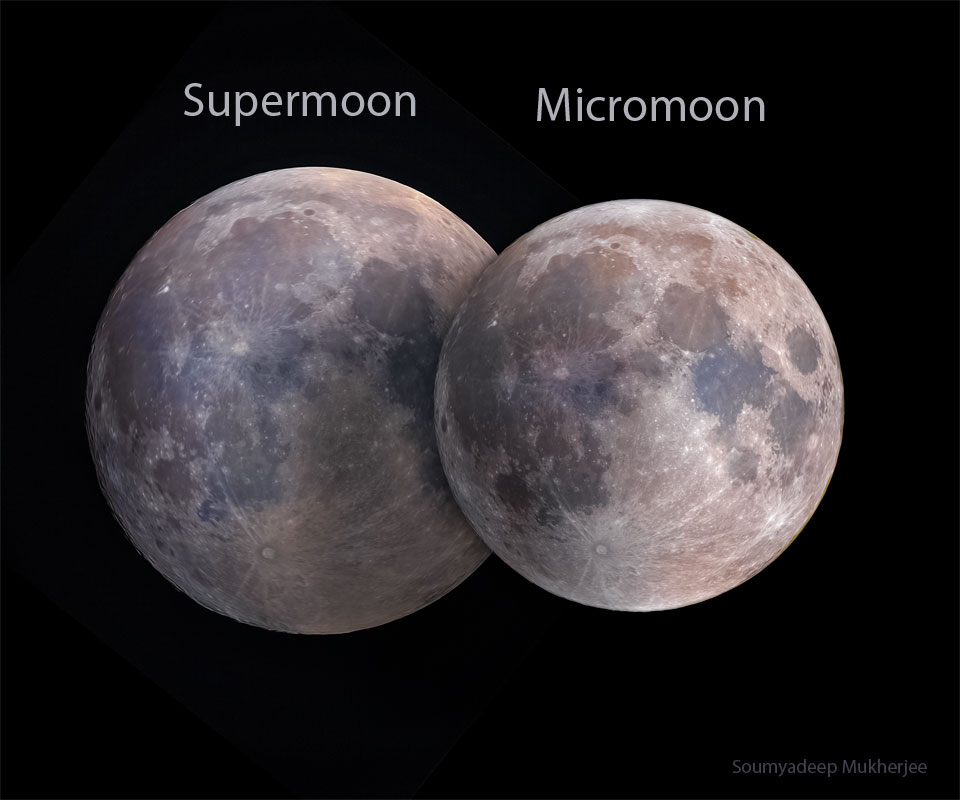
Catch the Blue Micromoon: This Year's Smallest Full Moon!

Disclosure: This post contains affiliate links. As an Amazon Associate, I earn from qualifying purchases.

The Full Story

Prepare for a unique celestial spectacle tonight as the full moon gracing our skies is no ordinary sight – it's a 'micromoon.' This intriguing term describes a full moon that appears subtly smaller and dimmer than usual. Why the change? It's because our lunar companion has reached its 'apogee,' the point in its elliptical orbit where it's farthest from Earth. While the difference might be subtle to the naked eye, a micromoon is the cosmic opposite of a 'supermoon,' which occurs when the Moon is closest to us and appears larger and brighter. Adding another layer of rarity to tonight's event, this micromoon is also a 'blue moon.' Before you imagine a sapphire-hued orb, rest assured, the 'blue' here refers to timing, not color. A blue moon is simply the astronomical nickname for the second full moon occurring within a single calendar month. It's a delightful quirk of our calendar system and the lunar cycle, reminding us how our earthly measurements sometimes align in interesting ways with cosmic rhythms. What makes tonight's blue micromoon truly exceptional is its extreme nature. This isn't just *a* micromoon; it's *the* farthest, smallest, and dimmest full moon we'll witness all year. The subtle visual difference between a supermoon and a micromoon, though hard to spot without a side-by-side comparison, highlights the dynamic nature of our Moon's journey around us. Images often beautifully capture this contrast, showcasing just how much our perspective of the Moon can change throughout the year. The reason for these variations lies in the fundamental physics of orbits. The Moon doesn't trace a perfect circle around Earth; instead, its path is an ellipse, like a slightly stretched circle. This means there are times it's closer to us (called perigee) and times it's farther away (apogee). When the full moon phase perfectly aligns with its apogee, we get a micromoon. It's a beautiful demonstration of celestial mechanics playing out right above our heads, making each lunar cycle a unique dance. While you can expect another micromoon relatively soon (next month!), and the next blue moon is slated for the end of 2028, the rare combination of a *blue micromoon* won't grace our skies again until 2053. This makes tonight's event a particularly special opportunity for skygazers and anyone curious about the wonders of our solar system. So, step outside, look up, and enjoy this delightful, once-in-a-generation lunar alignment!

Key Takeaways

  • 1 A micromoon occurs when the full moon is at its farthest point from Earth (apogee), making it appear slightly smaller and dimmer.
  • 2 A blue moon is the second full moon to occur within a single calendar month, a timing phenomenon unrelated to color.
  • 3 Tonight's blue micromoon is particularly special because it is the farthest, smallest, and dimmest full moon of the entire year.
  • 4 The Moon's elliptical orbit causes these variations in apparent size and brightness, distinguishing it from a supermoon (when it's closest).
  • 5 The combination of a blue moon and a micromoon is rare, with the next such event not occurring until 2053.
National Geographic Planisphere Star Finder

National Geographic Planisphere Star Finder

Essential tool for identifying constellations and stars. Perfect for beginners learning the night sky.

Check Price on Amazon
*As an Amazon Associate, we earn from qualifying purchases.

💡 Think of it this way:

Think of it like watching someone walk away from you – the farther they get, the smaller they appear. Tonight's micromoon is essentially our Moon taking its longest stroll away from Earth, making it look a bit more distant and petite.

How We Know This

The 'discovery' of a micromoon or blue moon isn't made with complex new technology, but rather through long-term astronomical observation and precise calculations of the Moon's well-understood orbital mechanics. Astronomers track the Moon's elliptical path and predict when its full phase will coincide with its farthest point (apogee) and when two full moons will fall within a calendar month. The visual difference, while subtle, can be confirmed with comparative photography, as demonstrated by images contrasting a supermoon with a micromoon.

What This Means

Observing events like the blue micromoon encourages public engagement with astronomy and helps demystify celestial mechanics. It provides a tangible way for people to understand concepts like elliptical orbits, lunar phases, and the dynamic nature of our Earth-Moon system. This heightened awareness can inspire future generations of scientists and foster a greater appreciation for the universe around us, reminding us that even common celestial bodies hold fascinating secrets.

Why It Matters

This is a fantastic, easy-to-observe astronomical event that offers a unique viewing opportunity and highlights the dynamic nature of our Moon's orbit, encouraging everyone to look up and appreciate our solar system.

Related Topics

#micromoon #blue moon #lunar phases #astronomy #skywatching