Back to Articles Image Of The Day

Apollo's 3D View: The Moon's Mysterious Elongated Craters Revealed

📖 3 min read 📊 beginner 🏷️ NASA APOD

In Brief

NASA scientists have created a stunning 3D view of two unique craters on the Moon, named Messier and Messier A. These aren't your typical round lunar pits; their elongated shapes tell the dramatic story of an ancient asteroid that essentially 'skipped' across the lunar surface. This fresh perspective from Apollo 11 data offers new insights into how powerful impacts shape our celestial neighbor.
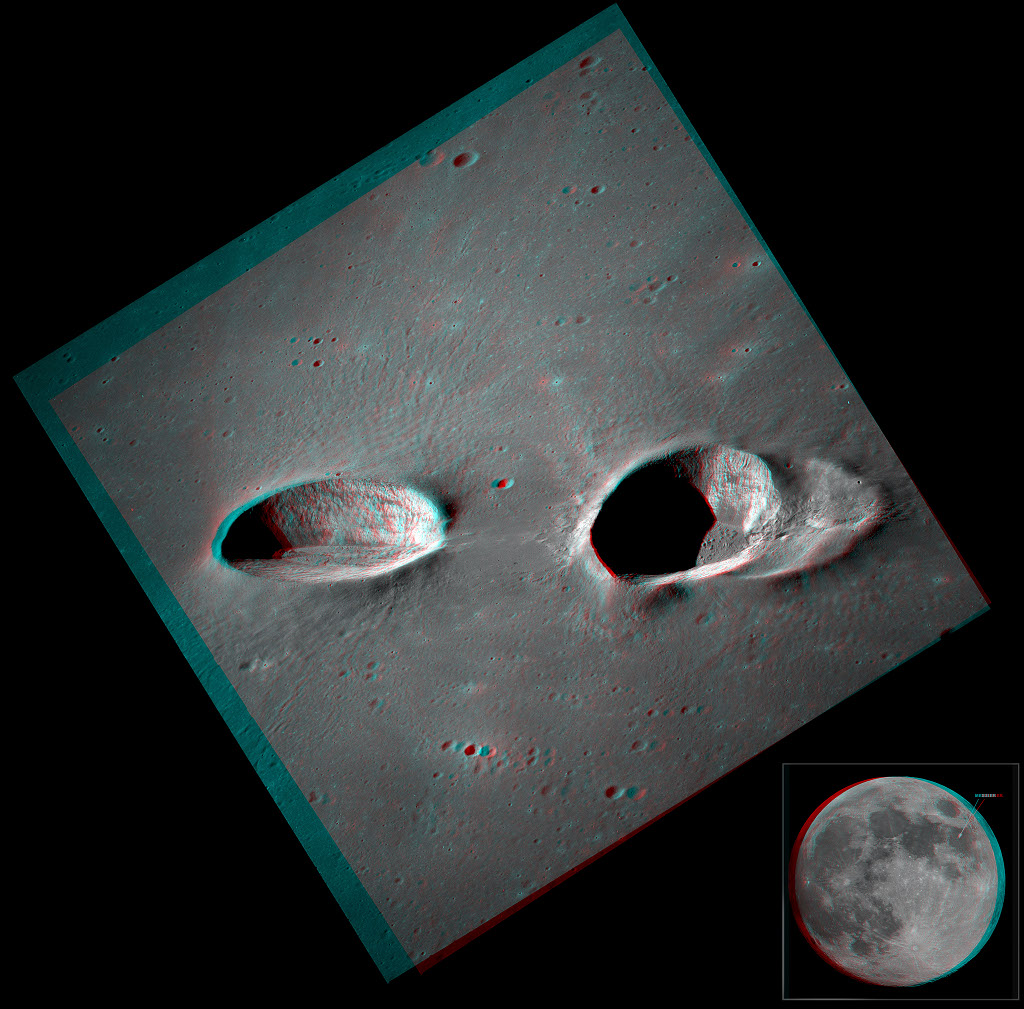
Apollo's 3D View: The Moon's Mysterious Elongated Craters Revealed

Disclosure: This post contains affiliate links. As an Amazon Associate, I earn from qualifying purchases.

The Full Story

When you think of Charles Messier, you likely picture his famous catalog of beautiful nebulae and star clusters scattered across our night sky. But did you know his name also adorns two of the Moon's most peculiar features? Nestled in the dark, smooth plains known as the Sea of Fertility (or Mare Fecunditatis), lie two remarkable craters: Messier and its companion, Messier A. These aren't your typical circular lunar pockmarks; their unusual, elongated shapes have long intrigued scientists. Most impact craters we see on the Moon are roughly circular, regardless of the angle at which the space rock hit. This is because the sheer force of the impact creates a massive explosion, effectively blowing out a round hole. However, Messier and Messier A defy this norm. Measuring approximately 15 by 8 kilometers and 16 by 11 kilometers respectively, their stretched-out forms tell a different, more dramatic story about their violent birth. What caused this cosmic anomaly? Scientists believe these craters are the result of an incredibly rare 'skip shot' event. Picture an asteroid approaching the Moon at an extremely shallow angle, almost parallel to the surface – like a perfectly thrown skipping stone. Instead of plunging directly in, this celestial billiard ball grazed the lunar surface, digging a long, shallow trench as it bounced or 'ricocheted' along. This left not one, but two distinct, stretched craters in its wake, with the impactor likely moving from left to right across the landscape. The powerful graze also sent bright trails of material, called 'rays,' streaking further across the surface beyond the visible area, like a giant cosmic spray. To help us truly understand this incredible event, scientists recently created a stunning 3D (stereo) image of the Messier craters. By carefully analyzing two high-resolution photographs (AS11-42-6304 and AS11-42-6305) taken during humanity's first journey to the Moon – the Apollo 11 mission – they were able to combine these slightly different perspectives. When viewed with special red/blue glasses, this creates a breathtaking sense of depth, allowing us to 'see' the craters in three dimensions and better appreciate the subtle contours of their unique formation. It's a testament to the enduring value of data collected decades ago. This fresh look at the Messier craters isn't just a fascinating visual; it provides valuable clues about impact mechanics throughout the solar system. Understanding how objects behave during extremely shallow impacts helps us model crater formation on other planets and moons, and even here on Earth. It also underscores the importance of revisiting historical data with new technologies and analysis techniques. Who knows what other secrets the Apollo archives, or future lunar missions, might reveal about our celestial neighbor?

Key Takeaways

  • 1 The Messier craters on the Moon are uniquely elongated, unlike most circular impact craters.
  • 2 Their unusual shape is attributed to an extremely shallow-angle impact, similar to a stone skipping across water.
  • 3 A new 3D (stereo) image, created from historic Apollo 11 photographs, provides a detailed view of their unique formation.
  • 4 This discovery helps scientists better understand rare impact events and how they shape planetary surfaces.
  • 5 It highlights the continued scientific value of revisiting old space mission data with new analytical methods.
Metal Earth Apollo Lunar Module 3D Model Kit

Metal Earth Apollo Lunar Module 3D Model Kit

Precision 3D metal model kit of the Apollo Lunar Module. Challenging build for space enthusiasts and model makers.

Check Price on Amazon
*As an Amazon Associate, we earn from qualifying purchases.

💡 Think of it this way:

Imagine skipping a flat stone across a calm lake; instead of making a round splash, it leaves an elongated mark or even bounces twice. That's similar to how the asteroid hit the Moon, creating these uniquely shaped craters.

How We Know This

Scientists used two distinct, high-resolution photographs taken by astronauts during the historic Apollo 11 mission. By scanning these images and digitally combining them with specialized software, they created a 'stereo' or 3D view. When you look at this combined image with red/blue glasses, your brain perceives depth, making the craters pop out and revealing their unique structure more clearly than a flat image ever could.

What This Means

Understanding these rare 'skip shot' impacts helps scientists refine models of how planetary surfaces evolve, not just on the Moon, but across the entire solar system. This knowledge can inform future missions aiming to explore impact sites or even identify potential resources. It also highlights the incredible potential of re-examining vast archives of historical space data with modern tools, proving that old missions can still deliver brand new discoveries.

Why It Matters

This new 3D perspective helps us visualize lunar geology like never before, offering fresh insights into the powerful forces that shaped the Moon and even Earth. It also reminds us how valuable historical mission data, like that from Apollo 11, continues to be for scientific discovery today.

Related Topics

#Lunar Geology #Apollo 11 #Impact Craters #3D Astronomy #Moon