Cosmic String of Pearls: Unveiling Markarian's Chain in the Virgo Cluster
In Brief
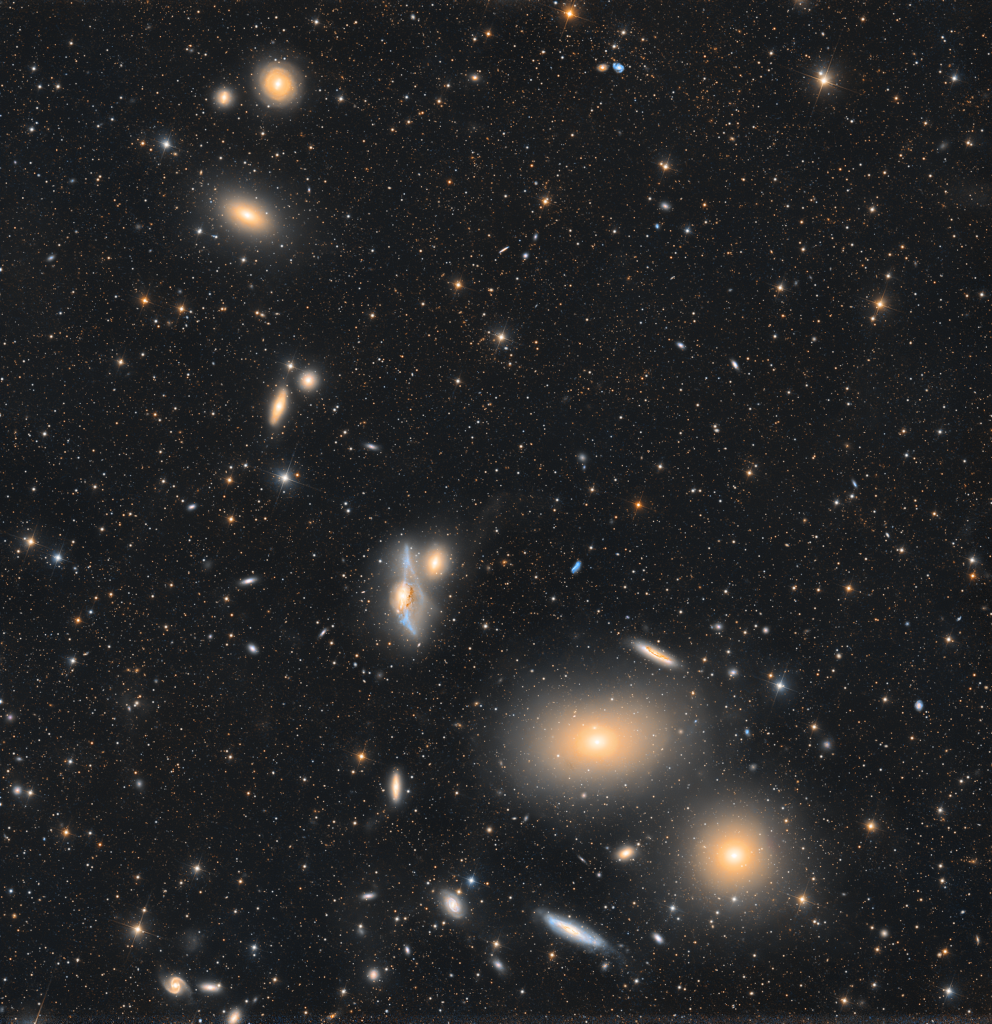
Astronomers have captured a stunning view of Markarian's Chain, a graceful arc of galaxies located deep within the nearby Virgo Galaxy Cluster. This cosmic 'string of pearls' includes several prominent galaxies and even a pair known as 'Markarian's Eyes.' It offers a glimpse into how galaxies organize themselves across vast cosmic distances.
The Full Story
Key Takeaways
- 1 Markarian's Chain is a visually striking arc of galaxies located within the nearby Virgo Galaxy Cluster.
- 2 The Virgo Cluster is the closest large galaxy cluster to us, about 50 million light-years away, containing around 2,000 galaxies.
- 3 Notable galaxies within the chain include M84, M86, and the interacting pair known as 'Markarian's Eyes' (NGC 4438 and NGC 4435).
- 4 At least seven galaxies in the chain exhibit true coherent motion, while others are merely optical alignments from our perspective.
- 5 The massive Virgo Cluster has a gravitational pull that even influences our own Local Group of Galaxies.
💡 Think of it this way:
Imagine looking at a distant city and seeing a particular street where several buildings appear to be lined up perfectly, some truly connected and others just happening to be in your line of sight. Markarian's Chain is like that cosmic street, with some galaxies truly 'holding hands' gravitationally, and others just appearing to be part of the same alignment from our perspective.
How We Know This
This stunning view of Markarian's Chain was captured using powerful ground-based telescopes, likely equipped with sensitive cameras. By collecting light over long exposure times, astronomers can gather faint details from incredibly distant objects like these galaxies. These telescopic observations, combined with techniques like measuring the redshift of light, allow scientists to not only see the galaxies but also to determine their distances and how they are moving through space.
What This Means
Future studies of Markarian's Chain and the Virgo Cluster will continue to shed light on how galaxy clusters form, grow, and interact over billions of years. Understanding the complex dynamics within such a dense galactic environment helps us refine our models of cosmic evolution, including the role of dark matter and how gravitational forces sculpt the universe on its grandest scales. As our telescopes become even more powerful, we'll gain even clearer, more detailed views of these fascinating cosmic structures, potentially uncovering new surprises about galactic life and the universe's past.
Why It Matters
Understanding structures like Markarian's Chain helps us grasp the immense scale of the universe and how galaxies, including our own Milky Way, interact and evolve under the powerful force of gravity. It's a window into the 'neighborhoods' of the cosmos, showing us how our galactic home fits into the grand scheme of things.