Back to Articles Image Of The Day

Spot the Comet: A Cosmic Hide-and-Seek in Our Crowded Skies

πŸ“– 3 min read πŸ“Š beginner 🏷️ NASA APOD

In Brief

A brilliant comet, R3 PanSTARRS, is making a rare visit to our inner solar system, but catching a glimpse is a true challenge. This incredible photo reveals it hiding amidst a tangled web of satellite trails, showing just how busy our orbital neighborhood has become.
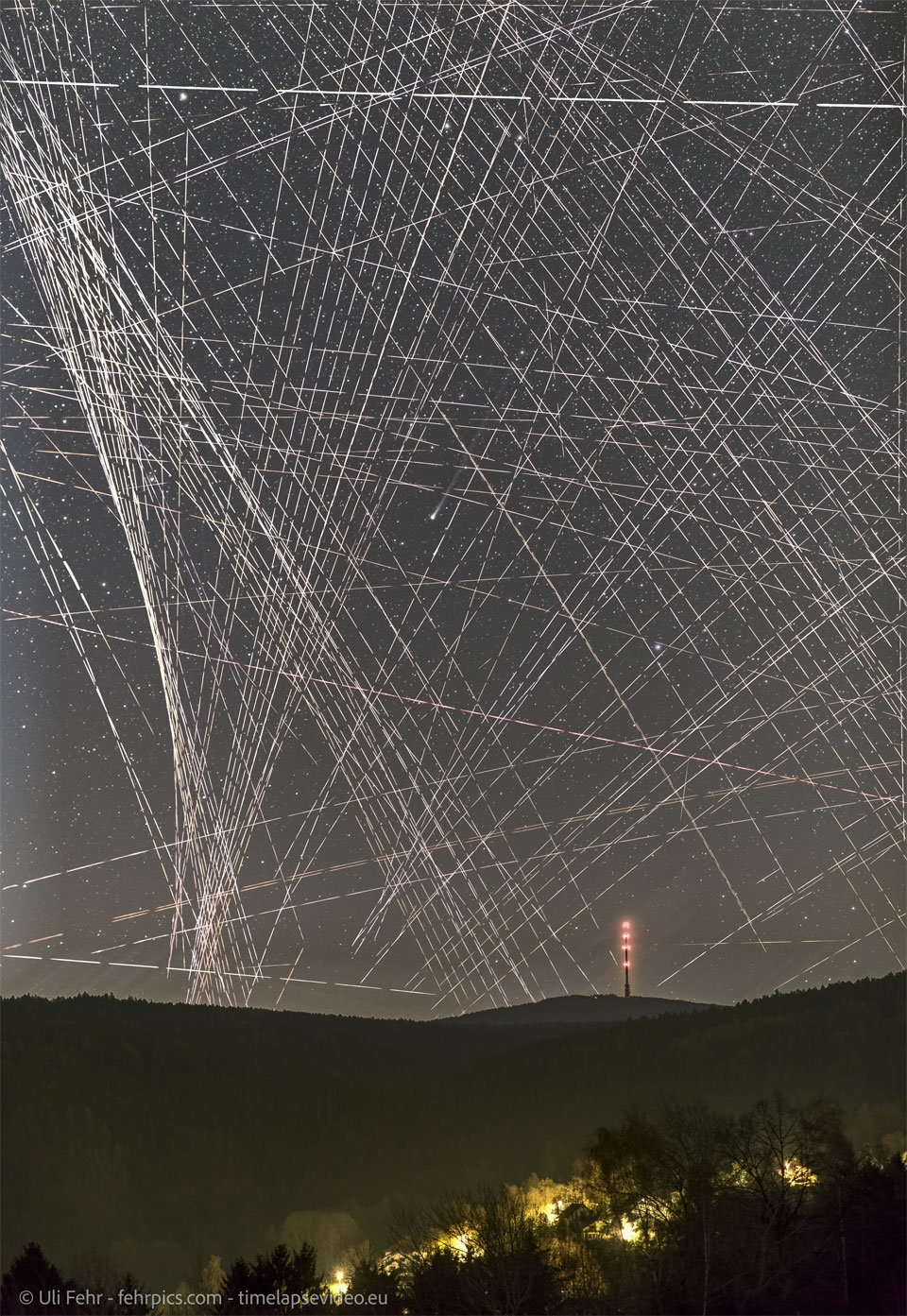
Spot the Comet: A Cosmic Hide-and-Seek in Our Crowded Skies

Disclosure: This post contains affiliate links. As an Amazon Associate, I earn from qualifying purchases.

The Full Story

Get ready for a cosmic scavenger hunt! High above Bavaria, Germany, an intrepid astrophotographer recently captured a breathtaking image featuring Comet C/2025 R3 (PanSTARRS) – an icy wanderer making a spectacular, albeit challenging, visit to our inner Solar System. But this isn't just any comet picture; it's a testament to both the wonders of the universe and the increasing hustle and bustle in Earth's orbit. Before you go searching for our elusive visitor, let's talk about those striking streaks across the sky. While they might look like shooting stars, these aren't natural phenomena. They're the ghostly signatures of Earth-orbiting satellites! To our eyes, a satellite appears as a slowly drifting point of light, reflecting sunlight just after dusk or before dawn. But during a long-exposure photograph, like the over 10-minute shot used for this image, these points stretch into luminous lines as the satellites move across the camera's view, creating a dazzling but sometimes distracting, celestial traffic jam. Our guest of honor, Comet R3 PanSTARRS, is playing hard to get. Even without the satellite photobombers, it's currently quite difficult to spot because it's so close to the Sun in the sky. Imagine trying to see a faint star right next to a bright streetlight – the Sun's glare makes it a tough observation. Comets, these 'dirty snowballs' from the outer solar system, brighten as they approach the Sun, heating up and spewing gas and dust to form their iconic tails. But don't lose hope! As Comet R3 PanSTARRS rounds the Sun and begins its journey back out to the colder reaches of space, it will become better positioned for viewing. Observers in the Southern Hemisphere will have the best chance to witness this celestial spectacle in the coming weeks, although by then, it will also be starting to fade. Each comet visit is a unique opportunity, as they often travel on orbits that take thousands or even millions of years, or, like this one, might eventually head out into interstellar space, never to return. This incredible image serves as a powerful reminder of both the vastness of space and the growing human presence within our immediate cosmic neighborhood. It’s a snapshot of a fleeting moment where a visitor from the ancient solar system crosses paths with our modern technological creations. And if you’re still squinting, trying to find our comet friend amidst the stellar highways, here’s a hint: look closely, just above the very center of the image. Happy hunting!

Key Takeaways

  • 1 Comet R3 PanSTARRS is a bright visitor currently in our inner solar system.
  • 2 The image showcases numerous satellite trails, highlighting increasing orbital traffic.
  • 3 The comet is currently difficult to observe due to its proximity to the Sun but will be better seen from the Southern Hemisphere soon.
National Geographic Planisphere Star Finder

National Geographic Planisphere Star Finder

Essential tool for identifying constellations and stars. Perfect for beginners learning the night sky.

Check Price on Amazon
*As an Amazon Associate, we earn from qualifying purchases.

πŸ’‘ Think of it this way:

Imagine trying to spot a rare bird in a bustling city park, but the 'bird' is a comet and the 'city park' is filled with constantly moving airplanes – that's our sky!

How We Know This

The photograph was taken using a long-exposure technique, where the camera's shutter stayed open for over 10 minutes. This allowed enough light from the faint comet to be collected, but it also caused faster-moving objects like satellites to appear as bright streaks across the sky as they traveled during the exposure time. The stunning image was captured by an astrophotographer in Bavaria, Germany, just before sunrise.

What This Means

The increasing number of satellites in orbit presents both opportunities for observation and challenges for astronomers trying to capture clear images of deep space. Studying comets like PanSTARRS R3 provides valuable clues about the early conditions and composition of our solar system, as they are essentially pristine time capsules. Future observations will track its path and provide more data as it exits our solar system, potentially offering insights into interstellar comets.

Why It Matters

It highlights the fascinating challenge of observing celestial wonders in an increasingly busy orbital environment, giving us a glimpse into both deep space phenomena and near-Earth human activity.

Related Topics

#Comet #PanSTARRS #Satellites #Astrophotography #Solar System #Astronomy