Mystic Mountain's 'Cosmic Monster' is Being Devoured by a Hidden Star
In Brief
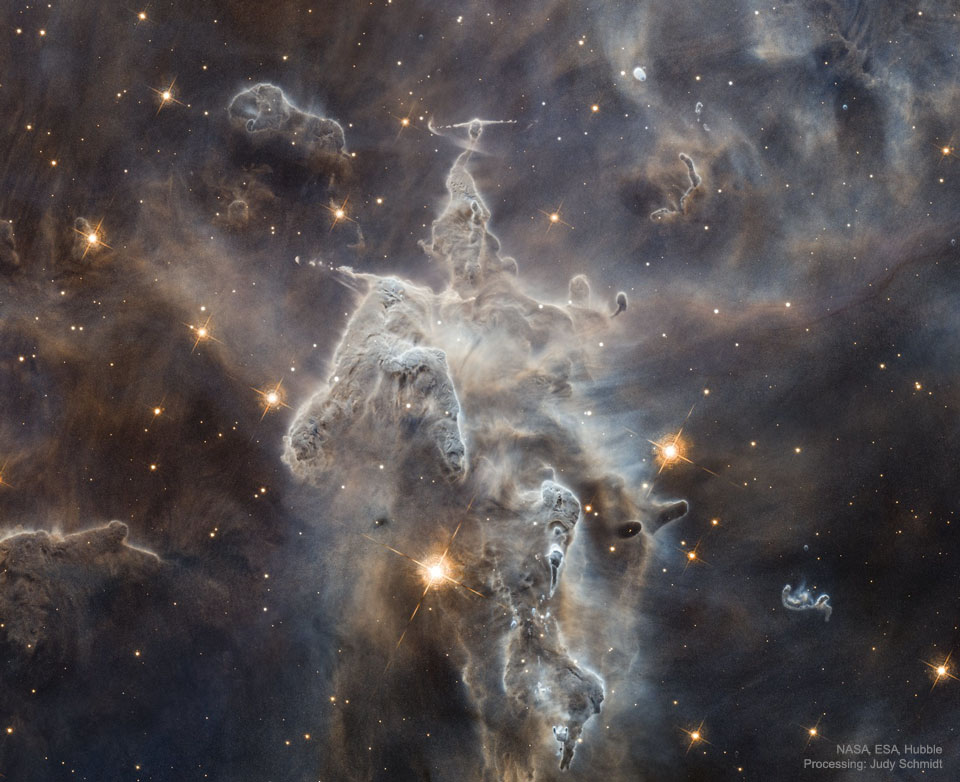
Astronomers are witnessing a dramatic event deep within the Carina Nebula: the iconic 'Mystic Mountain,' a gigantic pillar of gas and dust, is slowly being ripped apart. A hidden star inside its 'head' is blasting out powerful jets, while surrounding massive stars contribute to its gradual evaporation. This beautiful, towering structure, captured by the Hubble Space Telescope, is destined to disappear within a few million years.
The Full Story
Key Takeaways
- 1 Mystic Mountain is a gigantic pillar of gas and dust in the Carina Nebula, currently being destroyed.
- 2 A hidden star within its 'head' and surrounding massive stars are actively evaporating the pillar with powerful jets and radiation.
- 3 This cosmic destruction is a natural part of the star formation cycle, where stellar nurseries are both created and eventually dispersed by young, energetic stars.
💡 Think of it this way:
Imagine a magnificent sandcastle on a beach, slowly eroding under the constant assault of powerful waves. Mystic Mountain is like that sandcastle, and the energetic light and winds from massive stars are the waves steadily washing it away.
How We Know This
The breathtaking image and our understanding of Mystic Mountain's destruction come courtesy of the Hubble Space Telescope. By capturing light across various wavelengths, Hubble allows astronomers to pierce through some of the cosmic dust and witness these dynamic processes in stunning detail, revealing the intricate structures and the powerful jets emanating from hidden stars.
What This Means
Studying events like the destruction of Mystic Mountain helps scientists better understand the complex life cycle of stars and the intricate feedback loops within star-forming regions. It shows how massive stars, once formed, can dramatically reshape their environments, influencing where and when future generations of stars will be born. Continued observations with telescopes like the James Webb Space Telescope could offer even deeper insights, peering through the remaining dust to reveal more about these hidden stellar engines and the processes of cosmic destruction and renewal.
Why It Matters
This cosmic drama reveals the powerful forces at play in star-forming regions, showing us how new stars both emerge from and ultimately reshape their stellar nurseries. It's a vivid reminder of the universe's constant cycle of creation and destruction, influencing where future stars and planets might form.