Back to Articles Image Of The Day

A Celestial Hug: Our Young Moon Embraces the 'Seven Sisters' Stars

📖 3 min read 📊 beginner 🏷️ NASA APOD

In Brief

Recently, a stunning photo captured our slender crescent Moon appearing to 'hug' its faint night side, illuminated by Earth's glow. Adding to the beauty, the dazzling Pleiades star cluster, often called the 'Seven Sisters,' gathered just below the Moon, creating a rare and magical sky show.
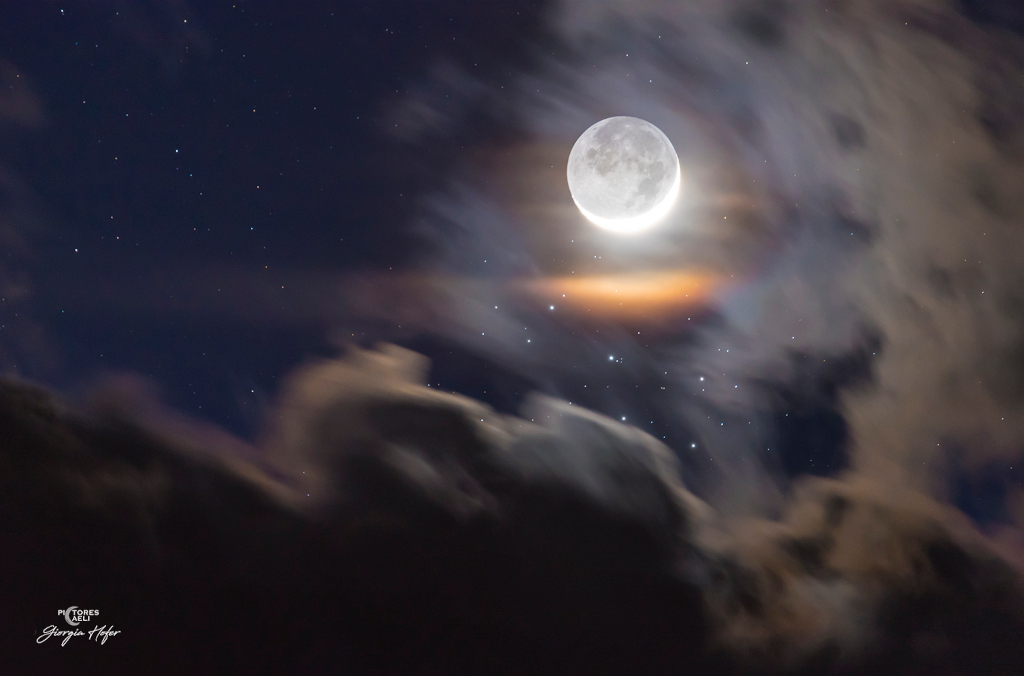
A Celestial Hug: Our Young Moon Embraces the 'Seven Sisters' Stars

Disclosure: This post contains affiliate links. As an Amazon Associate, I earn from qualifying purchases.

The Full Story

Imagine looking up at the night sky and seeing a truly breathtaking sight: a sliver of our Moon, barely two days old, looking like it's gently cradling its own dark side. This stunning celestial 'hug' was recently captured by a telephoto lens on April 19th, showcasing a spectacular alignment that highlights the intricate dance of our solar system. What makes this scene even more magical is the ghostly glow illuminating the Moon's 'dark' half. This isn't moonlight, but rather 'earthshine' – sunlight that first bounces off our vibrant Earth, travels across space, and then gently illuminates the lunar surface. It's like Earth is acting as a giant cosmic mirror, reflecting light onto its celestial neighbor. This phenomenon, affectionately known as 'the old moon in the young moon's arms,' is particularly striking during the northern hemisphere's spring. Adding another layer of wonder to this cosmic tableau were the beautiful Pleiades, a dazzling star cluster often called the 'Seven Sisters.' On this particular night, the young Moon was a close companion to this sparkling group, appearing just below its bright crescent. Even with some clouds dimming the bright moonlight, the cluster shone through, framed by a soft, colorful glow around the Moon known as a lunar corona. This close encounter between the Moon and the Pleiades isn't a one-off miracle; it's part of a recurring celestial ballet. The Moon's orbit brings it near the Pleiades almost every month in our sky. However, catching them so close and clear is often best when the Moon is a slender crescent, like it was on April 19th. That night was also special because the Moon was near 'perigee,' its closest point to Earth in its elliptical orbit, making it appear slightly larger in the sky. These types of celestial alignments offer us a profound connection to the universe. They remind us of the constant motion and stunning beauty above our heads, often visible without special equipment. It's a testament to the predictable yet ever-surprising mechanics of our solar system, inviting us all to look up and marvel.

Key Takeaways

  • 1 Witness a rare alignment of our young crescent Moon and the beautiful Pleiades star cluster.
  • 2 The Moon's 'dark' side glowed mysteriously, illuminated by 'earthshine' – sunlight reflected from Earth itself.
  • 3 This stunning 'old moon in the young moon's arms' effect is particularly bright during northern hemisphere spring.
  • 4 The Moon regularly passes by the Pleiades each month, offering repeated chances to see this celestial dance.
National Geographic Planisphere Star Finder

National Geographic Planisphere Star Finder

Essential tool for identifying constellations and stars. Perfect for beginners learning the night sky.

Check Price on Amazon
*As an Amazon Associate, we earn from qualifying purchases.

💡 Think of it this way:

Imagine a friend shining a flashlight onto you, and you reflecting a little light back to them. That's essentially what Earth does for the Moon's dark side, creating 'earthshine'!

How We Know This

A single telephoto exposure, expertly tracked to follow the sky's motion, was used to capture this intricate scene. The photographer utilized the ambient conditions, like cloud cover that naturally dimmed the bright moonlight, to bring out the fainter Pleiades cluster and the subtle lunar corona.

What This Means

While not a new 'discovery,' observations like this continually deepen our appreciation for the predictable yet spectacular dynamics of our solar system. For future stargazers, understanding these regular alignments means you can anticipate when to look for your own views of the Moon's luminous embrace or its dance with distant star clusters, fostering a greater connection to the cosmos.

Why It Matters

This wasn't just a beautiful photo; it's a reminder of the dynamic dance happening right above us. It highlights how Earth impacts the Moon's appearance and offers a chance to appreciate breathtaking celestial alignments visible even with simple observation.

Related Topics

#Moon #Earthshine #Pleiades #Astronomy #Stargazing