Back to Articles Image Of The Day

Our Universe's Giant 3D Map is Complete!

πŸ“– 3 min read πŸ“Š beginner 🏷️ NASA APOD

In Brief

Scientists using the DESI instrument have finished an epic five-year mission, surveying over 47 million galaxies and quasars to create the most detailed 3D map of the cosmos ever seen. This incredible cosmic chart, centered right on Earth, helps us understand the vast architecture of the universe.
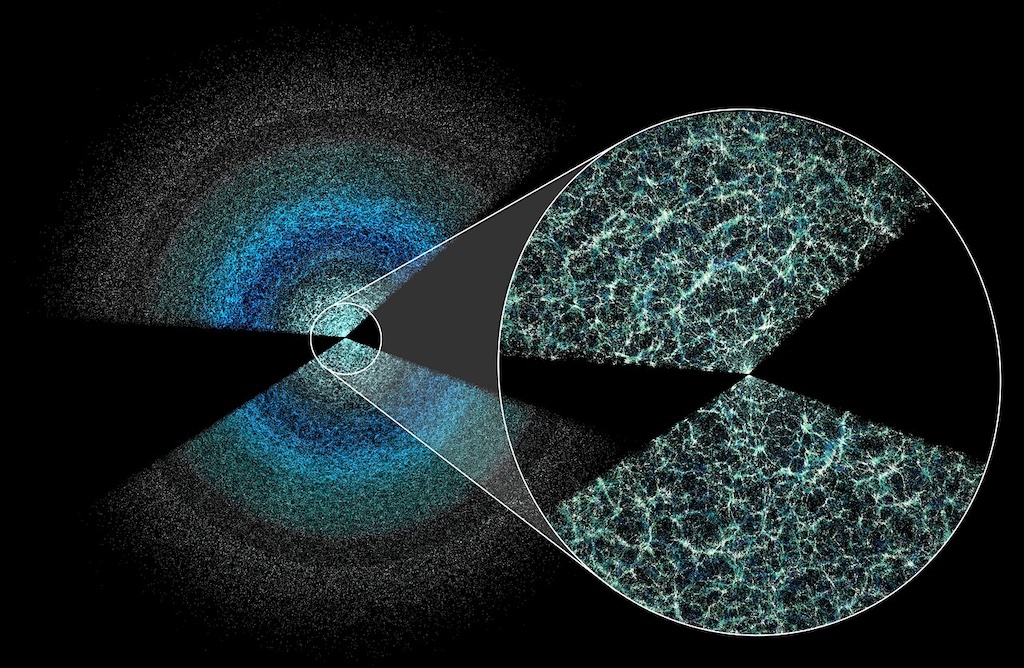
Our Universe's Giant 3D Map is Complete!

Disclosure: This post contains affiliate links. As an Amazon Associate, I earn from qualifying purchases.

The Full Story

For five years, the Dark Energy Spectroscopic Instrument (DESI) has been quietly revolutionizing our understanding of the cosmos from its perch at Kitt Peak National Observatory in Arizona. This ambitious project has now completed its mission: observing more than 47 million galaxies and super-bright quasars to assemble the most comprehensive 3D map of the universe ever created. Imagine drawing a map so vast that it literally shows the interconnected highways of galaxies stretching across billions of light-years, with Earth at its very center. That’s precisely what DESI has achieved. This isn't just any map; it's a map of the universe's "large-scale structure," often called the "cosmic web." Picture a colossal spiderweb spun across the cosmos, where galaxies aren't randomly scattered but clump together in long filaments, separated by enormous empty "voids." Where these filaments meet, you find massive clusters of galaxies. DESI's map vividly illustrates this intricate cosmic architecture, allowing scientists to see the universe's scaffolding in stunning detail. The original image's "thin slice" is just one cross-section of this magnificent global blueprint. So why go through all this trouble? The primary goal behind DESI's monumental undertaking is to shed light on one of the universe's greatest mysteries: dark energy. This elusive force is believed to be responsible for the accelerating expansion of the universe. By mapping the positions of millions of galaxies across vast distances and different cosmic epochs, DESI essentially gives us a "movie" of the universe's expansion history. How the cosmic web clumped together over time is directly influenced by dark energy, making this map a powerful tool to probe its nature. How did DESI achieve this? It used a sophisticated technique involving observing the light from distant galaxies and quasars. As light travels across billions of years to reach us, the expansion of the universe "stretches" it, shifting its color towards the red end of the spectrum – a phenomenon called "redshift." The more distant an object, the greater its redshift. DESI acts like a cosmic speedometer, precisely measuring these redshifts for tens of millions of objects. By knowing their redshift, scientists can calculate their distance from Earth, allowing them to build a precise 3D picture of the cosmos. With DESI's five-year survey now complete, the real work for scientists truly begins. This treasure trove of data – the largest 3D map of the universe to date – will be meticulously analyzed to constrain models of dark energy, providing insights that could reshape our understanding of fundamental physics. It will help us refine our understanding of cosmic evolution, test Einstein's theory of general relativity on the grandest scales, and potentially reveal new clues about dark matter. This incredible map is not just a picture; it’s a launchpad for future discoveries, guiding us closer to uncovering the universe's ultimate secrets.

Key Takeaways

  • 1 The Dark Energy Spectroscopic Instrument (DESI) has completed a five-year survey.
  • 2 It mapped over 47 million galaxies and quasars to create the largest 3D map of the universe.
  • 3 This map reveals the 'cosmic web' – the large-scale structure of the universe.
  • 4 The primary goal is to understand dark energy, the mysterious force accelerating cosmic expansion.
  • 5 Scientists measured the 'redshift' of light from distant objects to determine their distances and build the 3D map.
  • 6 The data will be used to refine cosmological models and make new discoveries about the universe's fundamental nature.
Astrophysics for People in a Hurry

Astrophysics for People in a Hurry

Neil deGrasse Tyson's bestselling introduction to the universe. Essential reading for anyone curious about space.

Check Price on Amazon
*As an Amazon Associate, we earn from qualifying purchases.

πŸ’‘ Think of it this way:

Imagine trying to understand how a city grew by only seeing a few random houses. This new map is like having the complete blueprint and historical records for the entire city, showing every street, building, and empty lot.

How We Know This

DESI observed light from millions of distant galaxies and quasars over five years. By precisely measuring how much this light was 'stretched' towards the red end of the spectrum (a phenomenon called 'redshift') due to the universe's expansion, scientists could accurately calculate their distances from Earth. This allowed them to build a detailed, three-dimensional map of the cosmic structure.

What This Means

The DESI map will be crucial for understanding the mysterious force of dark energy, which drives the accelerating expansion of the universe. This will help refine our cosmological models, test Einstein's theory of gravity on vast scales, and potentially lead to breakthroughs in fundamental physics regarding the universe's ultimate fate and evolution.

Why It Matters

This map is like a time capsule, revealing how the universe grew and evolved over billions of years. It's crucial for understanding mysterious forces like dark energy, which dictates the ultimate fate of our cosmos and everything within it.

Related Topics

#cosmology #dark energy #DESI #galaxies #cosmic web #universe map #astronomy