Back to Articles Image Of The Day

Our Space Home Photobombs the Moon!

📖 3 min read 📊 beginner 🏷️ NASA APOD

In Brief

That striking image shows our International Space Station (ISS) gracefully crossing in front of the Moon. This isn't an alien spaceship, but humanity's orbital home, tirelessly conducting science and preparing us for future journeys beyond Earth.
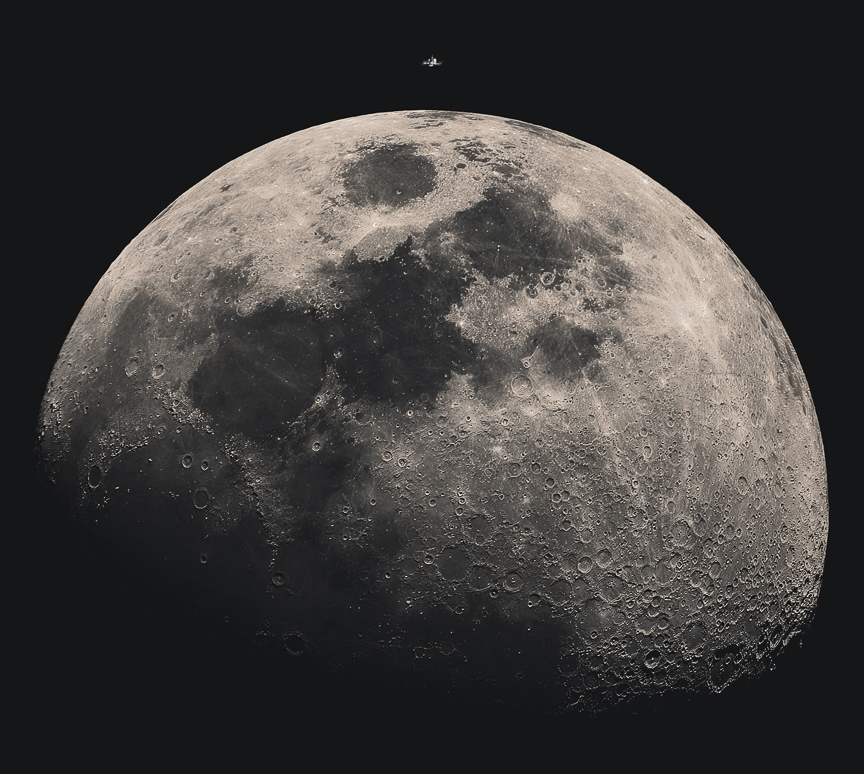
Our Space Home Photobombs the Moon!

Disclosure: This post contains affiliate links. As an Amazon Associate, I earn from qualifying purchases.

The Full Story

Imagine looking up at the night sky, ready to enjoy the serene glow of the Moon, when suddenly a distinct, intricate silhouette zips across its face. No, you haven't spotted an alien spacecraft! What you're witnessing in this remarkable image is our very own International Space Station (ISS) as it performs a 'transit' – meaning it passes directly in front of – the Moon. These breathtaking moments are incredibly fleeting, requiring precise timing and a dash of luck to capture, reminding us of the dynamic dance happening constantly above our heads. The International Space Station is much more than just a fleeting shadow; it's a colossal, orbiting laboratory, larger than a football field, and home to astronauts from around the world. Whizzing around Earth at an incredible speed of 17,500 miles per hour (28,000 km/h), the ISS completes an entire orbit every 90 minutes. That means it sees 16 sunrises and sunsets every single day! For over 25 years, this marvel of engineering has been a continuous human presence in low-Earth orbit, constantly circling our planet and occasionally 'photobombing' familiar celestial objects like Venus, Mars, Saturn, and even the Sun. But the ISS isn't just for cosmic photobombs; it's a bustling hub of scientific discovery. Thousands of unique experiments, led by researchers from over one hundred countries, have been conducted aboard this microgravity marvel. From growing protein crystals in low-gravity conditions – research that continues to inform new medical treatments here on Earth – to studying how plants grow in space, recycling water, and monitoring human health in extreme environments, the station is constantly expanding our understanding of life both on and off our planet. Each experiment brings us closer to solving earthly challenges and prepares us for the next great leaps in space. The vital research conducted on the ISS isn't just about curious exploration; it's about preparation. Many of the studies on human health, plant growth, and life support systems are directly supporting NASA's ambitious Artemis missions. These missions aim to return humans to the Moon and eventually establish a sustainable presence there, pushing humanity farther into deep space than ever before. The knowledge gained from living and working on the ISS is fundamental to understanding how we can safely and effectively explore destinations like Mars, making the Moon a crucial stepping stone. So, while capturing a perfect ISS transit across the Moon might require specialized equipment and careful planning, spotting the ISS with your own eyes is surprisingly easy! On a clear night, away from city lights, you can often see it as a bright, fast-moving 'star' gliding silently across the sky. Several websites and apps can tell you exactly when and where to look for this incredible outpost of human ingenuity. Next time you're out, take a moment to look up and wave – you might just catch a glimpse of our orbital home.

Key Takeaways

  • 1 The image shows the International Space Station (ISS) transiting the Moon, a rare and fleeting celestial alignment.
  • 2 The ISS is an international orbiting laboratory that has hosted thousands of experiments over 25 years, contributing to both earthly advancements and space exploration.
  • 3 Research on the ISS is crucial for supporting future deep-space missions, like NASA's Artemis program, which aims to return humans to the Moon and eventually Mars.
Hubble Space Telescope Deep Field Poster

Hubble Space Telescope Deep Field Poster

Stunning poster featuring iconic Hubble Space Telescope imagery. Perfect for space enthusiasts.

Check Price on Amazon
*As an Amazon Associate, we earn from qualifying purchases.

💡 Think of it this way:

Think of it like a tiny, super-fast airplane zooming across the face of a distant full moon – a blink-and-you'll-miss-it celestial ballet.

How We Know This

Capturing an image like this requires incredible precision and timing. Astrophotographers use specialized telescopes and high-speed cameras, meticulously planning their shots based on predicted ISS transit paths provided by organizations like NASA. It's about being in the exact right place at the exact right moment as the ISS zips across the face of a celestial object, often for less than a second.

What This Means

The ISS continues to be an unparalleled platform for global collaboration, scientific discovery, and technological innovation. Its ongoing research is not only improving life on Earth through medical and environmental breakthroughs but is also laying the essential groundwork for humanity's long-term presence in space, from lunar settlements to eventual missions to Mars and beyond. It represents our collective dream of exploration and progress.

Why It Matters

The ISS is humanity's orbital laboratory, where vital research happens daily that impacts life on Earth, from new medicines to sustainable living, all while paving the way for our next great leaps to the Moon and Mars.

Related Topics

#ISS #Space Exploration #Moon #Astrophotography #Space Science