Back to Articles Image Of The Day

Cosmic Oyster Nursery: Witnessing Infant Stars in a Neighbor Galaxy

πŸ“– 4 min read πŸ“Š beginner 🏷️ NASA APOD

In Brief

Astronomers are captivated by a stunning image of NGC 602, a vibrant star cluster nestled within the Small Magellanic Cloud. This 5-million-year-old stellar nursery is surrounded by its birth clouds, creating a cosmic vista that remarkably resembles an oyster holding luminous pearls.
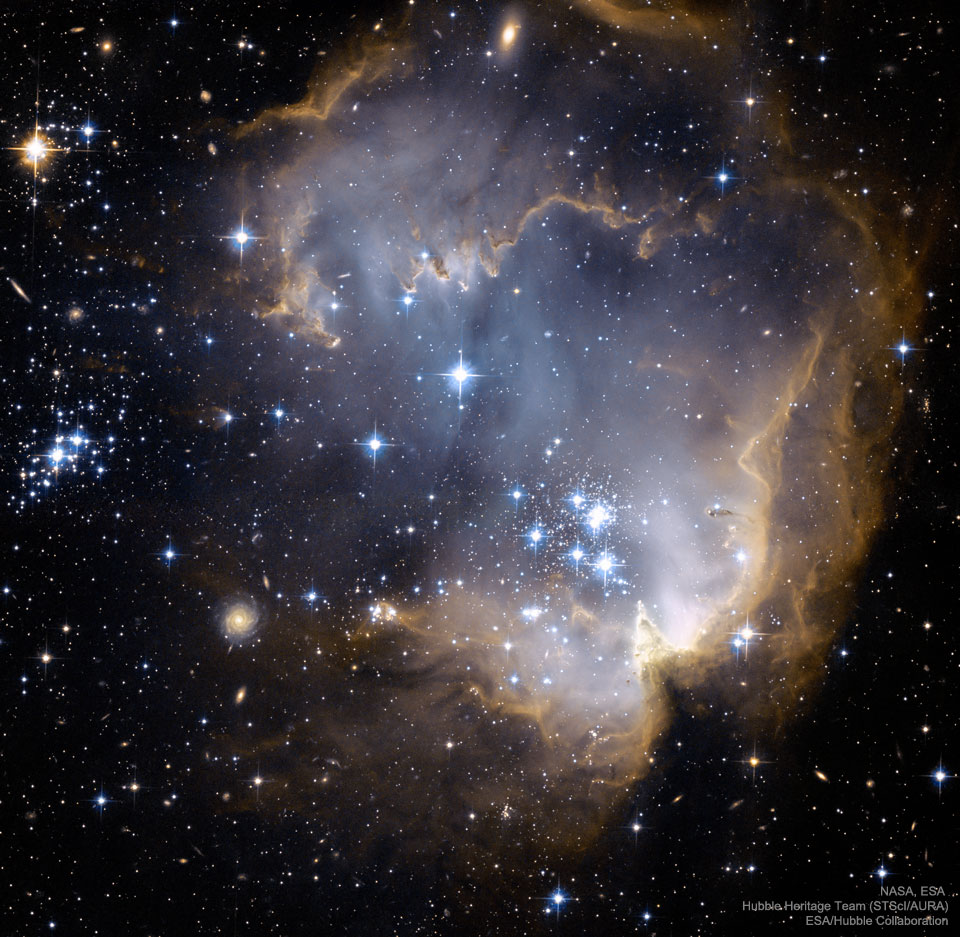
Cosmic Oyster Nursery: Witnessing Infant Stars in a Neighbor Galaxy

Disclosure: This post contains affiliate links. As an Amazon Associate, I earn from qualifying purchases.

The Full Story

Peering far beyond our familiar Milky Way galaxy, astronomers have captured a mesmerizing image of NGC 602, a stellar nursery radiating with the glow of millions of newborn stars. Located within the Small Magellanic Cloud, one of our galaxy's closest cosmic neighbors, this cluster is a vibrant testament to the universe's ongoing process of creation. The surrounding clouds of gas and dust, which gave birth to these stars, paint a picture so vivid, it’s been likened to an oyster cradling its luminous pearls. NGC 602 is a remarkably young star cluster, at only about 5 million years old. To put that in perspective, our own Sun is a middle-aged star at 4.6 billion years old! These 'baby' stars are still deeply embedded within the very material from which they formed – dense clouds of hydrogen gas and cosmic dust. As these young, massive stars ignite, their powerful radiation and stellar winds sculpt their surroundings, pushing away the remaining gas and dust to create the dramatic shapes we see. This process is essential for understanding how stars and eventually planets come into being across the cosmos. The Small Magellanic Cloud (SMC) itself is a fascinating object. It's a dwarf irregular galaxy, one of two satellite galaxies (along with the Large Magellanic Cloud) that orbit our Milky Way, roughly 200,000 light-years away. Unlike the elegant spiral arms of our galaxy, the SMC has a more chaotic, shapeless structure. This makes it an invaluable cosmic laboratory for studying star formation in an environment different from our own, potentially revealing universal principles of stellar birth and evolution that apply across diverse galactic settings. Why is observing such a distant, youthful cluster so important? By studying regions like NGC 602, scientists gain crucial insights into how stars form in different types of galaxies and how these newly born stars influence their surroundings. These observations help us refine our models of galaxy evolution, understand the lifecycle of stars, and trace the cosmic ingredients that eventually form everything we see, including ourselves. It’s like watching a real-time documentary of the universe's construction site, providing clues about our own cosmic origins. The brilliant colors captured in images of NGC 602 are not just beautiful; they are scientific data. Different colors represent different elements and energies, allowing astronomers to map out the distribution of gas, dust, and the temperature of the stars. This intricate detail, captured by powerful telescopes, helps scientists piece together the complex story of how a seemingly chaotic cloud of matter can coalesce under gravity's influence to ignite the brilliant engines we call stars.

Key Takeaways

  • 1 NGC 602 is a very young star cluster (5 million years old) actively forming stars.
  • 2 It's located in the Small Magellanic Cloud, a dwarf galaxy orbiting our Milky Way.
  • 3 The cluster and its surrounding gas and dust resemble a cosmic oyster with luminous pearls.
  • 4 Studying NGC 602 helps astronomers understand star formation and galaxy evolution in different cosmic environments.
National Geographic Planisphere Star Finder

National Geographic Planisphere Star Finder

Essential tool for identifying constellations and stars. Perfect for beginners learning the night sky.

Check Price on Amazon
*As an Amazon Associate, we earn from qualifying purchases.

πŸ’‘ Think of it this way:

Imagine a giant cosmic oyster, its shell made of glowing gas and dust, cradling brilliant baby stars as if they were precious pearls, just beginning their journey in the vast ocean of space.

How We Know This

Astronomers use advanced space telescopes, like those operated by NASA, to capture light from these incredibly distant celestial objects. These powerful instruments collect light across various wavelengths (visible, infrared, ultraviolet), allowing scientists to create stunning, detailed images that reveal the intricate structures of gas, dust, and the brilliant glow of newborn stars, providing a window into processes hundreds of thousands of light-years away.

What This Means

Continued study of star-forming regions like NGC 602 will deepen our understanding of stellar nurseries, allowing us to refine our models of how stars and planetary systems are born. This knowledge is crucial for understanding the overall evolution of galaxies, how heavy elements are forged and distributed across the universe, and ultimately, our place within the grand cosmic narrative. It helps us piece together the universe's past and predict its future.

Why It Matters

This breathtaking view offers a close-up look at star formation in a nearby galaxy, helping us understand how stars like our Sun are born and how galaxies evolve over cosmic time. It's a window into the universe's processes, revealing our origins.

Related Topics

#Star Formation #Galaxy Evolution #Small Magellanic Cloud #Star Clusters #Cosmic Nurseries