Cosmic Crash: Two Galaxies Lock in a Grand Dance of Destruction and Creation
In Brief
Sixty million light-years away, two immense galaxies are locked in a spectacular collision, a slow-motion cosmic ballet known as the Antennae Galaxies. While individual stars rarely crash, the gravitational forces and gas clouds are violently stirring, sparking a frenzy of new star birth across the merging celestial bodies.
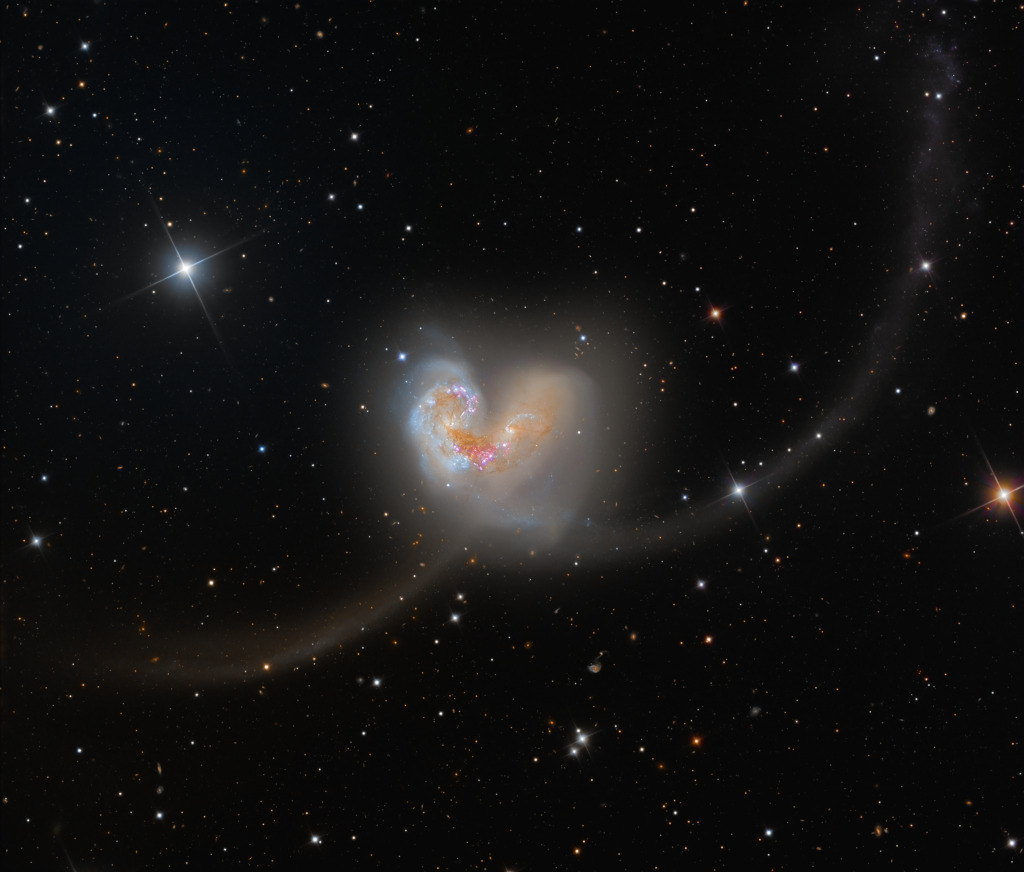
The Full Story
Key Takeaways
- 1 Two galaxies, the Antennae, are colliding 60 million light-years away.
- 2 During galactic collisions, stars rarely hit, but gravity, gas, and dust violently interact.
- 3 This interaction triggers massive bursts of new star formation, creating brilliant stellar nurseries.
- 4 The galaxies will eventually merge into one larger galaxy, a common process in the universe.
💡 Think of it this way:
Imagine two incredibly slow-moving, giant clouds of glitter and fog gently passing through each other. The individual glitter specs (stars) almost never hit, but the clouds themselves (gas, dust, gravity) merge and churn, creating dazzling new patterns and sparks (new stars).
How We Know This
Astronomers use powerful telescopes, like those in space such as the Hubble Space Telescope, to capture the light emitted by these distant galaxies. By observing this light, which has traveled for millions of years to reach us, scientists can analyze the structures, gas content, and star formation rates within the Antennae Galaxies, even witnessing a 'snapshot' of the collision as it was 60 million years ago.
What This Means
Studying the Antennae Galaxies provides crucial insights into how galaxies evolve and grow through mergers, influencing their shape, size, and star-forming activity. This helps us understand the past of the cosmos and predict the future of our own galaxy, offering a window into the dynamic and ever-changing nature of the universe. It also advances our knowledge of star formation in extreme environments.
Why It Matters
This incredible galactic collision offers us a rare peek into the fundamental processes that shape the universe, including how galaxies grow, evolve, and even form new stars. By studying events like this, scientists can better understand the ultimate fate of our own Milky Way galaxy and its future merger with Andromeda.