Back to Articles Image Of The Day

Gravity's Funhouse Mirror: Black Holes Warp a Nearby Nebula

📖 3 min read 📊 beginner 🏷️ NASA APOD

In Brief

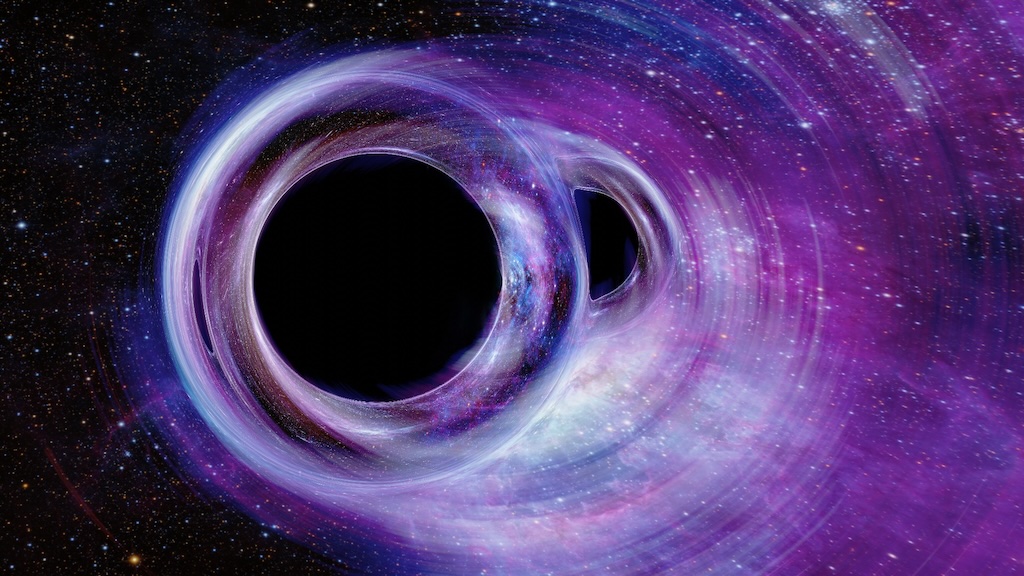
An incredible new visualization shows what a black hole merger would look like if it happened near the famous Tarantula Nebula. Black holes might be invisible, but their immense gravity bends and distorts light, turning the nebula into a cosmic funhouse mirror. This artistic rendering helps us understand how these unseen giants warp the fabric of space and time.
Gravity's Funhouse Mirror: Black Holes Warp a Nearby Nebula

Disclosure: This post contains affiliate links. As an Amazon Associate, I earn from qualifying purchases.

The Full Story

Black holes are some of the most mysterious objects in our universe – regions of spacetime where gravity is so strong that nothing, not even light, can escape. This fundamental property makes them invisible to our telescopes, yet astronomers know they exist, and they play a crucial role in shaping galaxies. So, how do we study something we can't directly see? We look for their effects on everything around them. The featured visualization offers a stunning answer, combining advanced simulations with an actual image of the beautiful Tarantula Nebula. It illustrates a hypothetical scenario: two black holes locked in a final, frantic 'death-dance' before merging into one colossal entity. While such an event isn't currently happening in the Tarantula Nebula, this artwork helps scientists and the public alike visualize the extreme physics involved in such a cosmic ballet. One of the most dramatic ways black holes reveal their presence is through a phenomenon called gravitational lensing. Just as a glass lens can focus or distort light, a black hole's immense gravity warps the fabric of spacetime, bending the path of light rays that pass nearby. In this visualization, the background of the Tarantula Nebula, with its glowing gas and dust, becomes a canvas for this distortion. What we see are the nebula's familiar shapes stretched, smeared, and even duplicated, creating bizarre patterns known as Einstein rings and multiple images, much like looking through a warped window or a funhouse mirror. The Tarantula Nebula itself is a massive star-forming region located in the Large Magellanic Cloud, a dwarf galaxy orbiting our own Milky Way, about 160,000 light-years away. This might sound incredibly distant, but in cosmic terms, it's remarkably 'close to home' – over a thousand times nearer than any binary black hole merger detected so far by gravitational wave observatories. While the chances of detecting a black hole merger actually happening *that* close are incredibly slim, imagining it here makes the science far more relatable. This visualization is more than just a pretty picture; it's a powerful tool. By taking complex mathematical models of general relativity – Einstein's theory of gravity – and turning them into an accessible image, scientists can better understand the extreme environments around black holes. It helps us prepare for future observations and interpret the subtle clues we gather from gravitational waves, which are ripples in spacetime caused by such mergers, giving us a 'sound' rather than a 'sight' of these cataclysmic events. Ultimately, this imaginative depiction bridges the gap between the invisible and the comprehensible, transforming abstract scientific concepts into a breathtaking cosmic spectacle. It reminds us that even without seeing them directly, black holes are powerful architects of the universe, capable of twisting light and space in ways that continually challenge our imagination.

Key Takeaways

  • 1 Black holes are invisible but detectable by their extreme gravitational effects on light and spacetime.
  • 2 Gravitational lensing causes black holes to warp the light from background objects, creating distorted views, like a cosmic funhouse mirror.
  • 3 This visualization combines black hole merger simulations with an image of the Tarantula Nebula to illustrate these powerful phenomena.
  • 4 The Tarantula Nebula, though 160,000 light-years away, is 'close' compared to previously detected black hole mergers, making this a relatable scenario.
  • 5 Visualizations help scientists and the public understand complex astrophysics and prepare for future discoveries.
Hubble Space Telescope Deep Field Poster

Hubble Space Telescope Deep Field Poster

Stunning poster featuring iconic Hubble Space Telescope imagery. Perfect for space enthusiasts.

Check Price on Amazon
*As an Amazon Associate, we earn from qualifying purchases.

💡 Think of it this way:

Imagine placing a heavy bowling ball on a stretched trampoline. Light, like marbles rolling across the trampoline, would curve dramatically around the bowling ball. That's a simplified way to picture how a black hole's immense gravity bends light around it.

How We Know This

This captivating image is an illustration, not a direct photograph. It combines two main elements: highly complex computer simulations and real astronomical photography. Scientists use Einstein's theory of general relativity to mathematically model how black holes interact and how their gravity distorts light. These simulations generate the distorted view of the nebula. This simulated view is then seamlessly merged with an actual astrophotography image of the Tarantula Nebula, providing a scientifically informed yet artistic representation of a hypothetical event.

What This Means

Visualizations like this are crucial for making complex astrophysics accessible to a wider audience, sparking curiosity about the universe. For scientists, they serve as powerful tools to explore and understand the extreme physics governing black holes and spacetime, improving our ability to interpret data from gravitational wave detectors and other observatories. As our technology advances, these visual aids help us anticipate what we might 'see' or 'hear' from future, more distant cosmic events, even if a merger in our cosmic backyard remains a fantastic dream.

Why It Matters

This visualization helps us grasp the incredible, mind-bending power of black holes and how they twist reality itself. It offers a captivating, albeit hypothetical, front-row seat to one of the most extreme events in the universe, making abstract physics tangible and visually stunning for everyone.

Related Topics

#Black Holes #Gravitational Lensing #Tarantula Nebula #Astrophysics #Space Art