Back to Articles Image Of The Day

Unveiling Titania: Uranus's Giant Moon Hides a Violent Past and Potential Ocean

📖 3 min read 📊 beginner 🏷️ NASA APOD

In Brief

Meet Titania, Uranus's largest moon, a massive 'dirty iceball' with a scarred surface hinting at a turbulent history. Recent insights suggest this icy world might even harbor hidden oceans beneath its frozen crust.
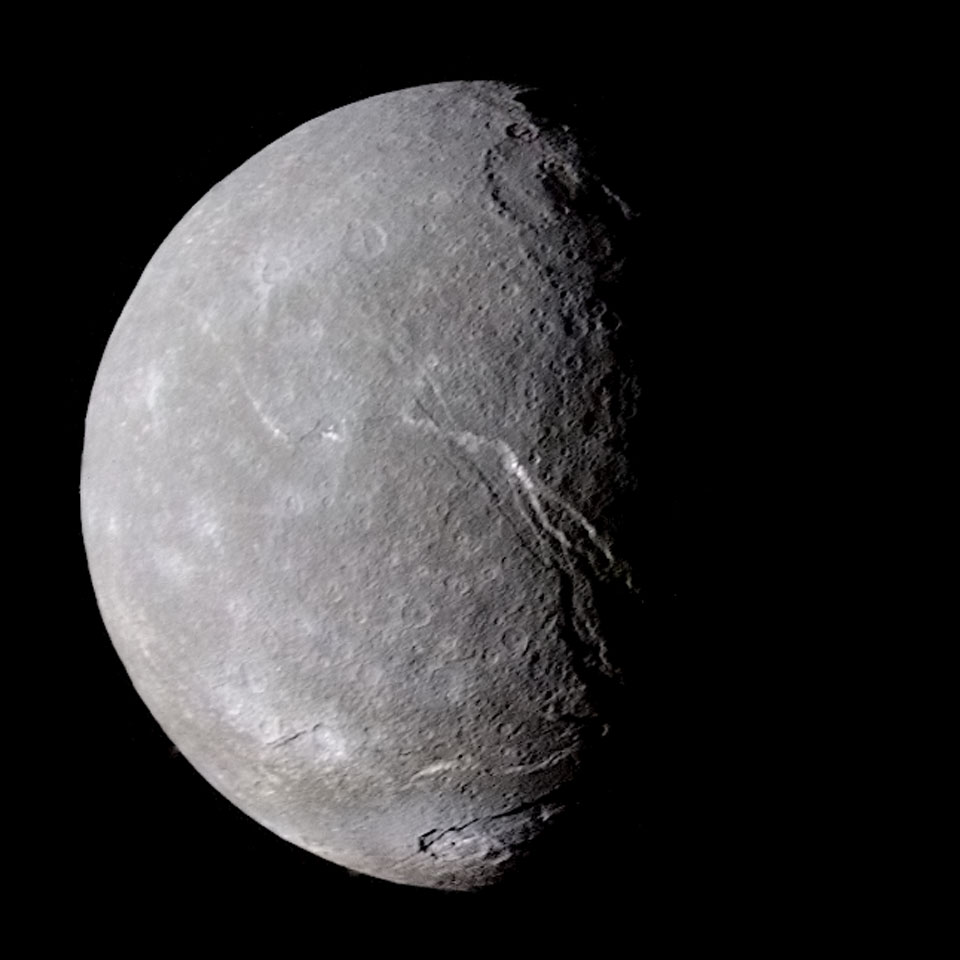
Unveiling Titania: Uranus's Giant Moon Hides a Violent Past and Potential Ocean

Disclosure: This post contains affiliate links. As an Amazon Associate, I earn from qualifying purchases.

The Full Story

Deep within our solar system, orbiting the distant ice giant Uranus, lies Titania – its largest and most mysterious moon. Our first close-up look at this intriguing world came in 1986, when NASA's intrepid robot spacecraft, Voyager 2, whizzed past, capturing images of a landscape unlike any we know. Titania's surface is a 'tortured terrain,' scarred with a dramatic mix of colossal canyons, towering cliffs, and ancient impact craters, hinting at a very eventful past. Those deep gashes and trenches crisscrossing Titania's surface are particularly fascinating. Scientists have noticed they bear a striking resemblance to features found on Ariel, another of Uranus's moons. This similarity strongly suggests that Titania endured a violent geological event long ago. The leading theory? It's believed that water, freezing and expanding deep within the moon's interior, caused immense pressure, much like water freezing in a pipe. This immense internal force could have literally cracked and pulled apart Titania's icy crust, leaving behind the dramatic scars we see today. While Titania holds the title of Uranus's largest moon, it's still quite a bit smaller than some of its lunar cousins. For perspective, it's only about half the size of Triton, Neptune's biggest moon, which itself is slightly smaller than Earth's own Moon. Discovered way back in 1787 by astronomer William Herschel, Titania is fundamentally a 'dirty iceball' – a cosmic mixture composed of roughly half water-ice and half rock. This blend gives it a unique density and internal structure. Perhaps the most exciting recent speculation about Titania concerns what might be hidden beneath its frozen exterior. Scientists now theorize that internal heat, generated by the decay of radioactive elements within its rocky core, could be melting some of that underground ice. This process might be creating vast, hidden oceans of liquid water deep beneath Titania's surface. Such 'ocean worlds' are incredibly exciting to astrobiologists, as liquid water is considered a prime ingredient for life. These tantalizing clues from Titania transform it from just another distant moon into a prime target for future exploration. Understanding its violent past helps us piece together the formation and evolution of moons in the outer solar system. And the possibility of underground oceans makes Titania, along with other icy moons, a compelling candidate in the search for extraterrestrial life, or at least environments that could support it. Each new insight from Titania pushes the boundaries of our knowledge, showing us that even in the coldest, most distant corners of our solar system, incredible secrets await discovery.

Key Takeaways

  • 1 Titania's surface features, like deep trenches, suggest a violent past likely caused by internal water freezing and expanding.
  • 2 Uranus's largest moon is a 'dirty iceball' made of half water-ice and half rock, discovered in 1787.
  • 3 New speculation suggests radioactive heating could melt underground ice into hidden liquid water oceans.
Hubble Space Telescope Deep Field Poster

Hubble Space Telescope Deep Field Poster

Stunning poster featuring iconic Hubble Space Telescope imagery. Perfect for space enthusiasts.

Check Price on Amazon
*As an Amazon Associate, we earn from qualifying purchases.

💡 Think of it this way:

Imagine a giant ice cube cracking and shifting as water freezes and expands inside it – Titania's ancient scars tell a similar story, but on a cosmic scale, shaping its surface over eons.

How We Know This

Our initial understanding of Titania's surface comes from images captured by NASA's Voyager 2 spacecraft during its 1986 flyby. Scientists then analyze these images, comparing features with other moons and using computer models to infer internal processes like the freezing and expansion of water or the generation of heat from radioactive decay. This allows them to piece together its geological history and potential current state.

What This Means

The potential for liquid water oceans on Titania, an 'ice giant' moon, expands our understanding of where water, and potentially life, could exist beyond Earth. This discovery strengthens the case for future missions to the Uranus system to investigate these moons further, providing crucial data for understanding planetary formation and the search for habitable environments in the outer solar system.

Why It Matters

Studying moons like Titania helps us understand how planets and their companions form, evolve, and if they could potentially host liquid water – a key ingredient for life – in unexpected places across our solar system.

Related Topics

#Titania #Uranus #Moons #Voyager 2 #Ocean Worlds